


Cart
0
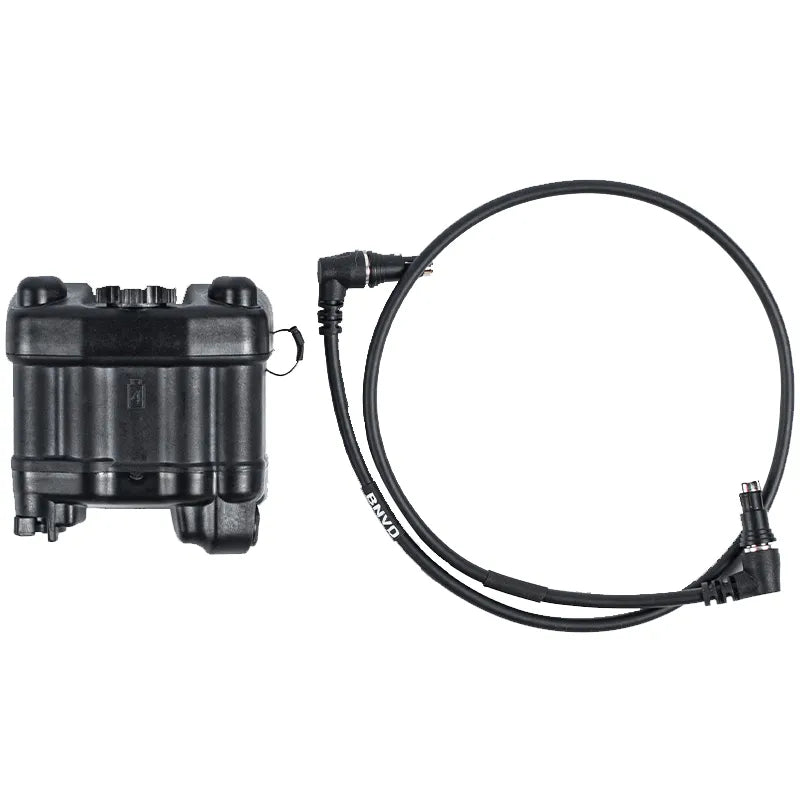
A night vision battery pack looks like a simple accessory and is not. The pack that ships with our binocular and panoramic combo sets does three separate jobs, and in our experience most owners only ever use the first of them. This article covers the whole specification: what the pack powers and for how long, why it doubles as a counterweight, what the infrared beacon is actually for, how to route the cable so it survives contact with a helmet, and what to do when the knob comes off in a bag.
What it is
The Universal Strobe Battery Pack is a helmet-mounted unit holding four AA cells that feeds the goggle over a Fischer connector. It mounts at the rear of the helmet, which is also where it performs its second job as a counterweight. Its third job is an infrared beacon.
Three functions in one housing is unusual, and it is why the pack costs more than a battery box.
Job one: runtime
All of our housings run on a single internal AA and all of them accept the external pack. The runtime difference is the reason the pack exists at all.
| Housing | Internal AA | External pack |
|---|---|---|
| BNVD-1431 MK2 | more than 15 hours | more than 50 hours |
| PVS-31 | 15 hours or more | 50 hours or more |
| PNVG-18 | no internal cell | 30 hours or more |
| PVS-14 | 50 hours or more | not required |
The monocular is the outlier. A PVS-14 already runs 50 hours or more on a single AA, so a pack adds weight and cable without adding much endurance. On the binoculars, one internal cell gives you two nights and the pack gives you a week. On the four-tube panoramic goggle the pack is not optional: it is the only power source, the housing draws 2.2 to 3.4 volts, and there is no cell in the goggle at all.
Job two: the beacon
The pack carries a 360 degree omnidirectional infrared beacon, invisible to the naked eye, strobing at 72 flashes per minute plus or minus five.
That rate is the point of it. Under night vision, a steady infrared source looks like every other infrared source: a vehicle marker, a security illuminator, a discarded light. A source blinking at a known rate identifies a person at a glance across a field or a treeline. If a group runs the same pack, everyone blinks at the same rate and the pattern becomes a team signature.
Two practical notes. The beacon sits at the back of the head, which means the people behind you can see it and the people in front of you cannot, which is usually the intent. And it is infrared only, so it does nothing for anyone without night vision.
Job three: the counterweight
A four-tube panoramic goggle is 800 grams or less, plus a mount of 145 grams or less. An articulating binocular is 500 to 580 grams depending on lens choice. All of that mass hangs in front of your face on a lever arm, and your neck pays for it.
Four AA cells and the pack body at the rear of the helmet move the centre of mass back toward the crown. It will not fully balance a quad, but it converts "my neck aches after twenty minutes" into "my neck aches after two hours", and a counterweight pouch on top of the pack closes more of the gap.
This is worth stating plainly because it changes the buying decision. If you own a binocular and think you do not need a pack because your runtime is adequate, you may still want one for balance alone.
ARGUS Universal Strobe Battery Pack
The cable, and how not to break it
The pack talks to the goggle over a Fischer connector. The right-angle version keeps the plug flat against the housing so it does not catch on a sling, a strap or a door frame.
The operating rule is simple and comes straight from the panoramic goggle's own manual: align the marker on the plug with the socket, push straight in, never pull on the cable, and never force it. The strain relief at the plug is the first thing to fail on a cable that has been yanked out by the wire rather than the connector body, and once the strain relief goes the conductors follow within a few uses.
Route the cable from the rear of the helmet, along the shell, down to the goggle, with enough slack that flipping the goggle up does not tension it. If the cable is taut at flip-up, it is either too short or routed wrong, and it will fail at the plug.
Right-angle Fischer power supply cable
Cells: what to use and what not to mix
Four AA cells, alkaline or lithium. Do not mix new and old, and do not mix chemistries or brands, because the weakest cell sets the pack's behaviour under load.
Lithium AA cells are the better choice for cold weather and for long storage, holding voltage far more consistently under load than alkaline; the manufacturer's Energizer L91 lithium AA datasheet shows the difference across temperature clearly. For comparison, some competing packs use CR123 lithium cells instead, which have a different voltage and discharge profile documented in the Energizer 123 datasheet; this is why packs are not interchangeable across systems even when the connector matches.
One habit prevents the most expensive avoidable failure in this whole category: take the cells out before storage. A leaked AA inside the pack destroys the contacts and turns an accessory into a replacement.
When the knob comes off
The rotary knob takes the impact when a helmet rolls off a bag or a bench. If the knob or its retaining hardware is damaged, note the revision from the label and contact us for the matching part rather than improvising.
Do not run the pack with a loose knob. A switch that cannot be positively turned off will quietly drain four cells inside a closed case, and you will find out on the night you needed them.
Cold weather, briefly
Cold does two things to a pack. It reduces available capacity, sharply with alkaline cells and far less with lithium. And it stiffens the cable, which makes the plug more vulnerable to a snag because the cable no longer flexes out of the way.
Plan for both: run lithium below freezing, and leave slightly more slack in the cable than you would in summer.
Which pack for which mount
The pack is designed alongside our lightweight mount, and that combination is what ships in the combo sets. Running a different mount does not stop the pack working; it only changes the cable routing and where the counterweight effect lands. The rest of the helmet-side hardware, including mounts, protective covers and pouches, sits in our night vision accessories range.
Choosing a night vision battery pack for your setup
Treat power, mount and counterweight as one decision rather than three purchases.
Work out your realistic session length first, because that decides whether an internal cell is genuinely sufficient. A four-hour evening on a binocular does not need a pack for runtime. A multi-night trip does, and a panoramic goggle needs one regardless.
Then look at the goggle's weight, because that decides whether you need rear mass irrespective of runtime. Anything above roughly 500 grams on the front of a helmet benefits from a counterweight, and a pack is a counterweight that also does something useful.
Then choose cable length and routing to suit your helmet, because a cable that is too long snags and one that is too short fails at the plug.
Troubleshooting a pack that seems dead
Three checks, in order, resolve almost every reported pack failure.
First, test the goggle on its own internal cell. If it works, the fault is in the pack, the cable or the connection, not the goggle. If it does not, the pack was never the problem.
Second, inspect the plug and the socket. A bent pin, a grain of grit or a partially seated connector all produce intermittent power that looks like a failing pack.
Third, replace all four cells with a fresh matched set rather than testing them individually. A cell that reads correctly on a meter can still collapse under load, and mixed cells hide the problem.
If all three pass and the pack is still dead, the switch or the internal wiring is the likely cause, and that is a repair rather than a field fix.
Sizing the setup as a whole
Treat power, mount and counterweight as one decision rather than three purchases.
Work out your realistic session length first, because that decides whether an internal cell is genuinely sufficient. Then look at the goggle's weight, because that decides whether you need rear mass regardless of runtime. Then choose the cable length and routing to suit your helmet, because a cable that is too long snags and one that is too short fails at the plug.
Buyers who do this in order end up with a setup that works on the first night. Buyers who add a pack later usually end up buying a second cable as well.
Frequently Asked Questions
Do I need a night vision battery pack if my goggle has an internal battery?
It depends on the housing and on how long your sessions are. A monocular already runs 50 hours or more on a single AA, so a pack adds little. A binocular goes from around 15 hours to more than 50. A four-tube panoramic goggle has no internal cell at all and requires the pack.
What is the infrared beacon on the pack for?
Identification. It strobes at 72 flashes per minute plus or minus five, which under night vision distinguishes a person from every steady infrared source in the scene. It sits at the rear of the helmet, so people behind you see it and people in front do not. It is invisible without night vision.
Can I mix battery brands or chemistries in the pack?
No. The weakest cell sets the behaviour of the whole pack under load, so mixing new with old, or alkaline with lithium, gives you the runtime of the worst cell. Use four matched cells and take them out before long storage.
Why do Fischer cables fail so often?
Almost always because they were unplugged by pulling the cable rather than the connector body, which destroys the strain relief. Route the cable with enough slack that flipping the goggle up does not tension it, and always pull the plug itself.
Does the pack really help with neck strain?
Yes, though it does not eliminate it. Four cells and the pack body at the rear of the helmet shift the centre of mass back toward the crown, which measurably extends how long a front-heavy goggle stays comfortable. A counterweight pouch on top of the pack closes more of the gap.


