
Cart
0
Introduction
When comparing night vision devices, most buyers focus on obvious specifications such as resolution, FOM, SNR, white phosphor, green phosphor, or Gen 2 vs Gen 3 tubes.
However, one important feature is often misunderstood:
Auto-gating.
You may see terms like:
-
Auto-gated night vision
-
Non-gated image intensifier tube
-
Auto-gated Gen 3 tube
-
Bright light protection
-
Automatic brightness control
But what does auto-gated night vision actually mean?
Is it really better than non-gated night vision?
And is it worth paying more for an auto-gated tube?
In this guide, the team at ARGUS Night Vision explains the real difference between auto-gated and non-gated night vision, how each system performs, and what buyers should consider before choosing a night vision device.
What Is Auto-Gated Night Vision?
Auto-gated night vision refers to an image intensifier tube that can rapidly regulate the power supplied to the tube when lighting conditions change.
In simple terms, an auto-gated tube can react extremely quickly when exposed to sudden bright light.
This allows the night vision device to maintain a more stable image in environments where lighting is constantly changing.
Examples include:
-
Urban areas with streetlights
-
Vehicle headlights
-
Muzzle flashes
-
Flashlights
-
Indoor-to-outdoor transitions
-
Mixed-light tactical environments
Instead of becoming heavily washed out or overwhelmed, an auto-gated tube helps control the image and reduce the impact of bright light exposure.
What Is Non-Gated Night Vision?
Non-gated night vision uses a more traditional image intensifier design without the same rapid power regulation capability.
A non-gated tube can still produce a bright and usable image in low-light conditions.
However, it may struggle more when exposed to sudden or intense light sources.
In stable darkness, a high-quality non-gated tube can still perform well.
But in dynamic lighting conditions, it may show more:
-
Blooming
-
Image washout
-
Halo around bright lights
-
Temporary loss of detail
-
Slower recovery after bright exposure
This is why auto-gating is often preferred for professional and tactical applications.
How Does Auto-Gating Work?
To understand auto-gating, it helps to first understand how an image intensifier tube works.
A night vision image intensifier tube collects available light, converts photons into electrons, amplifies those electrons, and then converts them back into a visible image on a phosphor screen.
Auto-gating controls the power supplied to key parts of this process.
When bright light enters the device, the tube rapidly adjusts its operation to reduce overload.
This happens so quickly that the user usually does not notice the switching process.
The result is a more controlled image with better performance under changing light conditions.
Think of auto-gating like an advanced light management system inside the tube.
It does not make the device immune to damage, but it helps the tube handle bright light more effectively than a non-gated system.
Auto-Gated vs Non-Gated: Quick Comparison
| Feature | Auto-Gated Night Vision | Non-Gated Night Vision |
|---|---|---|
| Bright light handling | Better | Weaker |
| Image stability | More stable | Less stable |
| Urban performance | Stronger | More limited |
| Tube protection | Better | Basic |
| Low-light performance | Excellent with quality tubes | Can still be good |
| Cost | Higher | Lower |
| Professional use | Recommended | Less ideal |
| Beginner-friendly | Yes, but more expensive | Yes, more affordable |
Bright Light Performance
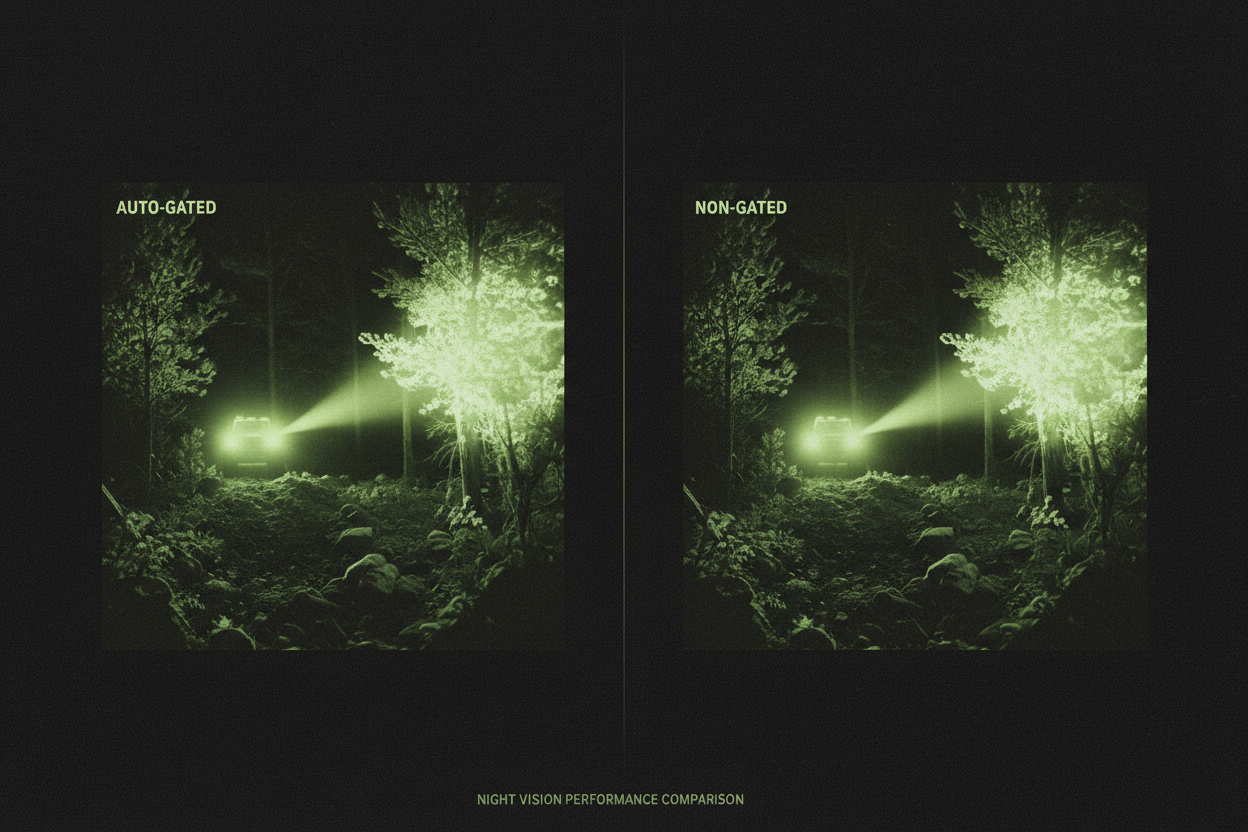
The biggest difference between auto-gated and non-gated night vision appears when bright light enters the scene.
With non-gated night vision, bright light can cause the image to bloom or wash out.
For example, if a vehicle headlight appears in the field of view, a non-gated tube may temporarily lose detail around the light source.
With auto-gated night vision, the tube reacts faster and helps maintain a more usable image.
This is especially valuable in:
-
Urban environments
-
Tactical operations
-
Law enforcement work
-
Vehicle movement
-
Training environments
-
Mixed indoor and outdoor use
Winner: Auto-gated night vision
Image Stability
Auto-gated tubes generally provide a more stable viewing experience when lighting conditions change.
This matters because real-world environments are rarely perfectly dark.
Even in nighttime operations, users may encounter:
-
Reflections
-
Flashlights
-
Building lights
-
Car lights
-
IR illuminators
-
Weapon-mounted lights
Auto-gating helps reduce sudden brightness spikes and allows the user to maintain better visual awareness.
Non-gated tubes may still perform well in open rural areas or natural darkness, but they are less adaptable when light conditions shift quickly.
Winner: Auto-gated night vision
Tube Protection
One of the most common questions buyers ask is:
Does auto-gating protect my night vision tube?
The answer is yes, but with an important limitation.
Auto-gating can help reduce stress on the tube during bright light exposure.
It can also help the tube recover faster after encountering sudden light.
However, auto-gating does not mean the device can be used carelessly.
Users should still avoid unnecessary exposure to intense light sources such as:
-
Direct sunlight
-
Lasers
-
Powerful flashlights at close range
-
Prolonged exposure to bright artificial lighting
Auto-gating improves protection, but it is not a guarantee against damage.
Winner: Auto-gated night vision
Performance in Very Dark Environments
In very dark environments, the difference between auto-gated and non-gated night vision may be less noticeable.
If there are no bright light sources and the environment is consistently dark, tube quality becomes more important than gating.
Important specifications include:
-
SNR
-
FOM
-
Resolution
-
EBI
-
Halo
-
Photocathode sensitivity
A high-quality non-gated tube may outperform a low-quality auto-gated tube in certain low-light conditions.
This is why buyers should not judge a night vision device based on auto-gating alone.
Winner: Depends on tube quality
Auto-Gated Night Vision and Urban Use
Auto-gated night vision is especially useful in urban environments.
Cities and developed areas contain many artificial light sources, including:
-
Streetlights
-
Windows
-
Vehicle headlights
-
Security lights
-
Reflective surfaces
-
Electronic displays
These light sources can create sudden brightness changes that challenge traditional night vision tubes.
Auto-gated systems help manage these changes more effectively.
For users operating around buildings, vehicles, roads, or mixed lighting, auto-gating can make a major difference in comfort and usability.
Winner: Auto-gated night vision
Auto-Gated Night Vision and Tactical Applications
For military, law enforcement, and professional security users, auto-gating is often considered an important feature.
Tactical environments can shift rapidly between darkness and bright light.
Examples include:
-
Muzzle flash
-
Flashbang exposure
-
Vehicle lights
-
Room clearing
-
IR illuminators
-
Team lighting systems
In these conditions, the ability to maintain a usable image is critical.
Auto-gated tubes help users keep better visual control during sudden changes in brightness.
This can improve:
-
Situational awareness
-
Reaction time
-
Target recognition
-
Movement confidence
-
Operational safety
Winner: Auto-gated night vision
Auto-Gated vs Automatic Brightness Control
Auto-gating is often confused with automatic brightness control.
They are related, but they are not the same thing.
Auto-Gating
Auto-gating rapidly controls tube operation to manage changing light conditions and reduce the impact of bright light exposure.
Automatic Brightness Control
Automatic brightness control adjusts image brightness to keep the viewing experience comfortable for the user.
In simple terms:
Auto-gating helps manage the tube’s response to light.
Automatic brightness control helps manage what the user sees.
Both features can work together, but they are different technologies.
Auto-Gated vs Manual Gain
Manual gain is another feature buyers often confuse with auto-gating.
Manual gain allows the user to adjust image brightness manually.
This can be helpful when the user wants more control over the viewing experience.
For example, reducing gain can make the image more comfortable in brighter environments.
However, manual gain is not the same as auto-gating.
Manual gain is user-controlled.
Auto-gating is tube-level light management.
A night vision device can have manual gain, auto-gating, both, or neither, depending on its design.
Does Auto-Gating Improve Image Quality?
Auto-gating does not automatically mean a tube has better resolution, higher FOM, or better SNR.
Instead, auto-gating improves image control and stability under changing light conditions.
A high-quality auto-gated tube can deliver excellent image quality.
But a poor-quality auto-gated tube may still perform worse than a premium non-gated tube in certain conditions.
When evaluating image quality, buyers should still review:
-
Resolution
-
SNR
-
FOM
-
EBI
-
Halo
-
Tube blemishes
-
Phosphor type
-
Overall tube grade
Auto-gating is important, but it is only one part of the full performance picture.
Is Auto-Gated Night Vision Worth It?
For many users, yes.
Auto-gated night vision is worth considering if you:
-
Operate in mixed lighting
-
Use night vision in urban environments
-
Need professional-grade performance
-
Want better bright light handling
-
Value image stability
-
Want better protection for your tube
However, non-gated night vision may still be suitable if you:
-
Have a limited budget
-
Use night vision mostly in rural darkness
-
Need a basic observation device
-
Are buying entry-level equipment
-
Do not frequently encounter bright lights
The right choice depends on your environment and mission requirements.
Who Should Choose Auto-Gated Night Vision?
Auto-gated night vision is recommended for:
-
Military users
-
Law enforcement teams
-
Professional security users
-
Search and rescue teams
-
Tactical trainers
-
Serious night vision enthusiasts
-
Users operating around vehicles or buildings
For demanding applications, auto-gating offers better control, better adaptability, and better overall confidence.
Who Can Use Non-Gated Night Vision?
Non-gated night vision can still be useful for:
-
Casual observation
-
Wildlife viewing
-
Rural outdoor use
-
Entry-level users
-
Budget-conscious buyers
-
Backup night vision equipment
If the environment is consistently dark and there are few bright light sources, a non-gated device may still provide acceptable performance.
The ARGUS Night Vision Perspective
At ARGUS Night Vision, we believe buyers should choose night vision equipment based on real operating conditions, not just specification labels.
Auto-gated night vision offers clear advantages in bright-light management, image stability, and professional usability.
For users who operate in urban, tactical, or unpredictable environments, auto-gating is strongly recommended.
However, tube quality still matters.
A complete evaluation should include:
-
Auto-gating
-
SNR
-
FOM
-
Resolution
-
EBI
-
Halo
-
Phosphor type
-
Housing quality
-
Mounting system
When these factors are properly balanced, users get a night vision system that performs reliably in real-world conditions.
Final Thoughts
Auto-gated and non-gated night vision devices can both provide useful low-light performance, but they are not equal in demanding environments.
Auto-gated tubes offer better performance when lighting conditions change quickly.
They help reduce image washout, improve visual stability, and provide better tube protection during exposure to bright light.
Non-gated tubes may still be suitable for basic use, especially in stable dark environments, but they are less capable in mixed-light or professional scenarios.
For users seeking dependable performance, especially in urban, tactical, or mission-critical conditions, auto-gated night vision is usually the better choice.
Understanding this difference can help you choose the right night vision device for your needs and invest in equipment that performs when it matters most.