
Cart
0
Introduction
When choosing a night vision image intensifier tube, most buyers compare technical specifications first.
They look at:
-
FOM
-
SNR
-
Resolution
-
EBI
-
Halo
-
Gain
-
Auto-gating
-
Gen 2+ vs Gen 3
-
MX10160 vs MX11769
These numbers matter.
But during long-duration night vision use, another factor becomes important:
Phosphor color.
The two common options many buyers compare are P43 green phosphor and P45 white phosphor.
Both can produce effective night vision images.
Both can be used in professional and recreational night vision systems.
Both can be found in monocular and binocular devices.
But they feel different to the user.
For short sessions, the difference may seem small.
For long-duration operations, the difference can affect eye comfort, perceived contrast, fatigue, scene interpretation, and user preference.
In this guide, we explain the difference between P43 green phosphor and P45 white phosphor, how each affects eye strain and contrast, and which one may be better for long night vision sessions.
If you are comparing tube options, start with the Image Intensifier Tube collection.
What Is Phosphor in Night Vision?
Inside an image intensifier tube, amplified electrons strike a phosphor screen.
That phosphor screen produces the visible image the user sees.
The phosphor type affects the color and appearance of the image.
Common night vision phosphor types include:
-
P43 green phosphor
-
P45 white phosphor
-
P22 green phosphor
-
Other phosphor variants depending on tube type and manufacturer
The phosphor does not work alone.
The final image also depends on:
-
Tube generation
-
FOM
-
SNR
-
Resolution
-
EBI
-
Halo
-
Gain
-
Lens quality
-
Device alignment
-
Lighting conditions
-
User eyesight
Phosphor color is important, but it should not be the only factor in your buying decision.
For broader tube specification education, read What Is FOM in Night Vision? Understanding Image Intensifier Tube Specs.
What Is P43 Green Phosphor?
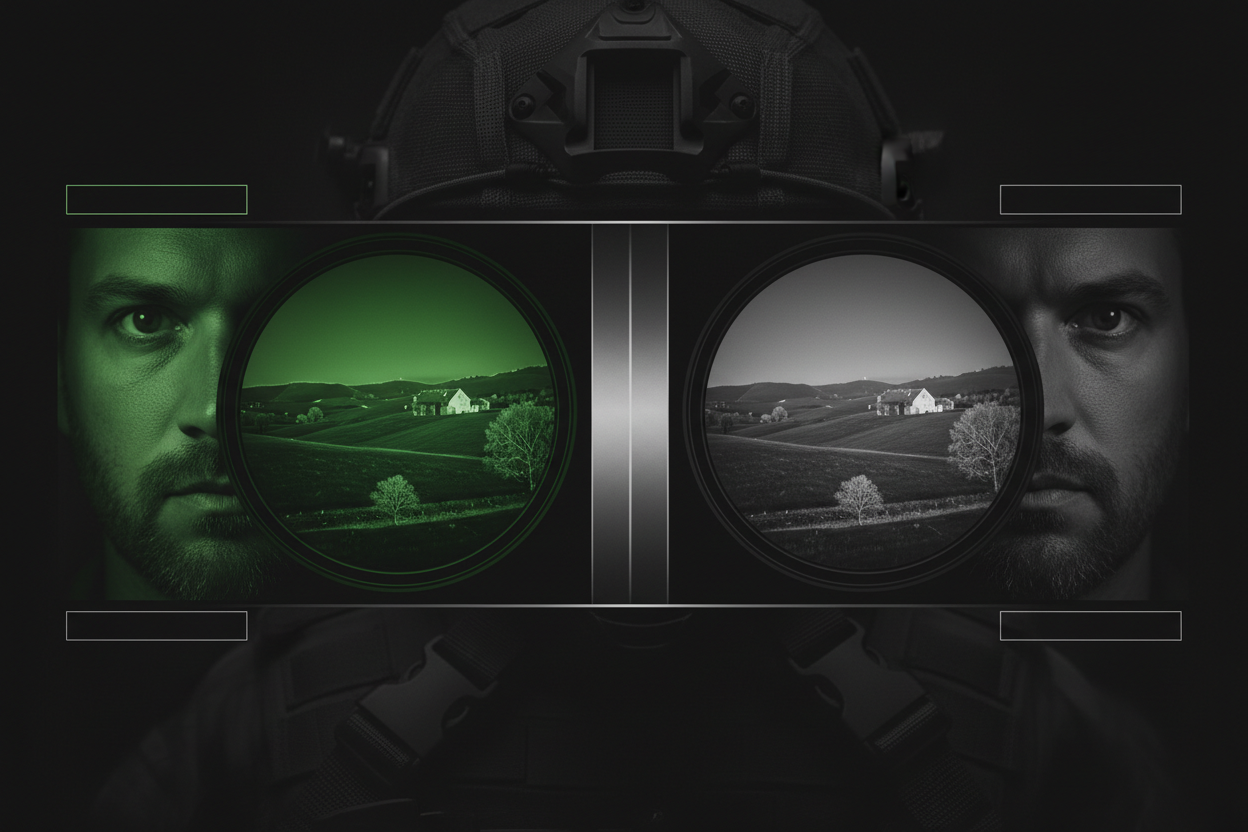
P43 green phosphor produces a green night vision image.
Green phosphor is the classic night vision look most people associate with traditional NVGs.
For decades, green phosphor was widely used because the human eye is highly sensitive to green light, and green images can be efficient for visual detection.
P43 green phosphor may appeal to users who want:
-
Traditional night vision appearance
-
Strong perceived brightness
-
Familiar image tone
-
Classic military-style NVG image
-
Good target visibility
-
Often lower cost depending on tube model
-
A proven visual format
ARGUS has real P43 product options such as PVS-31 NNVT GEN3 FOM1800+ P43 MX10160, PVS-14 NNVT GEN3 FOM1800+ P43 MX10160, and BNVD-1431 MK2 NNVT GEN3 FOM1800+ P43 AUTOGATE MX10160.
What Is P45 White Phosphor?
P45 white phosphor produces a grayscale or black-and-white style night vision image.
Instead of a green image, the user sees a more neutral image with shades of white, gray, and black.
P45 white phosphor has become popular because many users find it more natural and easier to interpret during longer viewing sessions.
P45 white phosphor may appeal to users who want:
-
More natural grayscale image
-
Better perceived contrast
-
Easier scene interpretation
-
Reduced color fatigue for many users
-
More modern viewing experience
-
Better comfort during extended use
-
Strong preference for detail recognition
ARGUS has real P45 product options such as PVS-31 NNVT GEN3 FOM1800+ P45 MX10160, PVS-31 NNVT GEN3 FOM2000+ P45 MX10160, and PVS-31 NNVT NVT7 GEN2+ FOM1800-2000+ AUTOGATE P45 MX10160.
P43 vs P45: Quick Comparison
| Feature | P43 Green Phosphor | P45 White Phosphor |
|---|---|---|
| Image color | Green | White / gray |
| Traditional look | Strong | Less traditional |
| Perceived brightness | Often feels bright | Often feels cleaner |
| Perceived contrast | Good | Often preferred by many users |
| Long-duration comfort | User-dependent | Often preferred for long sessions |
| Scene interpretation | Familiar but green-tinted | More natural grayscale |
| Eye strain | Can be comfortable for some users | Often considered easier for extended viewing |
| Cost | May be lower depending on product | Often higher depending on product |
| Best for | Traditional NVG users, budget-conscious buyers, users who prefer green | Long-duration users, contrast-focused users, users who prefer grayscale |
The best choice is not universal.
Some users strongly prefer green.
Others strongly prefer white.
The right choice depends on use case, tube quality, and personal visual comfort.
Eye Strain: Why Long-Duration Use Changes the Decision
For short night vision sessions, both green and white phosphor can work well.
But for longer operations, comfort becomes more important.
Long-duration night vision use may involve:
-
Multiple hours under NVGs
-
Helmet-mounted movement
-
Scanning terrain
-
Watching for movement
-
Working around vehicles
-
Operating in mixed lighting
-
Search and rescue
-
Security tasks
-
Wildlife observation
-
Training sessions
-
Tactical movement
During extended use, users may become more sensitive to:
-
Image noise
-
Phosphor tone
-
Brightness level
-
Contrast
-
Focus quality
-
Tube mismatch
-
Eye dominance
-
Helmet positioning
-
Diopter adjustment
P45 white phosphor is often preferred by users who want a more natural grayscale image over long viewing periods.
However, some users still prefer the familiarity and perceived brightness of P43 green phosphor.
There is no substitute for looking through both if possible.
Why P45 White Phosphor Often Feels More Natural
P45 white phosphor is popular because the grayscale image can feel closer to normal visual interpretation.
The user is not constantly processing a strong green image.
Instead, the scene appears in shades of gray.
This can help with:
-
Terrain recognition
-
Object separation
-
Shadow interpretation
-
Contrast perception
-
Long-session comfort
-
Reading shapes and edges
-
Reducing visual fatigue for many users
This is one reason many modern buyers prefer white phosphor for helmet-mounted NVGs and binocular systems.
For broader tube buying guidance, read The Ultimate Buyer’s Guide: NNVT Gen2+ vs. Gen3 Night Vision Image Intensifier Tubes.
Why P43 Green Phosphor Still Has Advantages
Green phosphor is not outdated simply because white phosphor is popular.
P43 green phosphor can still be effective and comfortable for many users.
Its advantages may include:
-
Familiar traditional night vision image
-
Strong perceived brightness
-
Proven field use history
-
Good visibility for many eyes
-
Often lower price depending on tube and system
-
Strong preference among users trained on green systems
For some users, green phosphor feels more immediately “bright” or “alive” in the image.
For users with prior experience on green NVGs, P43 may feel more familiar and easier to trust.
The best phosphor is partly technical and partly personal.
Contrast: P43 vs P45 in Real Viewing
Contrast is one of the biggest reasons buyers compare P43 and P45.
P45 white phosphor often gives users a stronger sense of grayscale separation.
This can make it easier to distinguish:
-
Terrain changes
-
Edges
-
Shadows
-
Rocks
-
Tree lines
-
Buildings
-
Vehicles
-
Human shapes
-
Movement
P43 green phosphor can still provide good contrast, but the entire scene is filtered through green.
Some users find green easy to read.
Others find white phosphor easier to interpret, especially during long sessions.
However, contrast is not only about phosphor color.
It also depends on SNR, resolution, EBI, gain, halo, tube cosmetics, and lens quality.
A high-quality P43 tube may outperform a lower-quality P45 tube.
A high-quality P45 tube may outperform a lower-quality P43 tube.
Do not choose by phosphor color alone.
Eye Strain Is Not Only About Phosphor
Phosphor color affects comfort, but it is not the only reason users experience eye strain.
Eye strain can also come from:
-
Poor diopter adjustment
-
Incorrect interpupillary distance
-
Bad helmet positioning
-
Tube mismatch in binocular systems
-
Poor collimation
-
Excessive brightness
-
Image noise
-
Low SNR
-
Poor lens quality
-
Edge distortion
-
Dirty lenses
-
Long viewing without breaks
If your night vision device feels uncomfortable, do not assume phosphor color is the only cause.
Start by checking focus, diopter, helmet fit, and optical alignment.
For lens-related image comfort issues, read What Causes Distortion in NVGs? The Difference Between Aspherical and Spherical Lenses.
P43 vs P45 for Monocular Night Vision
A monocular system such as a PVS-14 gives night vision to one eye while the other eye remains unaided.
In monocular use, phosphor preference can be very personal.
Some users like green phosphor because it creates a strong visual separation between the aided and unaided eye.
Others prefer white phosphor because the grayscale image feels more natural and less fatiguing.
Choose P43 green phosphor for a monocular if:
-
You like traditional night vision
-
You prefer green image tone
-
You want a familiar military-style appearance
-
Budget is an important factor
-
You are comfortable with green during long use
Choose P45 white phosphor for a monocular if:
-
You want a more natural image
-
You prioritize eye comfort
-
You prefer grayscale contrast
-
You use the device for long sessions
-
You want a modern viewing experience
For PVS-14 options, see PVS-14 NNVT GEN3 FOM1800+ P43 MX10160.
For platform comparison, read PVS-14 vs PVS-31: Which Night Vision Device Is Right for You?.
P43 vs P45 for Binocular NVGs
In binocular night vision systems, comfort becomes even more important.
Both eyes are looking through image intensifier tubes.
That means phosphor tone, brightness, tube matching, and collimation all matter.
For binocular NVGs, P45 white phosphor is often preferred by users who want long-duration viewing comfort and natural scene interpretation.
However, P43 green phosphor can still be a good choice for users who prefer the classic green image or want a specific product configuration.
For binocular systems, the bigger issue is consistency.
Both tubes should be matched in:
-
Phosphor type
-
Brightness
-
Gain
-
SNR
-
FOM
-
Resolution
-
Halo
-
EBI
-
Image tone
-
Tube cosmetics
A poorly matched binocular system can cause more discomfort than the phosphor color itself.
You can compare binocular options such as PVS-31 NNVT GEN3 FOM1800+ P43 MX10160 and PVS-31 NNVT GEN3 FOM1800+ P45 MX10160.
P43 vs P45 for Long-Duration Operations
Long-duration operations change the buying logic.
During short observation, most users can adapt to either phosphor color.
During multi-hour use, small comfort differences become more noticeable.
P45 white phosphor may be better for users who:
-
Wear NVGs for hours
-
Need better perceived contrast
-
Prefer grayscale scene interpretation
-
Want reduced visual fatigue
-
Use binocular NVGs
-
Perform search, security, training, or patrol tasks
-
Need to scan continuously
P43 green phosphor may be better for users who:
-
Prefer classic green NVG image
-
Are trained on green phosphor systems
-
Want strong perceived brightness
-
Want a lower-cost option when available
-
Use NVGs for shorter sessions
-
Prefer visual separation between green NVG image and unaided vision
The best choice is the one you can use longer with less fatigue.
P43 vs P45 in Tactical Use
For tactical users, phosphor choice should be evaluated alongside tube performance.
Important tactical specs include:
-
Auto-gating
-
Halo
-
SNR
-
EBI
-
Gain
-
Resolution
-
Tube format
-
Housing durability
-
Lens quality
-
Helmet balance
-
Battery life
P45 white phosphor may help with contrast and long-duration comfort.
P43 green phosphor may still be effective for users who prefer a traditional image.
But for tactical use, auto-gating and low-light performance may matter more than phosphor color alone.
A P45 non-gated low-SNR tube may not be better than a strong P43 autogated Gen3 tube.
Compare the full system.
For tactical tube behavior, read Gated vs. Non-Gated Image Intensifiers: Why Autogate Matters for Tactical Night Operations.
P43 vs P45 for Search and Rescue
Search and rescue work often involves long scanning sessions.
Users may need to identify shapes, movement, heat sources with support equipment, terrain changes, and human outlines.
For SAR-style viewing, many users may prefer P45 white phosphor because grayscale contrast can feel easier to interpret over time.
However, if the user is already trained on green phosphor, P43 may still feel faster and more familiar.
For search work, phosphor color should be considered together with:
-
Tube sensitivity
-
SNR
-
Low-light performance
-
Lens clarity
-
Helmet comfort
-
Battery planning
-
Thermal support if needed
If thermal detection is also part of the setup, read Clip-On Thermal Imagers Explained.
P43 vs P45 for Hunting and Wildlife Observation
For hunting and wildlife observation where legal, phosphor preference is usually personal.
P45 white phosphor may help users interpret terrain and animal shapes more naturally.
P43 green phosphor may feel brighter and more familiar.
The decision depends on:
-
Viewing duration
-
Ambient light
-
Terrain
-
User eyesight
-
Tube grade
-
Device type
-
Whether thermal is also used
-
Local laws and regulations
For long observation sessions, comfort should matter just as much as raw brightness.
Does P45 Always Reduce Eye Strain?
No.
P45 white phosphor is often preferred for long viewing, but it is not guaranteed to reduce eye strain for every user.
Some users still prefer green.
Eye strain may come from:
-
Incorrect focus
-
Poor tube matching
-
Excessive gain
-
Poor helmet setup
-
Bad collimation
-
Low SNR
-
Dirty lenses
-
Long continuous use
-
User vision differences
If possible, compare P43 and P45 in person before buying.
If not possible, P45 is often the safer choice for buyers who prioritize natural image interpretation and long-duration comfort.
Does P43 Have Better Contrast?
Not necessarily.
P43 green phosphor can appear bright and high-visibility, especially to users accustomed to green NVGs.
But many users perceive P45 white phosphor as having better usable contrast because grayscale separation feels more natural.
However, true contrast depends heavily on tube quality.
A tube with better SNR, cleaner optics, and stronger performance can outperform another tube regardless of phosphor type.
When comparing P43 and P45, always compare similar tube levels.
For example, do not compare a high-spec Gen3 P43 tube against a low-spec Gen2+ P45 tube and assume the difference is only phosphor color.
Cost Considerations
In many cases, white phosphor systems may cost more than comparable green phosphor systems.
But price depends on:
-
Tube generation
-
Tube grade
-
FOM
-
SNR
-
Auto-gating
-
Housing
-
Device type
-
Tube availability
-
Product configuration
P43 green phosphor may be attractive for users who want good performance at a lower price.
P45 white phosphor may be worth the added cost for users who value long-session comfort and contrast.
Do not choose only by price.
Choose by total value.
Common Buyer Mistakes
Mistake 1: Choosing Only by Color
Phosphor color matters, but tube specs matter more.
Mistake 2: Assuming White Is Always Better
P45 is popular, but some users still prefer P43.
Mistake 3: Ignoring Tube Matching
In binocular systems, mismatched tubes can cause more fatigue than phosphor color.
Mistake 4: Ignoring SNR
Low SNR can cause noisy images and eye fatigue regardless of phosphor type.
Mistake 5: Forgetting Auto-Gating
For mixed-light use, autogating may matter more than phosphor color.
Mistake 6: Not Adjusting Diopter Correctly
Poor focus can make any phosphor type uncomfortable.
How to Choose Between P43 and P45
Choose P43 green phosphor if:
-
You prefer traditional green night vision
-
You are trained on green systems
-
You like strong perceived brightness
-
Budget is important
-
You use NVGs for shorter sessions
-
You want a familiar classic image
Choose P45 white phosphor if:
-
You want a more natural grayscale image
-
You prioritize long-duration comfort
-
You prefer perceived contrast
-
You use binocular NVGs
-
You scan for long periods
-
You want a modern viewing experience
In simple terms:
P43 is the classic choice.
P45 is the comfort-focused modern choice.
But the actual tube specs still matter more than phosphor color alone.
Where to Compare P43 and P45 Night Vision Options
Useful pages include:
Related guides:
-
What Is FOM in Night Vision? Understanding Image Intensifier Tube Specs
-
The Ultimate Buyer’s Guide: NNVT Gen2+ vs. Gen3 Night Vision Image Intensifier Tubes
-
Gated vs. Non-Gated Image Intensifiers: Why Autogate Matters for Tactical Night Operations
-
Spec Breakdown: NNVT Gen2+ NVT5 vs NVT7 – Which Tube Should You Choose?
-
What Causes Distortion in NVGs? The Difference Between Aspherical and Spherical Lenses
Final Thoughts
P43 green phosphor and P45 white phosphor can both be effective for night vision use.
P43 green phosphor offers the classic night vision image, strong familiarity, and a traditional viewing experience.
P45 white phosphor offers a more modern grayscale image that many users prefer for perceived contrast and long-duration comfort.
For short sessions, either can work well.
For long-duration operations, P45 white phosphor is often the more comfortable choice for many users.
But phosphor color is only one part of the decision.
Before choosing a tube, compare the full specification:
-
FOM
-
SNR
-
Resolution
-
EBI
-
Halo
-
Auto-gating
-
Tube format
-
Tube cosmetics
-
Housing compatibility
-
Lens quality
A high-quality P43 tube can outperform a weak P45 tube.
A high-quality P45 tube can outperform a weak P43 tube.
The best choice is not simply green or white.
The best choice is the tube that gives you the clearest, most comfortable, and most useful image for your real operating environment.