
Cart
0
Introduction
When choosing a night vision device for serious field use, most buyers compare the obvious specifications first.
They look at:
-
FOM
-
SNR
-
Resolution
-
EBI
-
Halo
-
White phosphor vs green phosphor
-
Gen 2+ vs Gen 3
-
Monocular vs binocular NVGs
These specifications matter.
But for tactical night operations, one feature deserves special attention:
Autogating.
A gated image intensifier tube can react quickly to changing light conditions, helping the night vision image stay more controlled when exposed to sudden brightness.
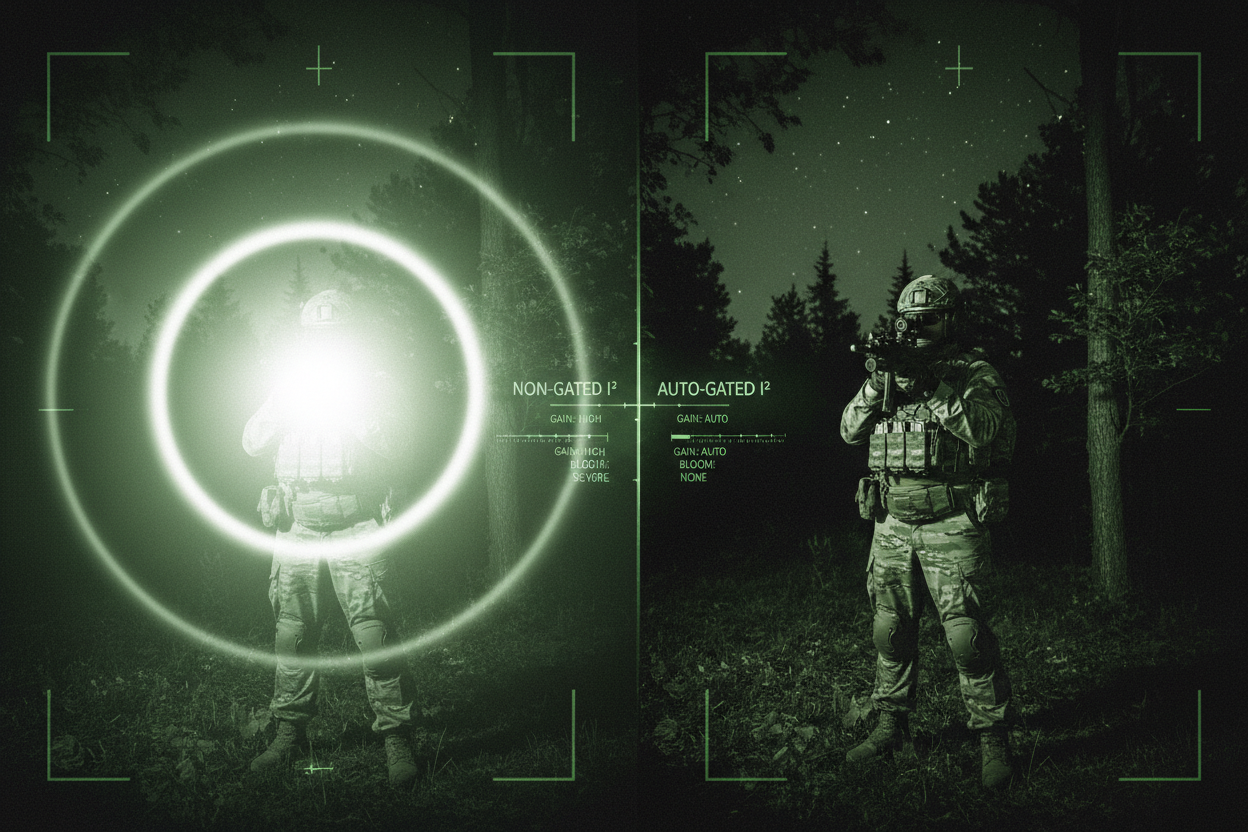
A non-gated image intensifier tube can still work well in stable darkness, but it may struggle more when the environment includes streetlights, vehicle headlights, flashlights, muzzle flash, IR illuminators, or other changing light sources.
In this guide, we explain the real difference between gated and non-gated image intensifiers, why autogate matters in tactical night operations, and how buyers should evaluate this feature when choosing a night vision system.
For a broader beginner-friendly version of this topic, read Auto-Gated vs Non-Gated Night Vision: What’s the Real Difference?.
What Is a Gated Image Intensifier?
A gated image intensifier is a night vision tube designed to rapidly regulate its operation when light conditions change.
This is often called:
-
Autogated night vision
-
Auto-gated image intensifier
-
Gated tube
-
Autogate tube
-
Bright light management tube
In simple terms, autogating helps the tube react when the scene suddenly becomes brighter.
This can happen when the user encounters:
-
Streetlights
-
Vehicle headlights
-
Flashlights
-
Weapon lights
-
IR illuminators
-
Muzzle flash
-
Building lights
-
Reflections
-
Urban lighting
-
Indoor-to-outdoor transitions
Instead of allowing the image to wash out heavily, a gated tube helps regulate brightness and maintain a more usable image.
This is one reason autogated tubes are widely preferred for tactical, law enforcement, and professional night vision use.
What Is a Non-Gated Image Intensifier?
A non-gated image intensifier is a tube that does not have the same rapid gating function.
It can still amplify available light and produce a usable night vision image.
In stable low-light environments, a good non-gated tube can still perform well.
For example, non-gated tubes may be useful for:
-
Casual observation
-
Rural outdoor use
-
Wildlife viewing
-
Budget-conscious setups
-
Entry-level night vision
-
Stable dark environments
However, non-gated tubes are less capable when light conditions change quickly.
In mixed-light environments, they may show more:
-
Blooming
-
Halo around lights
-
Temporary washout
-
Image instability
-
Reduced contrast
-
Slower recovery after bright exposure
This difference becomes more important during tactical night operations.
Gated vs Non-Gated: Quick Comparison
| Feature | Gated Image Intensifier | Non-Gated Image Intensifier |
|---|---|---|
| Bright light handling | Better | More limited |
| Image stability | Stronger in mixed light | Better in stable darkness |
| Tactical use | Strongly preferred | Less ideal |
| Urban use | Better | More likely to bloom or wash out |
| Tube protection | Better light management | More basic |
| Cost | Usually higher | Usually lower |
| Beginner use | Good but more expensive | Good for budget setups |
| Best environment | Dynamic lighting | Stable darkness |
The key difference is not whether the tube can see in the dark.
Both can.
The key difference is how well the tube handles light changes.
Why Autogate Matters in Tactical Night Operations
Tactical night operations rarely happen in perfect darkness.
Real environments are dynamic.
Users may move between:
-
Dark outdoor areas
-
Bright roads
-
Vehicles
-
Buildings
-
Flashlight exposure
-
IR illumination
-
Reflective surfaces
-
Lit windows
-
Open fields
-
Urban structures
In these environments, the lighting is constantly changing.
A non-gated tube may still function, but it can become harder to use when bright light enters the scene.
A gated tube helps maintain a more stable image, allowing the user to stay oriented and aware.
This matters because tactical users depend on night vision for more than observation.
They use it for movement, navigation, identification, communication, and decision-making.
A stable image can directly improve user confidence.
Bright Light Exposure: The Main Difference
The biggest advantage of autogated night vision appears around bright light sources.
When a bright light enters the field of view, a non-gated tube may show:
-
A large bloom around the light
-
Reduced detail near the light source
-
Temporary image washout
-
More halo
-
Slower image recovery
A gated tube reacts more quickly.
It helps reduce the intensity of the bright exposure and keeps the image more usable.
This is especially important around:
-
Vehicle headlights
-
White lights
-
Streetlights
-
IR illuminators
-
Muzzle flash
-
Building lights
For users operating in mixed-light environments, autogate is not just a premium feature.
It is a practical advantage.
Autogate and Urban Night Vision
Urban environments are one of the strongest arguments for autogated tubes.
Cities and developed areas are full of artificial light sources.
A user may encounter:
-
Streetlights
-
Vehicle headlights
-
Security lights
-
Storefront lights
-
Lit windows
-
Reflections from glass or metal
-
Electronic screens
-
Flashlights
-
IR sources
These conditions are difficult for basic night vision systems.
A gated image intensifier helps control rapid brightness changes and keeps the image more usable.
This can improve:
-
Movement confidence
-
Visual comfort
-
Threat detection
-
Target recognition
-
Navigation around vehicles
-
Awareness around doorways and windows
If your night vision use includes urban areas, autogating should be a high-priority feature.
Autogate and Vehicle Operations
Vehicle environments can create sudden lighting changes.
Users may encounter:
-
Headlights
-
Brake lights
-
Dashboard lights
-
Interior lights
-
Reflections
-
Road signs
-
Street lighting
-
Other vehicles
-
IR illumination
A non-gated tube may become overwhelmed more easily in these conditions.
A gated tube helps maintain a more controlled image.
This matters for users who need to move around vehicles, observe roads, or operate near traffic or convoy environments.
Autogating does not make night vision safe for all vehicle tasks by itself.
Training, environment, device setup, and local laws still matter.
But from a tube performance perspective, gated image intensifiers are better suited to mixed-light vehicle environments.
Autogate and Muzzle Flash
Muzzle flash is one of the classic examples used when discussing tactical night vision.
A sudden flash can temporarily affect the image.
With a non-gated tube, the flash may create more dramatic blooming or washout.
With a gated tube, the system reacts faster and helps the image recover more efficiently.
This can help preserve:
-
Situational awareness
-
Image stability
-
Visual comfort
-
Faster recovery after sudden brightness
This is one reason autogated tubes are generally preferred for tactical users.
Autogate and IR Illuminators
Many night vision users rely on infrared illuminators in extremely dark conditions.
IR illumination can help improve visibility, but it can also create bright hotspots.
Examples include:
-
Close-range IR bounce
-
Reflective surfaces
-
Strong illuminators
-
Overpowered IR lights
-
White walls or vehicle surfaces reflecting IR
A gated tube can help manage these brightness changes more effectively.
This can make IR illumination easier to use in enclosed or reflective environments.
However, autogate does not replace good IR discipline.
Users should still choose appropriate IR power levels and avoid unnecessary over-illumination.
Does Autogate Protect the Tube?
Autogating can help reduce the stress caused by sudden bright light exposure.
It improves the tube’s ability to manage changing brightness.
However, this does not mean the tube is immune to damage.
Users should still avoid:
-
Direct sunlight exposure
-
Lasers
-
High-power lights at close range
-
Long exposure to intense artificial light
-
Careless daytime use without protection
-
Improper testing in bright environments
Autogate is a protective and performance-enhancing feature, but it is not a license to abuse the tube.
For lens and device protection, read Why You Shouldn’t Skip Lens Protectors: Sacrificial Lenses vs. PVS-31/PVS-14 Rubber Caps.
Autogate vs Manual Gain Control
Autogate and manual gain control are often confused.
They are related to image brightness, but they are different.
Autogate
Autogate is a tube-level function that rapidly regulates tube operation when lighting changes.
It works automatically.
Manual Gain Control
Manual gain allows the user to adjust image brightness manually using a gain control knob or compatible system.
Manual gain is user-controlled.
Autogate is automatic tube-level light management.
A tube may have:
-
Autogate with fixed gain
-
Autogate with manual gain
-
Non-gated operation with manual gain
-
Non-gated operation with fixed gain
If you are comparing tube formats and gain control, read The Truth About Flying Wires vs 3-Pin Tubes: Managing Manual Gain Control.
Autogate vs Automatic Brightness Control
Automatic brightness control is also different from autogating.
Automatic Brightness Control
This helps manage the brightness level shown to the user.
Autogate
This rapidly controls tube operation to handle changing light conditions and reduce the impact of bright exposure.
Both can help with image usability, but they are not the same feature.
When evaluating a night vision tube, check whether the tube is truly autogated instead of assuming that any automatic brightness behavior means autogating.
Does Autogate Improve FOM or SNR?
Autogate does not directly increase FOM, SNR, or resolution.
A gated tube can still have poor specs.
A non-gated tube can still have good specs.
Autogating mainly improves how the tube behaves under changing light.
When choosing an image intensifier tube, still check:
-
FOM
-
SNR
-
Resolution
-
EBI
-
Halo
-
Gain
-
Phosphor type
-
Tube format
-
Tube cosmetics
-
Autogating
-
Warranty
For a full explanation of tube specs, read What Is FOM in Night Vision? Understanding Image Intensifier Tube Specs.
Halo Still Matters
Autogating helps with bright light response, but halo is still an important tube specification.
Halo describes the glow around bright light sources.
A lower halo value usually means less visible glow around lights.
For tactical night operations, halo matters because users may operate around:
-
Streetlights
-
Vehicle lights
-
Flashlights
-
IR illuminators
-
Building lights
A tube with autogating and good halo performance is generally more useful in mixed-light environments than a tube that only has one of those advantages.
Do not evaluate autogating alone.
Evaluate the complete tube specification.
SNR Still Matters
SNR is one of the most important image quality specifications.
A gated tube with low SNR may still look noisy in very dark conditions.
A high-SNR tube generally provides:
-
Cleaner image
-
Better contrast
-
Less grain
-
More comfortable viewing
-
Better low-light detail
For tactical night operations, users often need both:
-
Autogating for changing light
-
Strong SNR for dark environments
A good tactical tube should be balanced.
It should not rely on only one specification.
Gated vs Non-Gated for Gen 2+ Tubes
Many Gen 2+ tubes are available in both gated and non-gated configurations, depending on manufacturer and model.
For example, budget or entry-level Gen 2+ systems may use non-gated tubes to reduce cost.
Higher-grade Gen 2+ tubes may offer autogating.
A non-gated Gen 2+ tube can still be usable for general observation.
But if the user expects tactical, urban, or mixed-light use, autogated Gen 2+ is usually the better choice.
If you are comparing Gen 2+ tube grades, read Spec Breakdown: NNVT Gen2+ NVT5 vs NVT7 – Which Tube Should You Choose?.
You can also compare tube options through the Image Intensifier Tube collection.
Gated vs Non-Gated for Gen 3 Tubes
Gen 3 tubes are often selected for stronger low-light performance.
Many modern Gen 3 tubes also include autogating, especially in professional-oriented configurations.
For users comparing Gen 2+ and Gen 3, the key question should not only be:
Is it Gen 3?
The better question is:
What are the actual tube specifications, and is it autogated?
A good Gen 3 autogated tube can offer strong performance in both dark and mixed-light environments.
A non-gated or lower-spec tube may still have limitations.
For a broader comparison, read The Ultimate Buyer’s Guide: NNVT Gen2+ vs. Gen3 Night Vision Image Intensifier Tubes.
Gated vs Non-Gated for PVS-14 Users
The PVS-14 is one of the most common night vision platforms.
It may be used:
-
Handheld
-
Helmet-mounted
-
As a monocular
-
As a first night vision device
-
As a professional tool
-
As a general observation device
For casual outdoor use in stable darkness, a non-gated tube may be acceptable.
For tactical, urban, or dynamic use, autogating becomes more important.
PVS-14 users who operate around vehicles, buildings, flashlights, or mixed light should strongly consider an autogated tube.
If you are comparing monocular and binocular platforms, read PVS-14 vs PVS-31: Which Night Vision Device Is Right for You?.
Gated vs Non-Gated for PVS-31 and Binocular NVGs
Binocular night vision systems are commonly chosen by users who want better depth perception, comfort, and situational awareness.
In a binocular setup, two tubes must work together.
If one tube handles light differently from the other, the image can feel uneven or uncomfortable.
This is why matching tube behavior matters.
For binocular NVGs, users should consider:
-
Both tubes should be autogated if tactical use is expected
-
Tube brightness should be reasonably matched
-
SNR and FOM should be matched
-
Halo and EBI should be considered
-
Phosphor tone should be consistent
-
Tube cosmetics should not be distracting
For binocular platform guidance, read BNVD-1431 MK2 vs Traditional NVGs: A Comprehensive Review.
You can also browse complete systems in the Night Vision collection.
Tactical Night Operations: Where Autogate Helps Most
Autogate is especially useful in tactical scenarios such as:
Urban Movement
Mixed artificial lighting makes autogating valuable.
Vehicle Areas
Headlights, brake lights, and reflections can overwhelm non-gated tubes.
Building Approaches
Doorways, windows, and interior lighting create rapid brightness changes.
Team Operations
Users may encounter IR illuminators, white lights, and reflective gear.
Search and Rescue
Lighting conditions may change quickly between open areas, vehicles, and buildings.
Security Work
Perimeter lighting and surveillance environments often include bright points.
Training Environments
Ranges and training areas often include flashlights, IR lights, vehicles, and reflective surfaces.
If your night vision use includes any of these environments, autogate should be a serious buying factor.
When Non-Gated Tubes Still Make Sense
Non-gated tubes are not useless.
They may still make sense if:
-
Budget is the top priority
-
Use is mostly casual
-
Lighting conditions are stable
-
The device is used mainly for observation
-
The user avoids urban environments
-
The user does not expect tactical use
-
The tube has otherwise acceptable specs
For example, a budget non-gated tube may be enough for general outdoor viewing under steady darkness.
But for tactical night operations, a non-gated tube is usually less ideal.
The savings may not be worth the reduced bright-light performance.
Should Beginners Choose Autogated Tubes?
For most beginners, autogated tubes are worth considering.
Why?
Because beginners are more likely to encounter mixed lighting without fully understanding how to manage it.
They may accidentally look toward lights, move through urban areas, or use IR illumination too strongly.
Autogating gives the system more flexibility and forgiveness.
However, budget still matters.
A beginner should not only buy the most expensive tube.
They should build a balanced setup with:
-
Suitable tube
-
Good housing
-
Proper optics
-
Stable mount
-
Helmet balance
-
Lens protection
-
Training and safe handling
Autogating is important, but it is one part of the full system.
Common Buyer Mistakes
Mistake 1: Thinking Autogate Means the Tube Cannot Be Damaged
Autogate helps manage light, but it does not make the tube invincible.
Mistake 2: Confusing Manual Gain with Autogate
Manual gain is user brightness control.
Autogate is automatic tube-level light management.
Mistake 3: Ignoring Tube Specs
A gated tube with poor SNR, high EBI, or poor cosmetics may still disappoint.
Mistake 4: Buying Non-Gated for Tactical Use to Save Money
This may reduce cost upfront but limit real-world performance.
Mistake 5: Assuming All Gen 3 Tubes Are Autogated
Always check the specific tube configuration.
Mistake 6: Ignoring Halo
Autogating helps, but halo still matters around bright lights.
How to Choose Between Gated and Non-Gated Tubes
Choose a gated image intensifier if you:
-
Use NVGs for tactical night operations
-
Operate around vehicles
-
Use night vision in urban areas
-
Encounter artificial lighting
-
Use IR illuminators
-
Want better image stability
-
Need better bright light handling
-
Want a more capable long-term system
Choose a non-gated image intensifier if you:
-
Have a limited budget
-
Use night vision casually
-
Operate mostly in stable darkness
-
Do not need tactical performance
-
Want a basic observation device
-
Accept more limitations around bright lights
In simple terms:
Non-gated tubes can work in darkness.
Gated tubes work better when darkness is not perfectly controlled.
Where to Compare Gated and Non-Gated Night Vision Options
If you are comparing night vision tubes and complete systems, these pages may help:
Related guides:
-
Auto-Gated vs Non-Gated Night Vision: What’s the Real Difference?
-
What Is FOM in Night Vision? Understanding Image Intensifier Tube Specs
-
Spec Breakdown: NNVT Gen2+ NVT5 vs NVT7 – Which Tube Should You Choose?
-
The Ultimate Buyer’s Guide: NNVT Gen2+ vs. Gen3 Night Vision Image Intensifier Tubes
-
The Truth About Flying Wires vs 3-Pin Tubes: Managing Manual Gain Control
-
Why You Shouldn’t Skip Lens Protectors: Sacrificial Lenses vs. PVS-31/PVS-14 Rubber Caps
Final Thoughts
Gated and non-gated image intensifiers can both produce usable night vision images.
But they are not equal in demanding environments.
A non-gated tube can work well in stable darkness, especially for casual observation or budget-focused use.
A gated image intensifier offers better control when the environment includes sudden brightness, artificial lighting, IR illumination, vehicle lights, or tactical movement.
That is why autogate matters for tactical night operations.
It helps maintain image stability, improves bright light handling, reduces washout, and gives the user more confidence in unpredictable lighting.
However, autogate is not the only specification that matters.
The best tube choice still depends on FOM, SNR, EBI, halo, resolution, tube format, cosmetics, housing compatibility, and intended use.
For serious tactical night vision, autogating should be treated as a core feature, not a luxury upgrade.
A good autogated tube gives the user a more stable, flexible, and capable night vision system when conditions are not perfectly dark.