
Cart
0

Introduction
Image intensifier tube specifications receive most of the attention when people compare night vision devices.
Buyers carefully study:
-
FOM
-
Signal-to-noise ratio
-
Resolution
-
EBI
-
Halo
-
Autogating
-
Green vs. white phosphor
-
Monocular vs. binocular housings
However, none of those specifications matter when the device has no reliable power.
Battery choice affects more than runtime. It can influence:
-
Cold-weather performance
-
Device weight
-
Helmet balance
-
Battery availability
-
Field replacement
-
Cable management
-
Long-term storage
-
System reliability
The three power options buyers most often encounter are:
-
AA batteries
-
CR123A batteries
-
External battery packs
These are not direct equivalents.
AA and CR123A describe individual battery formats with different voltage and physical characteristics. An external battery pack is a complete power system that may contain several AA cells or another approved battery configuration.
The correct choice depends first on what the night vision device was designed to accept.
Never insert a battery simply because it physically fits.
This guide explains the differences between AA batteries, CR123A batteries and external NVG battery packs, including voltage, cold-weather use, runtime, helmet ergonomics and rechargeable-battery risks.
To compare complete monocular, binocular and panoramic systems, begin with the Night Vision collection.
The Most Important Rule: Follow the Device Specification
Battery selection begins with the night vision housing—not with personal preference.
A housing may be designed for:
-
One AA battery
-
One CR123A battery
-
Either AA or CR123A through different battery caps
-
An external battery pack
-
Onboard power plus external power
-
External power only
The correct voltage, polarity and battery interface are determined by the device’s electrical design.
Using the wrong battery can cause:
-
Failure to power on
-
Unstable operation
-
Reduced runtime
-
Excessive voltage
-
Circuit damage
-
Battery overheating
-
Damage not covered by warranty
Do not assume that one night vision battery can replace another.
A CR123A battery normally provides about twice the nominal voltage of a single AA cell. A rechargeable lithium-ion cell may provide even more voltage than its disposable counterpart.
Always verify:
-
Approved battery size
-
Approved battery chemistry
-
Nominal voltage
-
Polarity
-
External-port compatibility
-
Approved cable or adapter
AA Is a Size, Not a Chemistry
The term AA battery describes a physical battery format.
AA cells are available in several chemistries, including:
-
Alkaline
-
Primary lithium
-
Nickel-metal hydride rechargeable
-
Lithium-ion cells manufactured in an AA-like size
These batteries do not all behave the same way.
Alkaline AA
A standard alkaline AA cell has a nominal voltage of approximately 1.5V.
Advantages include:
-
Wide retail availability
-
Relatively low cost
-
Simple replacement logistics
-
Easy storage in emergency kits
-
Compatibility with many traditional NVG platforms
Disadvantages can include:
-
Reduced performance in severe cold
-
Greater weight than primary lithium AA
-
Voltage decline during discharge
-
Risk of leakage during long storage
-
Less consistent performance under demanding loads
Alkaline AA batteries can be practical for routine use when conditions are moderate and replacements are easy to obtain.
They should not automatically be considered the best option for every environment.
Primary Lithium AA
Primary lithium AA batteries also provide approximately 1.5V, but use a different chemistry from alkaline batteries.
Potential advantages include:
-
Better cold-weather performance
-
Lower weight
-
Long storage life
-
Stable discharge behavior
-
Better performance under demanding loads
-
Reduced leakage risk compared with many alkaline cells
Potential disadvantages include:
-
Higher purchase price
-
Lithium-battery transportation restrictions
-
Less availability in some locations
-
Not rechargeable
For cold-weather operations or long-term emergency storage, manufacturer-approved primary lithium AA cells are often a stronger option than ordinary alkaline AA batteries.
The device must still be rated for the battery type being used.
Why AA Batteries Remain Popular for NVGs
AA batteries are common in night vision because they are easy to source and simple to manage.
A team operating in different regions may be able to find AA batteries at:
-
Convenience stores
-
Hardware stores
-
Supermarkets
-
Outdoor retailers
-
Vehicle supply kits
-
Emergency equipment inventories
This availability can simplify logistics.
The ARGUS PVS-14 NNVT Gen3 FOM2000+ P45 uses one AA battery.
ARGUS binocular platforms such as the BNVD-1431 MK2 housing kit and BNVD-931 housing kit also support one onboard AA battery or compatible external power.
This makes AA-based systems practical for users who want simple onboard power with the option to expand later.
What Is a CR123A Battery?
CR123A is a compact cylindrical lithium battery commonly used in cameras, lights, sensors and some night vision devices.
A typical disposable CR123A cell provides:
-
Approximately 3V nominal voltage
-
Compact dimensions
-
Low weight
-
Broad operating-temperature capability
-
Stable voltage during discharge
-
Good high-current performance
-
Long storage life
A CR123A is shorter and wider than an AA battery.
Its higher nominal voltage allows some devices to operate from a single compact cell where another design might require a different battery arrangement.
However, the higher voltage also means it must never be placed into an AA-only system unless the manufacturer has specifically designed and approved that configuration.
Advantages of CR123A Batteries
Compact Size
CR123A cells can support short, compact battery compartments.
This may help reduce housing length or allow a different control layout.
Low-Temperature Performance
Quality primary CR123A lithium batteries generally perform well in cold environments compared with ordinary alkaline cells.
This makes them attractive for:
-
Winter observation
-
Mountain use
-
Cold-weather patrols
-
Search and rescue
-
Maritime environments
-
Long-term emergency kits
Stable Discharge
CR123A cells normally maintain useful voltage relatively well through much of their discharge cycle.
This can support predictable electronics performance in devices designed around them.
Long Storage Life
Primary lithium batteries are often selected for equipment that may remain stored for extended periods before being used.
Storage life still depends on:
-
Manufacturer
-
Storage temperature
-
Packaging
-
Battery age
-
Environmental conditions
Limitations of CR123A Batteries
Higher Cost
CR123A batteries usually cost more per cell than ordinary alkaline AA batteries.
Reduced Local Availability
They are common in specialty electronics and tactical equipment, but may be harder to find than AA batteries in remote or general retail locations.
Voltage Compatibility Risk
A CR123A is normally a 3V battery.
It must not be treated as an interchangeable replacement for a 1.5V AA cell.
Rechargeable Confusion
Rechargeable cells marketed as RCR123, 16340 or rechargeable CR123-style batteries may have a nominal voltage around 3.6V or 3.7V and may reach approximately 4.2V when fully charged.
That is significantly higher than a disposable 3V CR123A.
Only use them when the exact NVG manufacturer explicitly approves that rechargeable cell and voltage range.
AA vs. CR123A: Quick Comparison
| Feature | AA Alkaline | AA Primary Lithium | CR123A Primary Lithium |
|---|---|---|---|
| Typical nominal voltage | 1.5V | 1.5V | 3V |
| Physical format | Long and narrow | Long and narrow | Shorter and wider |
| Retail availability | Very high | Moderate to high | Moderate |
| Typical purchase cost | Lowest | Higher | Higher |
| Cold-weather performance | More limited | Strong | Strong |
| Typical weight | Heavier | Lighter | Compact and light |
| Rechargeable | No | No | No |
| Long-term storage | Good, with leakage considerations | Very strong | Very strong |
| Best use | Routine use and easy logistics | Cold weather and long storage | Devices specifically designed for 3V CR123A |
| Interchangeable | Only with approved AA chemistry | Only with approved AA chemistry | Never substitute for AA without approval |
Battery performance varies by manufacturer, load, temperature and device.
The table describes general battery characteristics—not guaranteed NVG runtime.
Which Battery Provides More Runtime?
Battery format alone does not determine runtime.
Actual NVG runtime depends on:
-
Number of image intensifier tubes
-
Tube power requirements
-
Housing electronics
-
Automatic pod shutoff
-
Manual gain circuitry
-
Temperature
-
Battery chemistry
-
Battery age
-
IR illuminator use
-
External accessories
-
Cable losses
-
Voltage-regulation efficiency
A single-tube PVS-14 generally consumes less power than a dual-tube binocular using similar tube technology.
A four-tube panoramic system requires more power than either.
Therefore, statements such as “CR123A always lasts longer than AA” or “AA always provides more capacity” are too simplistic.
The only useful runtime figure is one measured or specified for the exact device, battery type and operating conditions.
Why External Battery Packs Change the Comparison
An external battery pack is not simply a larger battery.
It is a complete power-management component that may include:
-
Multiple battery cells
-
Voltage regulation
-
Circuit protection
-
External output connector
-
Weather-resistant housing
-
Helmet attachment
-
Cable interface
-
Identification or strobe functions
A compatible external pack can provide several advantages over onboard power.
Longer Runtime
A pack holding multiple batteries can provide substantially more stored energy than one onboard cell.
Current ARGUS PVS-31 and BNVD product pages list more than 15 hours from one AA and more than 50 hours from a compatible external pack under normal-temperature conditions.
These figures should be treated as configuration-specific estimates rather than universal guarantees.
Easier Battery Changes
A rear-mounted pack may be easier to reach than a small onboard compartment located near the optical housing.
The best design depends on helmet layout and user training.
Helmet Counterbalance
Placing batteries at the rear of the helmet can offset some of the forward leverage created by the NVG.
This does not reduce total system weight.
It redistributes the weight to improve balance.
Centralized Power
One compatible battery pack may support different NVG platforms through approved cables or adapters.
Compatibility must be confirmed for every device.
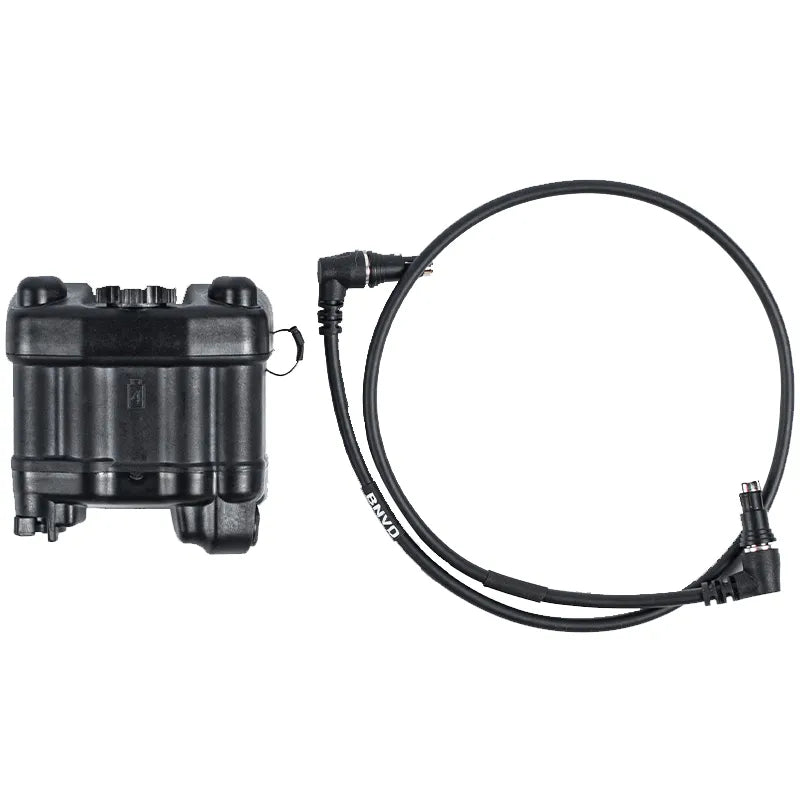
The ARGUS Universal Strobe Battery Pack
The ARGUS Universal Strobe Battery Pack uses four AA batteries.
Its listed functions include:
-
External NVG power
-
Rear helmet counterbalance
-
Voltage regulation
-
Circuit protection
-
Two IR strobes
-
Nighttime identification and SAR support
-
Sealed, durable housing
Using AA cells in the external pack combines increased capacity with relatively simple battery logistics.
The pack connects to compatible NVGs through the appropriate cable or adapter.
For BNVD-family devices, PVS-31-style systems and compatible panoramic platforms, ARGUS lists the BNVD Fischer right-angle power cable.
Do not assume a connector is compatible because it looks similar.
Verify:
-
Port type
-
Cable pinout
-
Output voltage
-
Polarity
-
Connector orientation
-
Device model
-
Battery-pack model
External Battery Packs and Helmet Balance
A night vision device sits forward of the head.
That creates rotational force around the neck.
A rear battery pack can help counteract this forward pull.
Potential ergonomic benefits include:
-
Less helmet movement
-
Reduced forward sliding
-
Better eye-relief stability
-
Less need to overtighten the chin strap
-
Improved comfort during long use
-
More consistent NVG positioning
However, more rear weight is not always better.
An oversized or poorly positioned pack can make the helmet rear-heavy.
Balance the complete operating configuration, including:
-
NVG
-
Mount
-
Lens protection
-
COTI or thermal attachments
-
Front-mounted lights
-
Cables
-
Rear battery pack
For a detailed setup guide, read Managing NVG Weight: Why You Need a Strobe Battery Pack for Helmet Balance.
Limitations of External Battery Packs
Additional Cable
A cable creates another component that can:
-
Snag
-
Disconnect
-
Become damaged
-
Interfere with pod articulation
-
Block helmet accessories
-
Collect moisture or contamination
Cable routing should be secure, low-profile and free from excessive tension.
Additional Connector
Every connector creates another possible failure point.
Inspect for:
-
Bent contacts
-
Dirt
-
Corrosion
-
Water
-
Damaged seals
-
Loose engagement
More Total Weight
A battery pack improves balance but increases total helmet weight.
The ergonomic benefit comes from distribution, not weight reduction.
Compatibility Complexity
Different NVGs may use:
-
Fischer ports
-
BNVS-style ports
-
LEMO-style connections
-
Proprietary connectors
-
Different voltage requirements
Use only a verified pack-and-cable combination.
Higher System Cost
A battery pack, cable and helmet attachment cost more than carrying a spare onboard battery.
The benefit is strongest for users who need longer runtime, better helmet balance or external-power redundancy.
Onboard Battery vs. External Battery Pack
| Requirement | Onboard Battery | External Battery Pack |
|---|---|---|
| Simplest setup | Best | More complex |
| Lowest equipment weight | Usually best | Adds pack and cable |
| Long runtime | More battery changes | Usually better |
| Helmet counterbalance | No | Yes |
| Cable-free operation | Yes | No |
| Fast system setup | Best | Requires routing and connection |
| Extended binocular use | Adequate for many sessions | Often preferable |
| Panoramic NVGs | May be insufficient or unsupported | Commonly required |
| Emergency backup | Useful | Depends on device architecture |
| Maintenance points | Fewer | More connectors and seals |
Some systems support onboard and external power.
Others may rely primarily or entirely on an external pack.
Check whether the device automatically switches between sources, requires removal of the onboard battery or follows another procedure.
Never assume.
Powering a PVS-14
A PVS-14 is a single-tube monocular, so it normally has lower power demand than a binocular or panoramic system using comparable tubes.
The ARGUS PVS-14 NNVT Gen3 FOM2000+ P45 uses one AA battery.
This makes the PVS-14 attractive for users who prioritize:
-
Simple logistics
-
Low system weight
-
Handheld use
-
Easy battery replacement
-
Minimal cabling
-
Long-duration backup capability
An external power system may not provide enough value for every PVS-14 user.
A single onboard battery and protected spare may be simpler for casual observation or short helmet-mounted sessions.
Powering PVS-31-Style and BNVD Systems
Dual-tube systems consume more power than comparable monoculars because they operate two tubes and additional housing electronics.
Platforms such as the BNVD-1431 MK2 can operate from one onboard AA battery or an external battery pack.
This gives users two useful configurations.
Onboard AA Configuration
Best when:
-
Lower weight is important
-
Cable-free operation is preferred
-
The session is relatively short
-
The battery compartment remains accessible
-
A rear counterweight is unnecessary
External Pack Configuration
Best when:
-
Extended runtime is required
-
The helmet feels front-heavy
-
Battery changes should be reduced
-
The system includes additional front accessories
-
Long-duration use is expected
The BNVD-1431 MK2 single battery cap assembly is part of the platform’s onboard-power system and may be relevant for maintenance or replacement.
Powering Panoramic NVGs
Panoramic NVGs use four image intensifier tubes and more complex electronics.
Their power demand and front-mounted weight make external battery packs especially important.
Some panoramic systems are designed around external power rather than a single onboard cell.
The ARGUS PNVG/APNVG configuration uses an external battery pack through a Fischer connection, with the USBP included in applicable complete sets.
For panoramic users, the external pack supports:
-
Higher energy capacity
-
Rear counterbalance
-
More practical battery replacement
-
Longer operating periods
-
Centralized cable routing
Because a panoramic NVG is an expensive multi-tube system, power compatibility should be confirmed before connecting any third-party battery pack.
What About Rechargeable AA Batteries?
Rechargeable AA batteries are commonly nickel-metal hydride cells with a nominal voltage of approximately 1.2V rather than 1.5V.
Some devices operate correctly from them.
Others may show:
-
Shorter runtime
-
Early low-battery indication
-
Failure to start
-
Unstable behavior
-
Reduced cold-weather performance
A rechargeable AA should only be used when the NVG manufacturer approves that chemistry and voltage.
Also be careful with 14500 lithium-ion cells.
A 14500 may have approximately the same physical dimensions as an AA battery, but typically operates around 3.6V or 3.7V and may reach 4.2V when fully charged.
It is not an AA replacement.
Using one in an AA-only NVG can damage the electronics.
What About Rechargeable CR123-Style Batteries?
Rechargeable batteries may be marketed as:
-
RCR123
-
16340
-
Rechargeable CR123A
-
3.7V CR123-style cells
These are not automatically equivalent to disposable 3V CR123A batteries.
A rechargeable lithium-ion cell may reach 4.2V immediately after charging.
That extra voltage can exceed the device’s electrical limit.
Use rechargeable CR123-style batteries only when the exact NVG documentation explicitly approves:
-
The cell chemistry
-
Nominal voltage
-
Maximum charged voltage
-
Protected or unprotected design
-
Required dimensions
Physical fit does not prove electrical compatibility.
Cold-Weather Battery Planning
Cold temperatures reduce the performance of many battery chemistries.
In cold environments:
-
Alkaline voltage may fall more quickly
-
Runtime may be shorter
-
Low-battery warnings may appear earlier
-
Old batteries may fail unexpectedly
-
External cables may become stiffer
-
Battery compartments may collect condensation
A cold-weather power plan should include:
-
Manufacturer-approved primary lithium cells
-
Protected spare batteries
-
More capacity than the expected mission requires
-
Pre-use testing
-
Dry battery storage
-
Inspection of cables and connectors
-
A battery-change procedure that can be performed safely
Keep spare batteries insulated from extreme cold where practical, but do not expose them to excessive heat or carry loose cells where their contacts can short against metal objects.
Battery Safety and Storage
Do Not Mix Cells
In a multi-cell pack, do not mix:
-
Old and new batteries
-
Different brands
-
Different chemistries
-
Different capacities
-
Different charge states
-
Rechargeable and disposable cells
Replace the complete set together.
Check Polarity
Confirm the positive and negative orientation before closing the battery compartment.
Protect Loose Batteries
Store spare cells in individual slots or a protective battery case.
Loose batteries can short against keys, tools, ammunition, coins or other metal objects.
Inspect for Damage
Do not use a battery that is:
-
Swollen
-
Crushed
-
Corroded
-
Leaking
-
Punctured
-
Excessively hot
-
Missing insulation
Remove Batteries for Long Storage
Removing batteries can reduce leakage and corrosion risk, especially when alkaline cells are involved.
Follow the device manufacturer’s storage instructions.
Keep Compartments Clean and Dry
Moisture and corrosion can increase electrical resistance and cause unstable operation.
Building a Practical NVG Power Plan
A reliable power plan should answer five questions.
1. What Is the Approved Onboard Battery?
Record the exact size, chemistry and voltage.
2. What Is the Expected Runtime?
Use the product specification as a planning baseline, not a guarantee.
3. How Many Spares Are Required?
Plan for longer use than expected, temperature loss and possible battery failure.
4. Is External Power Necessary?
Consider runtime, helmet balance, device weight and cable complexity.
5. What Happens if the External System Fails?
Know whether the device can return to onboard power and what procedure is required.
Test the full power configuration before relying on it during an extended operation.
Choosing the Right Power Source
Choose onboard AA power when:
-
The device is designed for AA
-
Simplicity matters most
-
AA availability is valuable
-
The session is relatively short
-
A cable-free setup is preferred
-
The NVG is a lightweight monocular
Choose CR123A power when:
-
The device is specifically designed for CR123A
-
Compact 3V power is required
-
Cold-weather performance matters
-
Approved CR123A logistics are already established
Choose an external battery pack when:
-
Extended runtime is important
-
A binocular or panoramic NVG is used
-
The helmet requires functional rear counterbalance
-
Frequent onboard battery changes are undesirable
-
The correct power cable and connector are available
-
Added weight and cable management are acceptable
Many serious users use more than one approach.
They may operate from an external pack while carrying an approved onboard battery or protected spares for redundancy, depending on the device’s supported power architecture.
Common Battery Mistakes
Assuming All AA Batteries Are Identical
Alkaline, primary lithium, NiMH and 14500 lithium-ion cells have different electrical characteristics.
Treating CR123A and RCR123 as Equivalent
Rechargeable CR123-style cells may have substantially higher voltage.
Buying a Battery Pack Without Checking the Cable
A compatible connector shape does not guarantee correct voltage or pinout.
Mixing Battery Types in an External Pack
Mixed cells can discharge unevenly and create reliability or safety problems.
Judging Runtime Only by Capacity Numbers
Device load, temperature, voltage regulation and cutoff voltage all affect usable runtime.
Leaving Alkaline Batteries Installed During Long Storage
Leakage can damage contacts and electronics.
Adding Too Much Rear Weight
A battery pack should balance the helmet, not pull it backward.
Ignoring Cable Strain
A tightly routed cable can pull on connectors or restrict pod movement.
Frequently Asked Questions
Is AA Better Than CR123A for Night Vision?
Neither format is universally better. AA offers excellent availability and flexible logistics. CR123A provides compact 3V lithium power and strong cold-weather characteristics. The correct format is the one approved for the device.
Can I Put a CR123A in an AA Night Vision Device?
No, unless the manufacturer provides a specifically designed and approved battery compartment or adapter. A CR123A normally provides twice the nominal voltage of one AA cell.
Are Lithium AA Batteries Better Than Alkaline AA Batteries?
Primary lithium AA batteries are generally lighter and perform better in severe cold, but cost more. Use them only when approved by the device manufacturer.
Can I Use Rechargeable Batteries?
Only when the manufacturer approves the exact chemistry and voltage. AA-size 14500 cells and rechargeable CR123-style cells can have dangerously high voltage for devices designed around disposable batteries.
Does an External Battery Pack Make an NVG Lighter?
No. It adds total weight but moves useful power to the rear of the helmet, which can improve balance.
Does Every PVS-31 or BNVD Use the Same Battery Cable?
No. Connector type, wiring, voltage and device generation may differ. Confirm the exact pack, cable and NVG combination.
Should I Leave an Onboard Battery Installed While Using External Power?
Follow the instructions for the exact device. Different housings may handle onboard and external sources differently.
Final Thoughts
Reliable night vision power begins with compatibility.
AA, CR123A and external battery packs each have real advantages, but they are not interchangeable solutions.
AA batteries offer:
-
Broad availability
-
Simple logistics
-
Low-cost alkaline options
-
Strong primary-lithium options
-
Compatibility with many PVS-14, PVS-31-style and BNVD systems
CR123A batteries offer:
-
Compact dimensions
-
3V nominal output
-
Strong low-temperature performance
-
Stable primary-lithium discharge
-
Long storage capability
External battery packs offer:
-
Longer runtime
-
Functional rear counterbalance
-
Easier power management for binocular and panoramic systems
-
Additional features such as IR strobes in some designs
Their disadvantages are equally important:
-
Added weight
-
More cables
-
Additional connectors
-
Higher cost
-
More compatibility checks
The best power setup is not the one with the largest battery or the highest advertised capacity.
It is the system that:
-
Matches the NVG’s electrical design
-
Uses approved battery chemistry
-
Performs reliably in the expected temperature
-
Provides enough runtime with a realistic reserve
-
Maintains comfortable helmet balance
-
Can be serviced and replaced safely
-
Includes a tested backup plan
Before inserting any new cell, adapter or external battery pack, confirm its voltage and compatibility.
A battery is inexpensive compared with an image intensifier tube or complete NVG housing.
Saving money by using an unapproved power source is never worth risking the device.