
Cart
0

Introduction
Night vision does not automatically make a user invisible at night.
Analog NVGs allow the wearer to amplify available light that would otherwise be difficult to see with the unaided eye. However, many night vision setups can also use active infrared illumination when ambient light is insufficient.
That creates an important tradeoff.
A passive night vision approach relies primarily on ambient light and the sensitivity of the image intensifier tube.
An active IR approach introduces infrared energy into the scene through an illuminator or other compatible IR-emitting equipment.
To the unaided human eye, that infrared output may be difficult or impossible to see.
To another person using compatible night vision or infrared-sensitive equipment, however, an active IR source may be detectable.
That is why buyers comparing passive aiming and active IR illumination need to understand more than brightness.
They should also consider:
-
Ambient light
-
Image intensifier performance
-
Autogating
-
Reflections
-
Device compatibility
-
Battery use
-
Helmet ergonomics
-
IR signature awareness
-
Training environment
-
Legal and organizational policies
This guide explains those tradeoffs at a system level without providing operational shooting or evasion instructions.
For current monocular and binocular night vision systems, start with the Night Vision collection.
What Does “Passive” Mean Under Night Vision?
In night vision terminology, passive use generally means relying on naturally available or existing environmental light instead of deliberately projecting additional infrared illumination into the scene.
Available light may include:
-
Starlight
-
Moonlight
-
Sky glow
-
Distant urban lighting
-
Existing artificial illumination
-
Light reflected from surrounding terrain
An analog image intensifier collects this available light and amplifies it.
The better the available light and the stronger the image intensifier tube, the less additional illumination may be necessary.
Passive use is therefore closely connected to:
-
Tube sensitivity
-
Signal-to-noise ratio
-
Lens transmission
-
Ambient-light conditions
-
Environmental contrast
A high-performance tube can remain useful in darker environments where a lower-performance tube may begin showing significantly more noise.
What Is Active IR Illumination?
Active IR illumination means intentionally adding infrared energy to improve the image seen through compatible night vision equipment.
Conceptually, an IR illuminator acts somewhat like a flashlight that operates outside the portion of the spectrum normally visible to the human eye.
An NVG can detect that additional infrared energy and display a brighter or more detailed image.
This can be useful when the environment provides very little usable ambient light.
Examples of challenging environments include:
-
Enclosed structures
-
Heavy tree cover
-
Overcast nights
-
Deep shadows
-
Areas with little sky exposure
-
Dark equipment compartments
Some PVS-14 configurations include an onboard infrared illuminator. For example, the PVS-14 NNVT Gen3 FOM2000+ P45 MX10160 is listed with an IR illuminator and IR indicator.
The important point is that active IR adds light to the scene rather than merely amplifying what is already available.
Passive vs Active IR: Quick Comparison
| Factor | Passive Night Vision | Active IR Illumination |
|---|---|---|
| Adds IR energy to scene | No | Yes |
| Depends heavily on ambient light | More | Less |
| Helps in extremely dark environments | Limited by tube performance | Can improve visibility |
| IR emission detectable by compatible equipment | No deliberate emitter | Potentially yes |
| Battery demand | Usually lower | Additional power required |
| Reflections and hot spots | Lower risk from own illumination | Can occur |
| Image quality | Depends strongly on tube and optics | Can improve when ambient light is insufficient |
| Complexity | Lower | Higher |
| Best general use | When existing light is adequate | When additional illumination is genuinely required |
Neither approach is automatically superior.
The environment determines which limitation matters most.
Why “Invisible IR” Does Not Mean Undetectable
One of the biggest misconceptions about infrared equipment is that invisible to the unaided eye means invisible to everyone.
That is not correct.
Night vision devices and other compatible sensors can detect portions of the infrared spectrum.
An active infrared source may therefore appear as:
-
A bright illuminated area
-
A distinct source of IR energy
-
Reflections from nearby surfaces
-
A visible hotspot through compatible equipment
This matters in any environment where multiple people may be using night vision.
The safest way to think about active infrared is:
It is illumination, not invisibility.
Whether the source is detectable depends on the equipment, environment and sensor involved.
Avoid assuming that IR use provides concealment simply because the light cannot be seen normally.
Why Passive Capability Starts with Better Tubes
Passive performance depends heavily on the image intensifier.
Important specifications include:
Signal-to-Noise Ratio
SNR influences how clean the image remains when available light becomes very limited.
A stronger SNR can help preserve useful detail instead of allowing image noise to dominate.
EBI
Equivalent Background Illumination becomes particularly relevant in very dark environments.
Lower EBI can help preserve shadow detail under difficult low-light conditions.
Resolution
Resolution affects how much fine detail the tube can display when sufficient signal is available.
FOM
FOM combines resolution and SNR into a convenient comparison metric.
It is useful, but it should not be treated as the only measure of low-light capability.
Tube Gain
Gain influences how much the incoming signal is amplified.
The user should evaluate the complete tube specification rather than choosing a system based on generation label alone.
Current tube configurations can be compared through the Image Intensifier Tube collection.
Better Optics Also Reduce Dependence on Additional Illumination
The image intensifier can only amplify the light that reaches it.
Objective-lens quality therefore matters.
A good optical system should preserve:
-
Light transmission
-
Contrast
-
Edge clarity
-
Focus accuracy
-
Low-light detail
Poor transmission means less usable signal reaches the tube.
That can make a capable image intensifier look noisier or darker than expected.
For users interested in optimizing passive image quality, tube specifications and optical quality should be considered together.
Read Glass Matters: How Ultra-Light Lenses Optimize Image Intensifier Tube Performance for a deeper explanation.
When Active IR Improves the Image
There are conditions where even a good image intensifier does not receive enough usable ambient light.
In those environments, additional IR illumination can increase the amount of scene information reaching the tube.
Potential benefits include:
-
More visible environmental detail
-
Better contrast
-
Improved short-range scene recognition
-
Easier observation in enclosed darkness
-
Less dependence on weak natural illumination
However, additional brightness should not be confused with automatically better information.
Too much illumination can create other problems.
The Problem with IR Reflections
Infrared light interacts with nearby surfaces just like other illumination.
Highly reflective or close surfaces can send significant energy back toward the NVG.
Possible sources include:
-
White walls
-
Glass
-
Metal surfaces
-
Vehicles
-
Wet surfaces
-
Signs
-
Light-colored equipment
-
Vegetation at close distance
This can create:
-
Bright hotspots
-
Reduced nearby detail
-
Blooming
-
Lower contrast
-
Visual distraction
The user may technically have more light but a less useful overall image.
Good IR use therefore depends on understanding that more illumination is not always better.
Autogating and Active IR
Autogating is especially useful in environments where lighting changes rapidly.
An autogated tube can better regulate its operation as the scene moves between:
-
Dark areas
-
Artificial lighting
-
Reflected IR
-
Vehicle lights
-
Indoor lighting
-
Bright exterior environments
ARGUS currently lists both autogated and non-gated PVS-31 configurations in its Night Vision collection.
Autogating does not make active IR invisible.
It also does not eliminate blooming or reflections completely.
Its benefit is improved tube behavior when incoming light levels change.
For a full explanation, read Gated vs. Non-Gated Image Intensifiers: Why Autogate Matters for Tactical Night Operations.
Passive Viewing and Manual Gain
Manual gain is another useful night vision feature, but it should not be confused with either passive operation or autogating.
Manual gain allows the user to control the apparent brightness of the intensified image.
In environments with enough ambient light, reducing gain may provide a more comfortable image.
In darker environments, higher gain may make the scene appear brighter but can also make image noise more noticeable.
Manual gain does not create additional scene information.
It adjusts how the available intensified image is presented to the user.
For tube and control compatibility, read The Truth About Flying Wires vs 3-Pin Tubes: Managing Manual Gain Control.
PVS-14 and Passive Night Vision
The PVS-14 remains popular because it can be:
-
Helmet-mounted
-
Handheld
-
Used as a compact observation device
-
Operated from a single AA battery
-
Configured with manual gain
A monocular also leaves one eye unaided, which some users prefer when moving between intensified and normally illuminated environments.
The PVS-14 NNVT Gen3 FOM2000+ P45 MX10160 is one current ARGUS example.
Its onboard IR illuminator provides an additional illumination option when ambient conditions are insufficient.
For normal observation, however, the image intensifier can operate from available environmental light without requiring continuous active IR.
Dual-Tube NVGs and Passive Viewing
Binocular systems such as PVS-31-style devices provide intensified imagery to both eyes.
Potential advantages include:
-
Better depth perception
-
More natural movement
-
Improved long-duration viewing comfort
-
More consistent visual information between the eyes
These characteristics can make high-quality binocular systems effective for passive observation when adequate ambient light exists.
A current platform example is the PVS-31 NNVT Gen3 FOM1800+ P43 MX10160.
For users deciding between monocular and binocular systems, read PVS-14 vs PVS-31: Which Night Vision Device Is Right for You?.
Why Helmet Stability Matters
Passive observation places greater importance on getting the best possible image from the existing light.
That means the NVG should remain correctly positioned in front of the eyes.
A loose or unstable mount can reduce:
-
Effective field of view
-
Eye alignment
-
Focus consistency
-
Binocular comfort
-
Visual confidence
The ARGUS A4 Lightweight Night Vision Mount supports standard dovetail-equipped monocular and binocular systems and provides fore-and-aft, vertical and tilt adjustments.
Good helmet setup will not improve tube SNR.
It does ensure that the user can see the image the tube is already producing.
Additional Electronics Mean Additional Power
Active IR equipment adds another electrical load to the overall night vision system.
A complete setup may require power for:
-
NVG
-
IR illumination
-
Thermal attachment
-
Helmet accessories
-
Identification equipment
Power planning becomes more important as accessories are added.
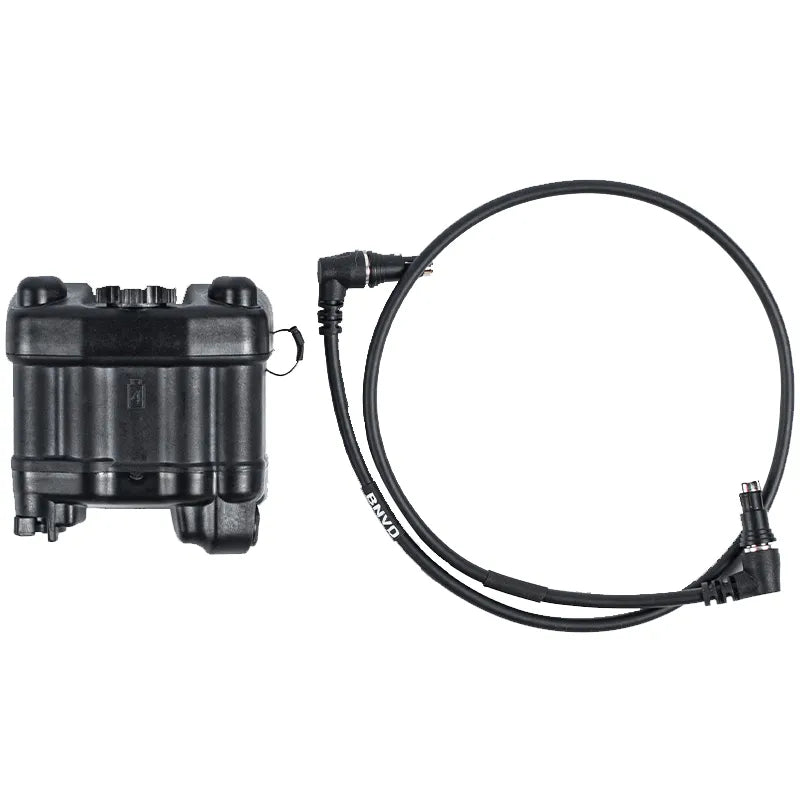
An external battery pack can support compatible night vision systems and also move useful weight to the back of the helmet.
The ARGUS Universal Strobe Battery Pack uses four AA batteries and can provide external power to compatible NVGs through the correct cable or adapter.
Its IR strobe function should also be understood as an active IR emitter rather than a visually invisible signal to every sensor.
For a complete battery comparison, read Powering Your Night Vision: AA vs. CR123A vs. External Battery Packs.
Passive Does Not Mean Zero Signature
Avoid oversimplifying the issue as:
Passive = invisible
Active = visible
Real-world detectability depends on many factors beyond whether an IR illuminator is turned on.
Equipment may create other observable signatures, such as:
-
Visible status lights
-
Display glow
-
Electronic emissions
-
Reflections
-
Movement
-
Sound
-
Thermal output
This article focuses only on night vision illumination.
A passive NVG setup simply avoids deliberately projecting additional IR light into the environment.
That is useful to understand, but it should not be treated as a guarantee of concealment.
Active IR Does Not Automatically Mean Poor Practice
The opposite mistake is assuming that active IR should never be used.
Infrared illumination exists because there are conditions where ambient light is inadequate.
For lawful observation, training, search and rescue, inspection and other professional applications, active IR may improve scene visibility when passive amplification alone is insufficient.
The correct question is not:
“Is active IR good or bad?”
It is:
“Does this environment require additional illumination, and what are the consequences of introducing it?”
That includes thinking about:
-
Image quality
-
Reflections
-
Other sensor users
-
Battery consumption
-
Organizational procedures
-
Safety
Passive vs Active IR for Search and Rescue
Search and rescue provides a good example of why the two approaches should not be treated as rivals.
Passive night vision can help rescuers move through:
-
Trails
-
Forests
-
Shorelines
-
Structures
-
Open terrain
Active IR may help illuminate areas where ambient light is extremely weak.
Thermal imaging may provide a separate advantage by detecting heat signatures.
A rescue team may therefore use several complementary sensors rather than relying on one method.
For more context, read Night Vision in Search & Rescue: How NVGs Support Critical Missions.
Passive vs Active IR in Urban Environments
Urban environments can contain enough artificial lighting for passive NVGs to work well.
At the same time, cities create difficult mixed-light conditions.
Possible challenges include:
-
Streetlights
-
Vehicle headlights
-
Dark interiors
-
Reflective windows
-
White walls
-
Security lighting
-
Deep shadows
Moving between these conditions can change the image dramatically.
Autogating becomes valuable because the tube may need to handle both low-light shadows and sudden brightness.
Active IR used near reflective surfaces can also create strong return illumination.
The best image is often produced by understanding the available light before adding more.
Passive vs Active IR in Maritime Environments
Water creates additional challenges.
IR and visible illumination can reflect from:
-
Calm water
-
Waves
-
Wet decks
-
Glass
-
Sea spray
This may increase glare and reduce contrast.
Passive observation may work well when coastal or celestial light provides enough usable signal.
When illumination is required, reflections should be considered as part of the overall image.
For a complete explanation, read Night Vision for Maritime & Coastal Patrols: Overcoming Water Reflection and Glare.
Image Intensifier Quality Changes the Decision
A low-performance tube and a high-performance tube may behave very differently under the same ambient light.
Before assuming that active illumination is necessary, evaluate:
-
Tube SNR
-
EBI
-
FOM
-
Gain
-
Lens quality
-
Objective focus
-
Phosphor-screen cleanliness
-
Environmental light
Users sometimes blame the environment when the real limitation is a weak tube or poor optical system.
Likewise, an expensive tube cannot make useful visual detail appear when there is essentially no usable signal reaching the objective lens.
The entire system matters.
A Safer Decision Framework
For lawful night vision observation and training, the choice can be approached in this order:
1. Evaluate Existing Ambient Light
Determine whether the NVG already provides enough usable information.
2. Check Device Setup
Confirm:
-
Objective focus
-
Diopter
-
Gain where available
-
Lens cleanliness
-
Helmet position
3. Consider the Tube’s Limits
A noisy image may indicate that the available signal is reaching the tube’s practical limit.
4. Decide Whether Additional Illumination Is Necessary
Use active illumination only when it materially improves the task.
5. Consider Other IR-Sensitive Equipment
Remember that compatible sensors may detect deliberately projected infrared energy.
6. Watch for Reflections and Blooming
More light can sometimes reduce useful contrast.
7. Follow Applicable Procedures
Professional, training and organizational environments may have specific rules regarding active illumination.
This framework focuses on image quality and equipment awareness rather than tactical concealment.
Common Misconceptions
“IR Light Is Completely Invisible”
It may be invisible to unaided human vision, but compatible imaging systems can detect infrared energy.
“Better Tubes Never Need Illumination”
Even high-performance image intensifiers have limits when usable ambient light becomes extremely low.
“Active IR Always Gives a Better Image”
Reflections and excessive illumination can reduce contrast.
“Autogating Hides IR”
Autogating manages incoming brightness. It does not prevent another sensor from detecting an IR emitter.
“Passive Use Guarantees Concealment”
Avoiding active IR removes one possible source of emitted illumination, but it does not make a person or device undetectable.
“FOM Tells Me Everything”
Low-light performance also depends on SNR, EBI, gain, optics and environmental conditions.
Frequently Asked Questions
What Is Passive Aiming Under NVGs?
At a high level, passive aiming describes using a night-vision-compatible sighting arrangement without relying on a projected IR aiming or illumination source. Exact firearm setup, alignment and shooting procedures are outside the scope of this guide.
Can Other NVGs See an IR Illuminator?
Compatible night vision or infrared-sensitive equipment may detect infrared illumination, depending on the sensor, wavelength, environment and distance.
Does a PVS-14 Need IR Illumination to Work?
No. An image intensifier can operate from available ambient light. Some PVS-14 configurations include an onboard IR illuminator for conditions where additional illumination is needed.
Is Passive Night Vision Always Better?
No. Passive viewing avoids deliberately adding IR energy, but image quality may deteriorate when available light is extremely weak.
Does Autogating Improve Passive Performance?
Autogating mainly improves behavior under changing or brighter illumination. Passive low-light image quality still depends strongly on tube SNR, EBI, gain and optics.
Do Binocular NVGs Work Better Passively Than a PVS-14?
A binocular provides intensified imagery to both eyes and may improve depth perception and viewing comfort, but the actual low-light performance depends on the tubes and optics installed.
Should I Use the Highest Possible IR Output?
This guide does not provide operational IR-emitter settings. In general, unnecessary illumination can create reflections, reduce contrast and increase the amount of IR energy introduced into the scene.
Final Thoughts
Passive night vision and active IR illumination solve different problems.
Passive use relies on:
-
Ambient light
-
Image intensifier sensitivity
-
Lens transmission
-
Tube specifications
-
Environmental contrast
Active IR adds:
-
Additional scene illumination
-
Better visibility when ambient light is insufficient
-
Additional battery demand
-
Greater potential for reflections
-
An IR emission that may be detectable by compatible equipment
The key lesson is that infrared should never be treated as automatically invisible.
Likewise, passive use should never be treated as a guarantee of being undetectable.
For night vision buyers, the better priority is building a system that performs efficiently from available light first.
That means selecting:
-
Strong image intensifier tubes
-
Appropriate SNR and EBI
-
Quality optics
-
Autogating where mixed lighting is expected
-
Properly fitted helmet equipment
-
Reliable power
Then treat active illumination as an additional capability for environments where the available light is genuinely insufficient.
Understanding when your NVG is amplifying the environment and when your equipment is actively adding energy to it is an important part of responsible night vision use.