
Cart
0
Introduction
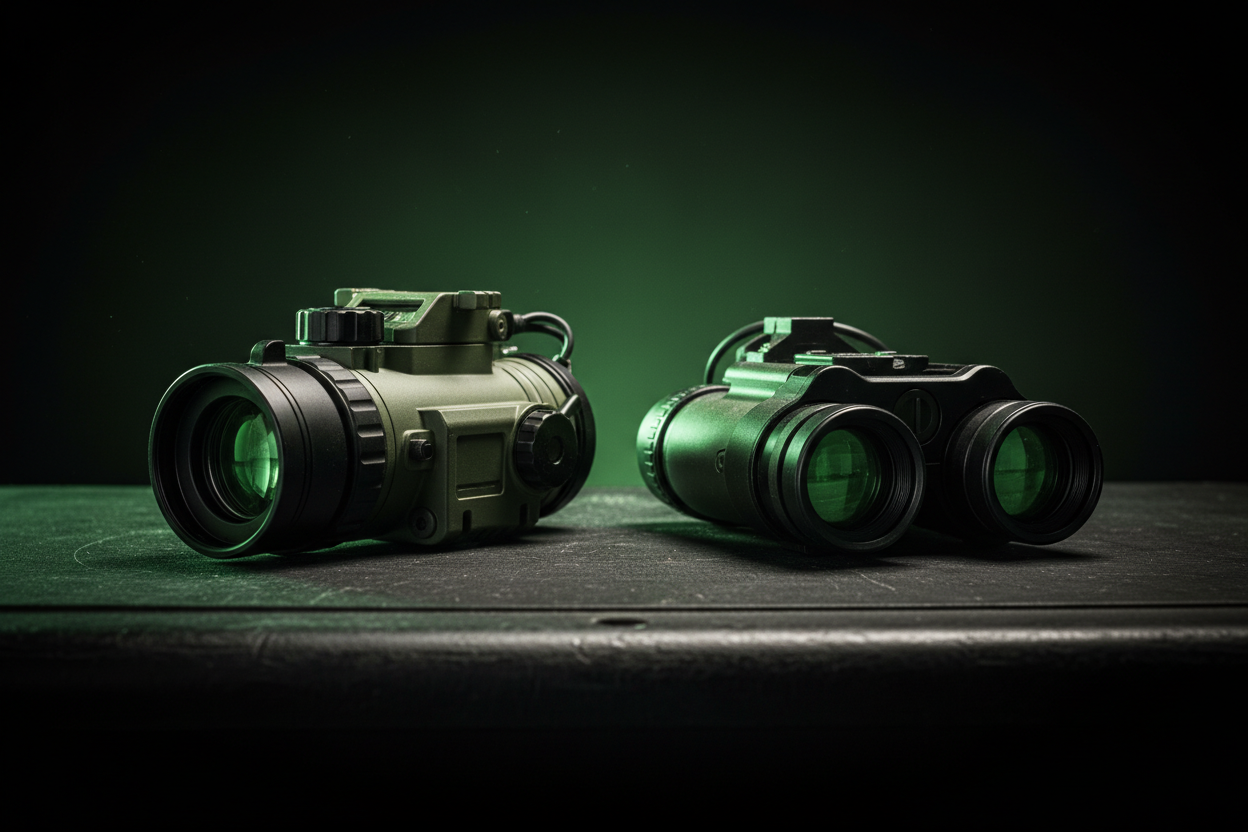
When it comes to professional night vision equipment, two names consistently dominate the conversation: the PVS-14 monocular and the PVS-31 binocular night vision goggle.
Both systems have proven themselves in military, law enforcement, hunting, and tactical applications. However, they are designed for different users, budgets, and operational requirements.
If you're considering investing in a night vision device, understanding the strengths and limitations of each platform is essential.
In this guide, the experts at ARGUS Night Vision compare the PVS-14 and PVS-31 in detail, covering design, performance, comfort, versatility, and overall value.
What Is a PVS-14?
The PVS-14 is arguably the most recognizable night vision monocular ever produced.
Originally developed for military use, it remains one of the most versatile and widely adopted night vision systems in the world.
Key features include:
-
Single-tube monocular design
-
Lightweight construction
-
Helmet-mount compatible
-
Handheld operation
-
Weapon-mount capable
-
Excellent reliability
The PVS-14 continues to serve military personnel, law enforcement agencies, hunters, and civilian enthusiasts worldwide.
What Is a PVS-31?
The PVS-31 is a modern dual-tube binocular night vision goggle designed primarily for special operations and professional tactical users.
Unlike the monocular PVS-14, the PVS-31 provides independent image intensifier tubes for each eye.
Key features include:
-
Dual-tube binocular design
-
Enhanced depth perception
-
Greater situational awareness
-
Lightweight military-grade housing
-
Folding pod system
-
Advanced ergonomics
The PVS-31 has become one of the most sought-after night vision systems among elite military and professional users.
PVS-14 vs PVS-31: Quick Comparison
| Feature | PVS-14 | PVS-31 |
|---|---|---|
| Configuration | Monocular | Binocular |
| Tubes | One | Two |
| Depth Perception | Limited | Excellent |
| Weight | Lighter | Slightly heavier |
| Cost | Lower | Significantly higher |
| Power Consumption | Lower | Higher |
| Versatility | Extremely versatile | Primarily helmet-mounted |
| Professional Use | Excellent | Exceptional |
| Entry-Level Friendly | Yes | No |
Image Quality
Many first-time buyers assume the PVS-31 automatically provides a better image.
This is only partially true.
Image quality depends primarily on:
-
Tube generation
-
Signal-to-noise ratio
-
Resolution
-
Photocathode sensitivity
-
Tube manufacturer
A premium Gen 3 white phosphor PVS-14 can produce image quality comparable to a PVS-31 using identical tubes.
The real difference comes from how the brain processes information.
Because the PVS-31 delivers imagery to both eyes, users often experience:
-
Better depth perception
-
Reduced visual fatigue
-
Improved situational awareness
-
Faster target acquisition
Winner: PVS-31
Depth Perception and Spatial Awareness
This is where the PVS-31 truly shines.
The human brain naturally relies on binocular vision to estimate distance and understand spatial relationships.
With a single PVS-14:
-
Distance estimation takes practice
-
Navigating obstacles can be more difficult
-
Users rely heavily on training
With a PVS-31:
-
Movement feels more natural
-
Terrain navigation improves significantly
-
Driving and mobility tasks become easier
-
Obstacle avoidance is more intuitive
For users spending extended periods under night vision, binocular systems provide a major advantage.
Winner: PVS-31
Weight and Comfort
One of the biggest advantages of the PVS-14 is simplicity.
A typical PVS-14 setup weighs significantly less than most dual-tube systems.
Benefits include:
-
Reduced neck strain
-
Easier helmet balancing
-
Less fatigue during long missions
-
Lower equipment costs
While modern PVS-31 systems are remarkably lightweight, dual-tube configurations still place more weight on the helmet.
For extended recreational use, many users appreciate the lighter feel of a monocular.
Winner: PVS-14
Versatility
The PVS-14 remains one of the most versatile night vision devices ever created.
It can be used as:
-
A handheld monocular
-
A helmet-mounted system
-
A weapon-mounted optic
-
An observation device
-
A backup night vision solution
The PVS-31 is optimized primarily for helmet-mounted operation.
While it excels in this role, it does not offer the same flexibility as the PVS-14.
Winner: PVS-14
Battery Life
A single image intensifier tube requires less power than a dual-tube system.
As a result, PVS-14 units generally offer:
-
Longer runtime
-
Simpler power management
-
Lower battery consumption
This can be an important factor during extended field operations.
Winner: PVS-14
Professional Tactical Performance
When evaluating pure operational capability, the PVS-31 takes the lead.
Professional users benefit from:
-
Superior situational awareness
-
Enhanced movement speed
-
Better depth perception
-
Increased comfort during prolonged use
-
Improved team coordination
These advantages explain why dual-tube systems have become increasingly common among military special operations units.
Winner: PVS-31
Cost Comparison
Budget is often the deciding factor.
A quality PVS-14 setup typically costs substantially less than a PVS-31 system.
The difference is not small.
When comparing premium white phosphor configurations, a PVS-31 may cost two to three times more than a similarly equipped PVS-14.
For many civilian users, the performance gains may not justify the additional investment.
Winner: PVS-14
Who Should Choose a PVS-14?
A PVS-14 may be the best option if you:
-
Are purchasing your first night vision device
-
Want maximum versatility
-
Need a lightweight solution
-
Have a limited budget
-
Plan to use the device for hunting or observation
-
Prefer a proven and highly reliable platform
The PVS-14 remains one of the best values in the night vision market.
Who Should Choose a PVS-31?
A PVS-31 may be the right choice if you:
-
Require professional-grade performance
-
Frequently operate under night vision
-
Prioritize mobility and navigation
-
Need enhanced depth perception
-
Use night vision for tactical applications
-
Have the budget for a premium system
For demanding users, the PVS-31 delivers one of the most immersive night vision experiences available today.
Why Tube Quality Matters More Than Housing
One common mistake buyers make is focusing only on the device model.
In reality, tube specifications often matter more than whether the housing is a PVS-14 or PVS-31.
When evaluating any night vision device, pay close attention to:
-
Resolution (lp/mm)
-
Signal-to-noise ratio (SNR)
-
EBI
-
Halo
-
Photocathode sensitivity
-
White phosphor vs green phosphor
A high-spec image intensifier tube can dramatically improve performance regardless of the housing platform.
The ARGUS Night Vision Perspective
At ARGUS Night Vision, we regularly help customers choose between monocular and binocular night vision systems.
For most first-time buyers, a premium PVS-14 provides outstanding performance, flexibility, and value.
For professional users seeking the highest level of nighttime capability, the PVS-31 offers superior depth perception, situational awareness, and operational efficiency.
The right choice ultimately depends on your mission requirements, budget, and intended use.
Final Verdict
The PVS-14 and PVS-31 are both exceptional night vision platforms, but they serve different purposes.
Choose the PVS-14 if you want affordability, versatility, and proven reliability.
Choose the PVS-31 if you prioritize maximum performance, superior depth perception, and professional-grade operational capability.
No matter which platform you choose, investing in high-quality image intensifier tubes and trusted equipment is the key to achieving the best possible night vision performance.
For expert guidance on selecting the right night vision solution, the team at ARGUS Night Vision is here to help you navigate the latest technologies and find the system that best matches your needs.