
Cart
0
Introduction
Night vision technology has transformed the way military personnel, law enforcement officers, hunters, security professionals, and outdoor enthusiasts operate in low-light environments. At the heart of most traditional night vision devices lies a remarkable component known as the image intensifier tube (IIT).
Whether you're using night vision goggles, monoculars, binoculars, or weapon sights, the image intensifier tube is the technology responsible for turning tiny amounts of available light into a bright, visible image.
In this guide, we'll explain what an image intensifier tube is, how it works, the differences between tube generations, and why it remains the gold standard for professional night vision systems.
What Is an Image Intensifier Tube?
An image intensifier tube is an electro-optical device that amplifies existing ambient light to create a visible image in dark conditions.
Unlike thermal imaging systems, which detect heat signatures, image intensifier tubes work by collecting small amounts of available light from sources such as:
-
Moonlight
-
Starlight
-
Atmospheric glow
-
Distant artificial lighting
The tube multiplies incoming photons thousands of times, producing a bright image that allows users to see in conditions where the naked eye would struggle.
Image intensifier tubes are commonly found in:
-
Night vision goggles (NVGs)
-
Night vision monoculars
-
Night vision binoculars
-
Weapon-mounted night vision scopes
-
Aviation night vision systems
-
Military surveillance equipment
Without an image intensifier tube, traditional night vision devices would not be possible.
How Does an Image Intensifier Tube Work?
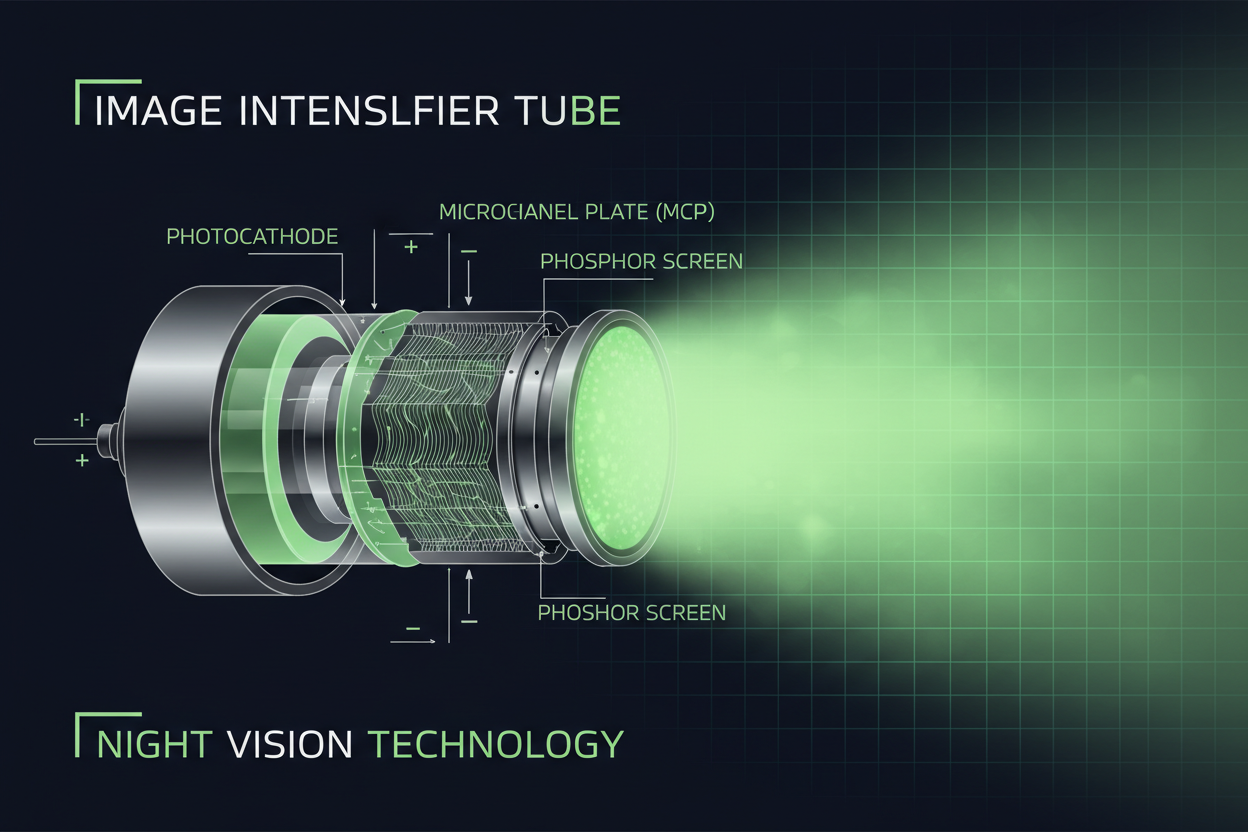
The process may seem complex, but it can be broken down into four key stages.
1. Light Collection
The objective lens gathers available ambient light and focuses it onto the front of the image intensifier tube.
Even in near-total darkness, small amounts of light still exist. The objective lens captures as much of this light as possible.
2. Photocathode Conversion
The incoming photons strike a component called the photocathode.
The photocathode converts light particles (photons) into electrons.
This is the first stage where the image transitions from an optical signal to an electronic signal.
3. Electron Amplification
The electrons then pass through a component called a Microchannel Plate (MCP).
The MCP contains millions of microscopic channels.
As electrons travel through these channels, they collide with the channel walls and generate additional electrons.
This multiplication process dramatically increases the signal strength.
Depending on the tube design, the amplification factor can exceed 50,000 times the original light level.
4. Phosphor Screen Display
The amplified electrons strike a phosphor screen at the rear of the tube.
The phosphor screen converts the electrons back into visible light.
The user sees a bright image through the eyepiece, even though the original scene was extremely dark.
This entire process occurs almost instantly, providing real-time night vision capability.
Main Components of an Image Intensifier Tube
A modern image intensifier tube consists of several critical elements:
Objective Lens
Captures and focuses incoming light.
Photocathode
Converts photons into electrons.
Microchannel Plate (MCP)
Amplifies the electron signal.
Phosphor Screen
Converts amplified electrons into visible images.
Fiber Optic Inverter
Corrects image orientation and improves optical efficiency.
Power Supply
Provides the high voltage necessary for electron multiplication.
Each component plays an essential role in producing clear night vision performance.
Understanding Night Vision Generations
Image intensifier technology has evolved significantly over the past decades.
Generation 1
Gen 1 tubes were the first commercially available night vision systems.
Characteristics:
-
Basic amplification
-
Lower image resolution
-
More distortion around edges
-
Shorter viewing range
-
Lower cost
Gen 1 systems remain suitable for casual observation but are rarely used in professional applications today.
Generation 2
Gen 2 introduced the Microchannel Plate.
Advantages include:
-
Better image quality
-
Increased sensitivity
-
Improved resolution
-
Longer detection distances
-
Better reliability
Gen 2 tubes are widely used by law enforcement and civilian users.
Generation 3
Gen 3 technology introduced gallium arsenide photocathodes.
Benefits include:
-
Exceptional low-light performance
-
Superior signal-to-noise ratio
-
Longer tube lifespan
-
Greater sensitivity
-
Enhanced image clarity
Gen 3 image intensifier tubes are commonly found in military-grade night vision equipment.
Generation 4 and Filmless Technologies
Modern advanced tubes often feature:
-
Filmless construction
-
Auto-gating technology
-
Improved brightness control
-
Faster response times
These systems deliver some of the highest levels of night vision performance currently available.
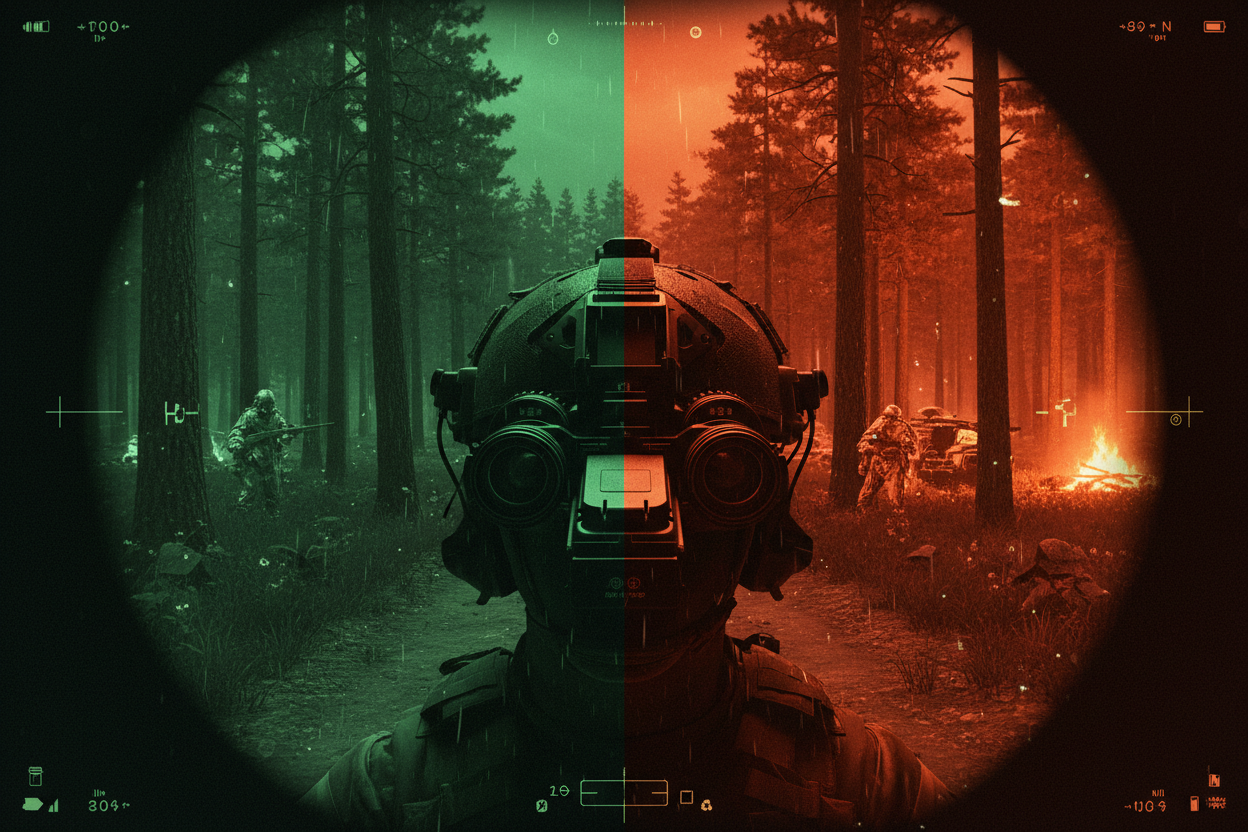
White Phosphor vs Green Phosphor
One of the most visible differences in modern night vision systems is phosphor color.
Green Phosphor
Traditional night vision uses green phosphor screens.
Advantages:
-
Long-established technology
-
High contrast
-
Familiar appearance
-
Lower cost
Green phosphor became standard because the human eye can distinguish many shades of green.
White Phosphor
White phosphor has become increasingly popular among professional users.
Advantages:
-
More natural image appearance
-
Improved perceived detail
-
Reduced eye fatigue
-
Enhanced contrast recognition
Many military and law enforcement professionals now prefer white phosphor systems for extended operations.
Image Intensifier Tubes vs Digital Night Vision
Many buyers wonder whether image intensifier technology is still superior to digital night vision.
Image Intensifier Night Vision
Pros:
-
True real-time viewing
-
Minimal latency
-
Excellent low-light sensitivity
-
Natural image appearance
-
Proven military performance
Cons:
-
Higher cost
-
Sensitive to excessive bright light
Digital Night Vision
Pros:
-
Lower cost
-
Day and night functionality
-
Recording capability
-
Easier integration with electronics
Cons:
-
Reduced performance in extremely dark conditions
-
Potential image lag
-
Often requires infrared illumination
For professional applications, image intensifier tubes remain the preferred solution.
How Long Does an Image Intensifier Tube Last?
Modern tubes are remarkably durable.
Typical lifespan estimates include:
-
Gen 2 tubes: approximately 5,000 to 10,000 hours
-
Gen 3 tubes: approximately 10,000 to 15,000+ hours
Many premium military-grade tubes can exceed these figures when properly maintained.
Factors affecting lifespan include:
-
Exposure to bright light
-
Storage conditions
-
Operating temperature
-
Usage frequency
Proper handling can significantly extend service life.
Common Applications of Image Intensifier Tubes
Military Operations
Night vision goggles are standard equipment for military personnel conducting nighttime missions.
Law Enforcement
Police tactical teams use image intensifier systems for surveillance and search operations.
Hunting
Night hunters rely on night vision optics for target detection and observation.
Search and Rescue
Rescue teams can locate missing individuals more effectively in low-light conditions.
Wildlife Observation
Researchers and enthusiasts use night vision devices to observe nocturnal animals without disturbing them.
Security and Surveillance
Night vision systems enhance situational awareness in perimeter monitoring and critical infrastructure protection.
Why Image Intensifier Tubes Remain Important
Despite advances in digital sensors and thermal imaging, image intensifier tubes continue to offer several advantages:
-
Exceptional low-light sensitivity
-
Real-time image processing
-
Lightweight designs
-
Proven battlefield reliability
-
Superior depth perception
-
Natural scene recognition
For many professionals, these benefits make image intensifier technology the preferred solution for nighttime operations.
Conclusion
An image intensifier tube is the core component that powers traditional night vision devices. By collecting tiny amounts of ambient light, converting photons into electrons, amplifying those electrons, and displaying them on a phosphor screen, the tube allows users to see clearly in darkness.
From Gen 2 and Gen 3 technologies to modern white phosphor and auto-gated systems, image intensifier tubes continue to represent some of the most advanced night vision solutions available today.
Whether you're evaluating a night vision monocular, binocular, or professional NVG system, understanding how an image intensifier tube works will help you make a more informed decision and choose the right equipment for your mission.