
Cart
0
Introduction
If you've spent any time researching night vision devices, you've probably encountered specifications like:
-
FOM 1600
-
FOM 2000
-
FOM 2500+
-
High-FOM Gen 3 Tubes
Manufacturers, dealers, and enthusiasts frequently use FOM (Figure of Merit) as a way to evaluate image intensifier tube performance. In many cases, FOM is one of the first numbers buyers compare when shopping for premium night vision equipment.
But what exactly does FOM mean?
Is a higher FOM always better?
And should FOM be the most important factor when choosing a night vision device?
In this guide, the team at ARGUS Night Vision explains what FOM is, how it's calculated, and how to use it when comparing image intensifier tubes.
What Is FOM in Night Vision?
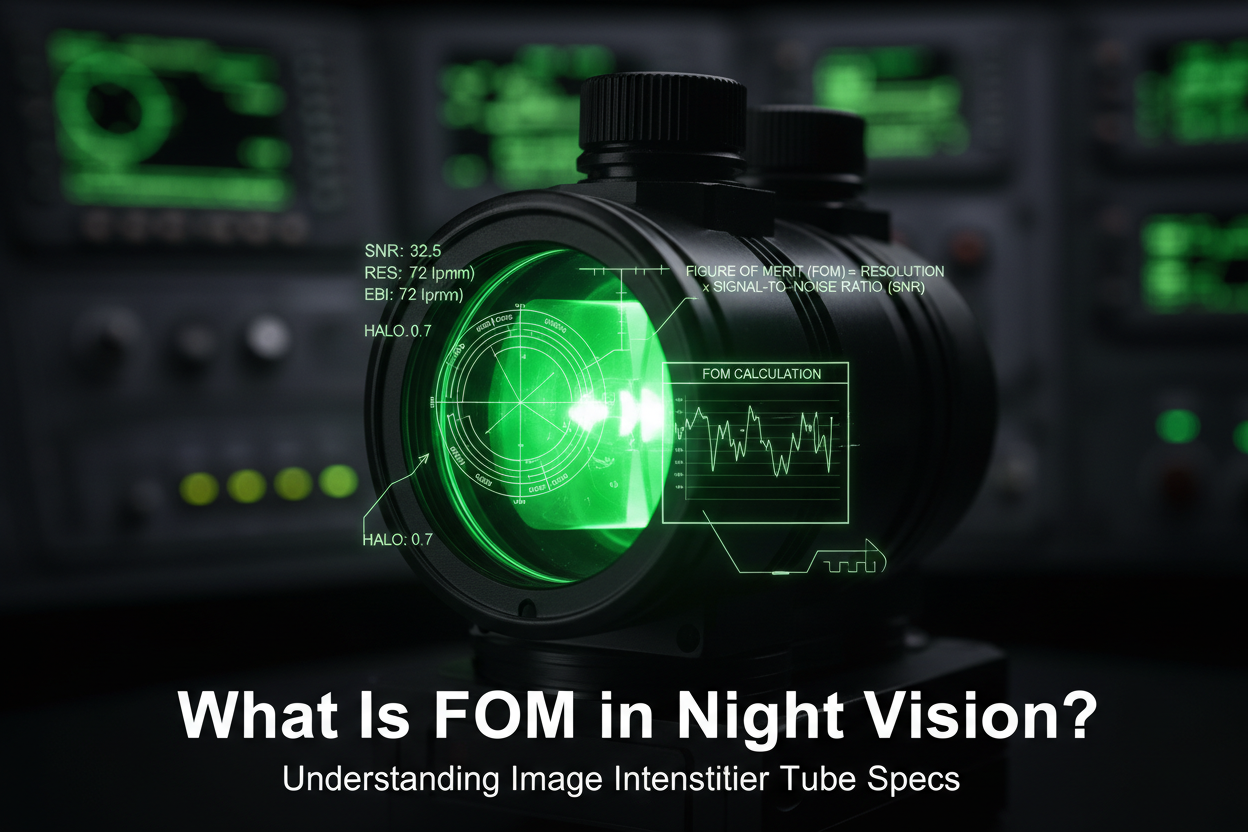
FOM stands for Figure of Merit.
It is a numerical value used to estimate the overall performance of an image intensifier tube.
Rather than being measured directly, FOM is calculated using two key specifications:
-
Resolution (lp/mm)
-
Signal-to-Noise Ratio (SNR)
The formula is:
FOM = Resolution \times SNR
For example:
A tube with:
-
Resolution: 64 lp/mm
-
SNR: 30
Would have:
FOM = 64 \times 30 = 1920
This means the tube's FOM would be 1920.
The higher the FOM, the stronger the combination of image resolution and low-light performance.
Why Does FOM Matter?
FOM provides a quick way to compare night vision tubes.
It combines two of the most important performance metrics into a single number:
Resolution
Resolution measures how much detail a tube can display.
Higher resolution means:
-
Sharper images
-
Better target identification
-
Improved object recognition
Measured in:
Line Pairs Per Millimeter (lp/mm)
Common values include:
-
57 lp/mm
-
64 lp/mm
-
72 lp/mm
-
81 lp/mm
Signal-to-Noise Ratio (SNR)
SNR measures how effectively a tube amplifies useful light while suppressing image noise.
Higher SNR results in:
-
Cleaner images
-
Better low-light performance
-
Improved contrast
-
Less visual grain
SNR becomes especially important in extremely dark environments where available light is limited.
Typical FOM Ranges
While exact specifications vary by manufacturer, most modern night vision tubes fall into the following ranges:
| FOM Range | Performance Level |
|---|---|
| Under 1400 | Entry-level |
| 1400–1800 | Good |
| 1800–2200 | Very Good |
| 2200–2600 | Professional |
| 2600–3000+ | Premium |
| 3000+ | Elite Military Grade |
As image intensifier technology improves, tubes exceeding 3000 FOM are becoming increasingly common among high-end military and law enforcement systems.
Is Higher FOM Always Better?
Generally speaking, yes.
A higher FOM often indicates:
-
Better image quality
-
Improved low-light performance
-
Enhanced target recognition
-
Greater operational capability
However, FOM does not tell the entire story.
Two tubes can have identical FOM values but perform differently in real-world conditions.
For example:
Tube A:
-
Resolution: 72
-
SNR: 30
-
FOM: 2160
Tube B:
-
Resolution: 64
-
SNR: 33.75
-
FOM: 2160
Both tubes have the same FOM.
Yet many experienced users would prefer Tube B because the higher SNR provides better performance in extremely dark environments.
This illustrates one of the key limitations of relying solely on FOM.
Why SNR Often Matters More Than FOM
Among experienced night vision users, SNR is often considered the single most important specification.
A higher SNR helps deliver:
-
Cleaner images
-
Better detail in darkness
-
Reduced scintillation
-
Improved contrast
When operating under starlight-only conditions, SNR frequently has a greater impact on image quality than resolution alone.
For this reason, many professional buyers evaluate SNR before looking at FOM.
Other Important Tube Specifications
FOM should never be viewed in isolation.
Several additional specifications play a critical role in night vision performance.
Equivalent Background Illumination (EBI)
EBI measures the tube's internal electronic noise.
Lower EBI is better.
Benefits include:
-
Improved performance in warm environments
-
Better operation in near-total darkness
-
Cleaner images during extended use
For premium tubes, lower EBI values are highly desirable.
Halo
Halo refers to the glow that appears around bright light sources.
Examples include:
-
Street lights
-
Vehicle headlights
-
Building lighting
Lower halo values result in:
-
Better target visibility
-
Less bloom around lights
-
Improved urban performance
Photocathode Sensitivity
Photocathode sensitivity measures how efficiently incoming photons are converted into electrons.
Higher sensitivity generally leads to:
-
Better low-light performance
-
Improved image brightness
-
Greater detail retention
Tube Gain
Gain determines how much the tube amplifies incoming light.
Modern tubes often feature automatic gain control systems that optimize image brightness under changing lighting conditions.
Comparing Real-World Examples
Consider the following tubes:
Tube A
-
Resolution: 64
-
SNR: 28
-
FOM: 1792
Tube B
-
Resolution: 64
-
SNR: 34
-
FOM: 2176
Tube C
-
Resolution: 72
-
SNR: 38
-
FOM: 2736
As FOM increases, users generally experience:
-
Better image clarity
-
Improved low-light performance
-
Higher contrast
-
Enhanced target detection
However, factors such as EBI, halo, and gain can still influence real-world performance.
FOM and Export Restrictions
Some countries regulate the export of high-performance image intensifier tubes.
Historically, export regulations have often referenced FOM thresholds when determining whether a tube can be sold internationally.
As regulations evolve, specific limits may change, but FOM remains an important benchmark within the global night vision industry.
Buyers should always verify local laws and export requirements before purchasing controlled night vision equipment.
What FOM Should You Choose?
Casual Users
Recommended FOM:
-
1600–2000
Suitable for:
-
Recreational use
-
Wildlife observation
-
General outdoor activities
Hunters
Recommended FOM:
-
1800–2400
Provides:
-
Better detection capability
-
Improved target identification
-
Enhanced low-light performance
Professional Users
Recommended FOM:
-
2200–2800+
Ideal for:
-
Tactical operations
-
Search and rescue
-
Security applications
-
Professional surveillance
Elite Applications
Recommended FOM:
-
2800–3000+
Designed for:
-
Military operations
-
Special operations forces
-
Advanced tactical environments
The ARGUS Night Vision Perspective
At ARGUS Night Vision, customers frequently ask whether they should focus solely on FOM when selecting a night vision device.
Our answer is simple:
FOM is an excellent starting point, but it should never be the only specification you consider.
A truly high-performance night vision system is built from a balanced combination of:
-
High SNR
-
Strong resolution
-
Low EBI
-
Low halo
-
Reliable image intensifier technology
Understanding how these specifications work together will help you choose the right night vision solution for your mission and budget.
Final Thoughts
FOM, or Figure of Merit, is one of the most widely used performance indicators in the night vision industry. By combining resolution and signal-to-noise ratio into a single value, FOM offers a convenient way to compare image intensifier tubes.
However, while higher FOM generally indicates better performance, it does not tell the complete story.
For the best results, evaluate FOM alongside SNR, EBI, halo, gain, and overall tube quality.
Whether you're purchasing your first night vision monocular or building a professional-grade dual-tube system, understanding FOM will help you make a more informed decision and select equipment that delivers reliable performance when it matters most.