
Cart
0
Introduction
When comparing night vision image intensifier tubes, most buyers focus on the obvious specifications:
-
FOM
-
SNR
-
Resolution
-
EBI
-
Halo
-
White phosphor vs green phosphor
-
Auto-gated vs non-gated
But once you start looking deeper into tube compatibility, especially for PVS-14 style builds and binocular night vision systems, another topic appears:
manual gain control.
More specifically, buyers often run into questions like:
-
What are flying wires on a night vision tube?
-
What is a 3-pin image intensifier tube?
-
What is the difference between MX-11769 and MX-10160 tubes?
-
Do you need flying wires for manual gain?
-
Are 3-pin tubes better than pigtail tubes?
-
Can all night vision housings support manual gain?
These questions matter because the wrong tube type can create compatibility problems with your housing, gain control knob, or electrical contacts.
In this guide, we explain the real difference between flying wires and 3-pin tubes, how manual gain control works, and what buyers should check before choosing an image intensifier tube.
For more general tube information, you can also read What Is FOM in Night Vision? Understanding Image Intensifier Tube Specs.
What Is Manual Gain Control?
Manual gain control allows the user to adjust the brightness level of a night vision image.
In simple terms, it lets you turn the image brightness up or down depending on the environment.
This can be useful when moving between:
-
Very dark areas
-
Mixed-light environments
-
Urban streets
-
Indoor spaces
-
Vehicle areas
-
Areas with artificial lighting
-
Bright moonlight
-
IR-illuminated scenes
Instead of letting the device decide everything automatically, manual gain gives the user more control over the image.
This can improve comfort, reduce eye strain, and make the image easier to interpret in changing lighting conditions.
Manual Gain vs Auto-Gating
Manual gain and auto-gating are often confused, but they are not the same thing.
Manual Gain
Manual gain is user-controlled brightness adjustment.
The user adjusts image brightness with a gain control knob or compatible housing system.
Auto-Gating
Auto-gating is a tube-level function that helps manage sudden light changes by rapidly regulating tube operation.
It helps improve image stability in bright or mixed lighting.
A tube can be:
-
Manual gain and auto-gated
-
Manual gain and non-gated
-
Fixed gain and auto-gated
-
Fixed gain and non-gated
These features are related to image control, but they are not the same.
For a deeper explanation, read Auto-Gated vs Non-Gated Night Vision: What’s the Real Difference?.
Why Tube Format Matters
Not every image intensifier tube connects to the housing in the same way.
Even if two tubes are both 18mm tubes, they may use different electrical layouts.
This matters because manual gain requires a way for the housing to communicate with the tube’s power supply.
That communication may happen through:
-
Flying wires
-
Pigtail ribbon cable
-
3-pin contact system
-
Housing-integrated gain contacts
-
Fixed gain connection with no manual control
If the tube and housing are not designed for the same control method, manual gain may not work.
This is why buyers must check compatibility before purchasing.
What Are Flying Wires?
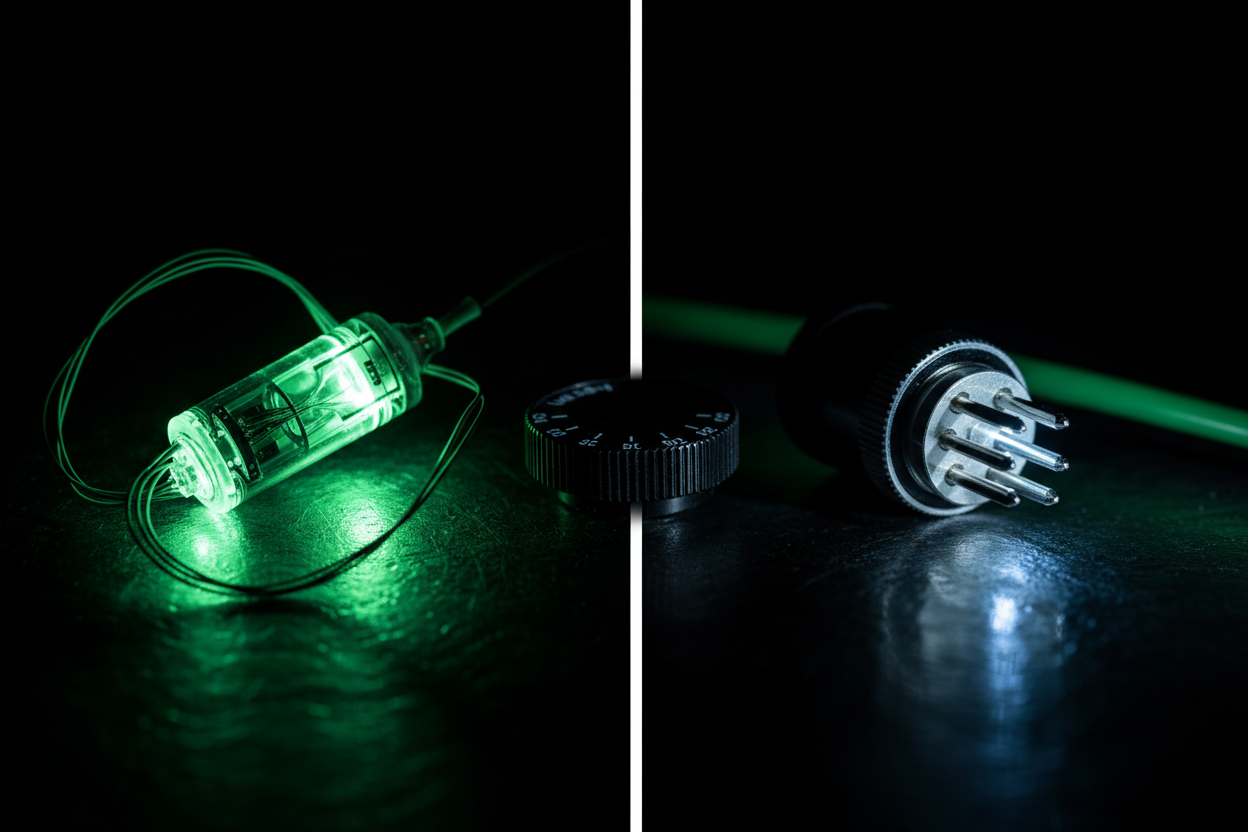
Flying wires are small external wires or a pigtail-style connection attached to the image intensifier tube.
They are commonly associated with manual gain tubes such as MX-11769 style tubes.
The wires allow the tube to connect to a gain control circuit inside the night vision housing.
In a PVS-14 style system, this usually allows the user to adjust image brightness using the manual gain knob.
Flying wire tubes are often described using terms like:
-
Pigtail tube
-
Flying lead tube
-
Manual gain tube
-
MX-11769 tube
-
11769-style tube
The basic idea is simple:
The tube includes an external wire connection that supports manual gain control when installed in a compatible housing.
Advantages of Flying Wire Tubes
1. Traditional Manual Gain Compatibility
Flying wire tubes are strongly associated with traditional manual gain PVS-14 style builds.
If your housing is designed for MX-11769 style tubes, a flying wire tube may be the expected choice.
2. Proven System Design
Pigtail-style manual gain tubes have been used for many years.
Many technicians and builders are familiar with this format.
For users building or maintaining PVS-14 style systems, this can make servicing and compatibility easier when the correct parts are used.
3. Good for PVS-14 Manual Gain Builds
If your goal is a classic manual gain PVS-14 setup, a flying wire / pigtail tube is often the standard format to consider.
This is especially true if the housing was designed around the MX-11769 tube format.
Limitations of Flying Wire Tubes
1. More Delicate Handling
Flying wires can be fragile.
During installation or servicing, the wires must be handled carefully.
Improper handling can damage the connection and affect manual gain function.
2. More Internal Space Required
A pigtail or wire connection takes up space inside the housing.
This may not be a problem in housings designed for that format, but it can be an issue in compact or incompatible systems.
3. Compatibility Is Housing-Dependent
Not every night vision housing supports flying wire tubes.
Some housings are designed for MX-10160 style tubes or 3-pin tubes instead.
A tube may physically fit but still not provide proper manual gain control.
What Is a 3-Pin Tube?
A 3-pin tube is an image intensifier tube that uses three electrical contacts instead of the traditional two-contact fixed-gain layout.
In simple terms, the third contact can support gain control in compatible systems.
This format is often discussed in relation to MX-10160 style tubes.
Traditional MX-10160 tubes are commonly associated with fixed gain operation.
However, some modern 3-pin tube designs aim to provide manual gain capability while keeping a compact 10160-style form factor.
This can make 3-pin tubes attractive for modern night vision housings where builders want manual gain control without a flying wire pigtail.
Advantages of 3-Pin Tubes
1. Cleaner Physical Layout
A 3-pin tube does not require an external flying wire connection in the same way a pigtail tube does.
This can make the tube easier to package inside compatible housings.
2. More Compact Integration
Because there is no external pigtail, 3-pin tubes can be easier to integrate into certain modern housings.
This can be useful for binocular night vision systems or compact builds where internal space matters.
3. Reduced Wire Handling Risk
With no flying wires to route or damage, 3-pin tubes may reduce one common installation risk.
This does not mean they are simple or universal, but it can make the physical installation cleaner when the housing is designed for them.
4. Modern Manual Gain Possibilities
In compatible systems, 3-pin tubes can allow manual gain control without using a traditional pigtail format.
This is one reason some users compare 3-pin tubes against MX-11769 flying wire tubes.
Limitations of 3-Pin Tubes
1. Not All Housings Support 3-Pin Gain Control
A 3-pin tube only helps if the housing is designed to use that third contact.
If the housing does not support it, manual gain may not function properly.
2. Confusing Product Descriptions
Some sellers use terms like:
-
3-pin
-
manual gain
-
variable gain
-
10160 format
-
MX-10160 compatible
These terms can be confusing.
Buyers should confirm exactly what the tube supports and which housings it works with.
3. Builder Knowledge Matters
Not every installer is familiar with every 3-pin configuration.
If you are building a night vision device, make sure your technician understands the tube format and housing compatibility.
Flying Wires vs 3-Pin Tubes: Quick Comparison
| Feature | Flying Wire / Pigtail Tube | 3-Pin Tube |
|---|---|---|
| Common association | MX-11769 style tubes | MX-10160 style 3-pin tubes |
| Manual gain support | Yes, with compatible housing | Yes, with compatible housing |
| External wire | Yes | No traditional flying wire |
| Internal space | Requires wire routing | Cleaner compact layout |
| Handling risk | Wires can be delicate | Fewer wire-routing concerns |
| Best for | Traditional PVS-14 manual gain builds | Modern compatible housings |
| Compatibility | Housing-dependent | Housing-dependent |
| Buyer mistake risk | Moderate | High if compatibility is misunderstood |
MX-11769 vs MX-10160: Why Buyers Get Confused
Many night vision buyers hear two model names repeatedly:
-
MX-11769
-
MX-10160
The basic difference is often explained like this:
MX-11769 tubes are commonly associated with manual gain and pigtail / flying wire connections.
MX-10160 tubes are commonly associated with fixed gain and no pigtail.
However, modern 3-pin tube options complicate this simple explanation.
Some 3-pin tubes may use a 10160-style physical format while still offering gain control through an additional contact.
That is why buyers should not rely only on the model family name.
You should check:
-
Tube format
-
Pin layout
-
Manual gain support
-
Housing compatibility
-
Power supply design
-
Seller documentation
-
Spec sheet details
For more general tube selection advice, visit the night vision image intensifier tube collection.
Does Manual Gain Really Matter?
Manual gain can be useful, but it is not always required.
Some users strongly prefer manual gain because it gives them more control over brightness.
Others are comfortable with fixed gain systems, especially if the tube has strong auto-gating and good automatic brightness behavior.
Manual gain is most useful when:
-
Lighting conditions change often
-
You move between open and enclosed spaces
-
You operate in urban environments
-
You use IR illumination
-
You want to reduce image brightness for comfort
-
You want more control during long viewing sessions
-
You need to balance brightness between both eyes in some dual-tube setups
Manual gain is less critical if:
-
You use night vision casually
-
You operate mostly in consistent darkness
-
Your device has good auto-gating
-
You prefer a simpler system
-
You want fewer controls to manage
The best choice depends on how you use your night vision device.
Manual Gain in PVS-14 Builds
The PVS-14 is one of the most common platforms where manual gain is discussed.
Many classic PVS-14 builds use a manual gain knob.
For that system to work correctly, the housing and tube must be compatible.
A PVS-14 manual gain setup commonly uses a tube format that supports external gain control.
This is where MX-11769 / flying wire tubes are often discussed.
Before building or upgrading a PVS-14, check:
-
Does the housing support manual gain?
-
Does the tube support manual gain?
-
Is it a pigtail / flying wire tube?
-
Is it a 3-pin tube?
-
Does the gain knob actually connect to the tube correctly?
-
Is the installer familiar with the tube format?
If any of these points are wrong, manual gain may not function.
For broader platform comparison, read PVS-14 vs PVS-31: Which Night Vision Device Is Right for You?.
Manual Gain in Binocular Night Vision Systems
Manual gain becomes more complex in binocular night vision devices because the system uses two tubes.
A dual-tube setup may require:
-
Matched tube specs
-
Compatible gain control system
-
Proper wiring or contact layout
-
Housing support
-
Correct power distribution
-
Skilled assembly
In many binocular systems, users may prefer fixed gain or simplified control to reduce complexity.
Other users prefer manual gain because it allows finer image adjustment.
The correct choice depends on the housing design and user preference.
If you are comparing modern binocular systems, you may also find this useful: BNVD-1431 MK2 vs Traditional NVGs: A Comprehensive Review.
Are 3-Pin Tubes Better Than Flying Wire Tubes?
Not automatically.
A 3-pin tube can offer a cleaner and more compact design, but only if the housing supports it properly.
A flying wire tube can be excellent for traditional manual gain builds, especially if the housing was designed for that format.
The better choice depends on:
-
Housing compatibility
-
Tube specifications
-
Builder experience
-
Manual gain requirements
-
Device type
-
Serviceability
-
Intended use
In performance terms, the connection format does not automatically make the image better.
A high-spec flying wire tube can outperform a lower-spec 3-pin tube.
A high-spec 3-pin tube can outperform a lower-spec flying wire tube.
The image quality still depends on the actual tube specs.
Tube Specs Still Matter More Than Wire Format
When choosing an image intensifier tube, do not focus only on whether it uses flying wires or a 3-pin layout.
You should still evaluate:
-
FOM
-
SNR
-
Resolution
-
EBI
-
Halo
-
Gain
-
Phosphor type
-
Auto-gating
-
Tube cosmetics
-
Warranty
-
Compatibility
The connection format affects gain control and housing integration.
The tube specifications affect image performance.
Both matter, but they are not the same.
For a deeper spec breakdown, read Spec Breakdown: NNVT Gen2+ NVT5 vs NVT7.
Common Buyer Mistakes
Mistake 1: Assuming All Manual Gain Tubes Are the Same
Manual gain can be implemented in different ways.
A flying wire tube and a 3-pin tube may both support manual gain, but they are not interchangeable in every housing.
Mistake 2: Buying a Tube Before Checking Housing Compatibility
This is one of the most expensive mistakes.
Always confirm tube compatibility before purchasing.
Mistake 3: Confusing Auto-Gating with Manual Gain
Auto-gating and manual gain are different features.
A tube can have one without the other.
Mistake 4: Thinking 3-Pin Always Means Better
3-pin tubes can be convenient, but they are only better if your housing supports them and the tube specs meet your needs.
Mistake 5: Ignoring the Spec Sheet
Connection format matters, but tube specs matter more for image performance.
Always review the individual tube data sheet.
What Should You Choose?
Choose a flying wire / pigtail tube if:
-
Your housing is designed for MX-11769 style tubes
-
You are building a traditional manual gain PVS-14
-
Your technician recommends that format
-
You want proven manual gain compatibility in the correct housing
Choose a 3-pin tube if:
-
Your housing supports 3-pin manual gain
-
You want cleaner internal integration
-
You are using a modern compatible housing
-
You want manual gain without a traditional flying wire pigtail
-
Your installer confirms compatibility
Choose a fixed gain tube if:
-
You do not need manual gain
-
You want a simpler setup
-
Your housing does not support manual gain
-
You prefer fewer controls
-
You prioritize simplicity over brightness adjustment
Questions to Ask Before Buying
Before purchasing a manual gain image intensifier tube, ask these questions:
-
Is this tube flying wire, 3-pin, or fixed gain?
-
Does it support manual gain?
-
Which housings is it compatible with?
-
Does my housing support this tube format?
-
Does the gain knob actually control the tube?
-
Is the tube auto-gated?
-
What are the FOM, SNR, EBI, halo, and resolution?
-
Does the seller provide a tube spec sheet?
-
Are there tube photos?
-
Who will install the tube?
These questions can prevent costly compatibility mistakes.
Where to Compare Image Intensifier Tubes
If you are comparing tube formats, specifications, and compatibility, start with the image intensifier tube category:
night vision image intensifier tube collection
You may also find these guides useful:
-
What Is FOM in Night Vision? Understanding Image Intensifier Tube Specs
-
Auto-Gated vs Non-Gated Night Vision: What’s the Real Difference?
-
PVS-14 vs PVS-31: Which Night Vision Device Is Right for You?
Final Thoughts
Flying wires and 3-pin tubes both exist to solve the same broader problem:
How to manage gain control in a night vision device.
Flying wire / pigtail tubes are commonly associated with traditional manual gain builds, especially MX-11769 style PVS-14 systems.
3-pin tubes offer a cleaner contact-based approach in compatible modern housings.
Neither format is automatically better in every situation.
The right choice depends on your housing, your tube specs, your manual gain requirements, and your installer’s experience.
If you want the safest answer, remember this:
Do not choose a tube based only on the words “manual gain.”
Choose based on tube format, housing compatibility, actual specifications, and your intended use.
A properly matched tube and housing will give you a more reliable night vision system, better control, and fewer installation problems.