
Cart
0
If your BNVD-1431 MK2 won't turn on, the odds are good that nothing is broken. This housing runs a gravity sensor, a motion-based sleep timer, a five-press function lock and a two-press infrared mode, and every one of those behaviours can look exactly like a dead unit if you do not know the button codes. Work through the following eight checks in order. In our experience most no-power cases are resolved before check five, and the ones that are not usually point at a specific, replaceable part rather than a tube failure.
Start by matching the symptom
Before you touch anything, note precisely what the device does. The symptom narrows the cause faster than any single test.
| What you observe | Most likely cause | Go to |
|---|---|---|
| Nothing at all, no sound, no light | Battery, cap contact, or function lock | Checks 3, 4, 6 |
| Brief buzz from one pod, then nothing | Contact losing grip under load | Check 6 |
| Steady red LED, no image | Low battery | Check 4 |
| Works held level, dies when tilted | Gravity sensor doing its job | Check 1 |
| Works, then dies after a minute on the bench | Sleep timer | Check 2 |
| Washed out image, one pod LED lit | Infrared flood mode is on | Check 5 |
| Works on internal cell, dead on the pack | Cable or pack | Check 7 |
| One pod dark in every configuration | Pod-internal fault | Read the final section |
1. Is it flipped up, or tilted past the shutoff angle?
The MK2 cuts power through a built-in gravity sensor rather than a magnet in the mount. That distinction matters when you are diagnosing, because there is no magnet to remove and no reed switch to clean. The sensor only trips beyond a preset angle, which is why raising your head while wearing the goggle does not shut it down, but holding the housing in your hand at a steep upward tilt will.
Bench-test with the housing level and the objectives pointed at the horizon. If it lights up level and dies when you tip it back, the sensor is working correctly and you do not have a fault.
2. Has it gone dormant?
Leave the housing motionless for more than 100 seconds and the sensor puts the tubes to sleep. This is deliberate: it saves battery, and it protects the phosphor screens from a long static burn caused by leaving a goggle powered and pointed at one bright scene. Movement wakes it.
A unit that lit up when you picked it up, then went dark while sitting on the bench, is not broken. Pick it up and move it. If you are doing extended bench work and the sleep cycle is getting in the way, see check 3 for how to suspend it.
3. Did someone lock the functions with the five-press code?
Press the power button five times and the flip-up shutoff and the sleep function are both deactivated. The red LED in the pods flashes five times to confirm. The feature exists for military free fall, diving and rappelling, where rolling body positions would otherwise cut power at the worst possible moment.
Two consequences follow. First, if you bought the goggle used, or lent it out, assume the previous user may have left it in a non-default state. Press five times again to restore normal behaviour. Second, there is a three-press variant that suspends the same functions temporarily and clears itself at the next power-up. A goggle that seemed to fix itself overnight was almost certainly in three-press mode.
4. Read what the red LED is telling you
The red light inside the pod is a status indicator, not a fault lamp. It flashes to acknowledge button codes and it stays lit to warn of low battery. A steady red glow with no image means change the cell before you do anything else.
This is worth doing even when a tester says the battery is fine. The housing runs from 2.2 to 3.4 volts, and a cell that has sat through a hot summer can hold acceptable open-circuit voltage while collapsing the instant the tube power supplies draw current. Lithium AA cells hold their voltage far more stubbornly under load and across temperature than alkaline; the manufacturer's own Energizer L91 lithium AA datasheet shows the discharge behaviour clearly, and it is the reason a fresh lithium cell is the correct diagnostic battery even if you normally run alkaline.
5. Rule out infrared flood mode
Two presses of the power button switch on the infrared flood illuminator. The right pod LED flashes twice and the left pod LED stays lit. Standing in a lit room, the image looks washed out and that steady LED reads like an error condition. Two further presses turn it off. This one catches new owners constantly.
6. Inspect the battery cap and the contact spring
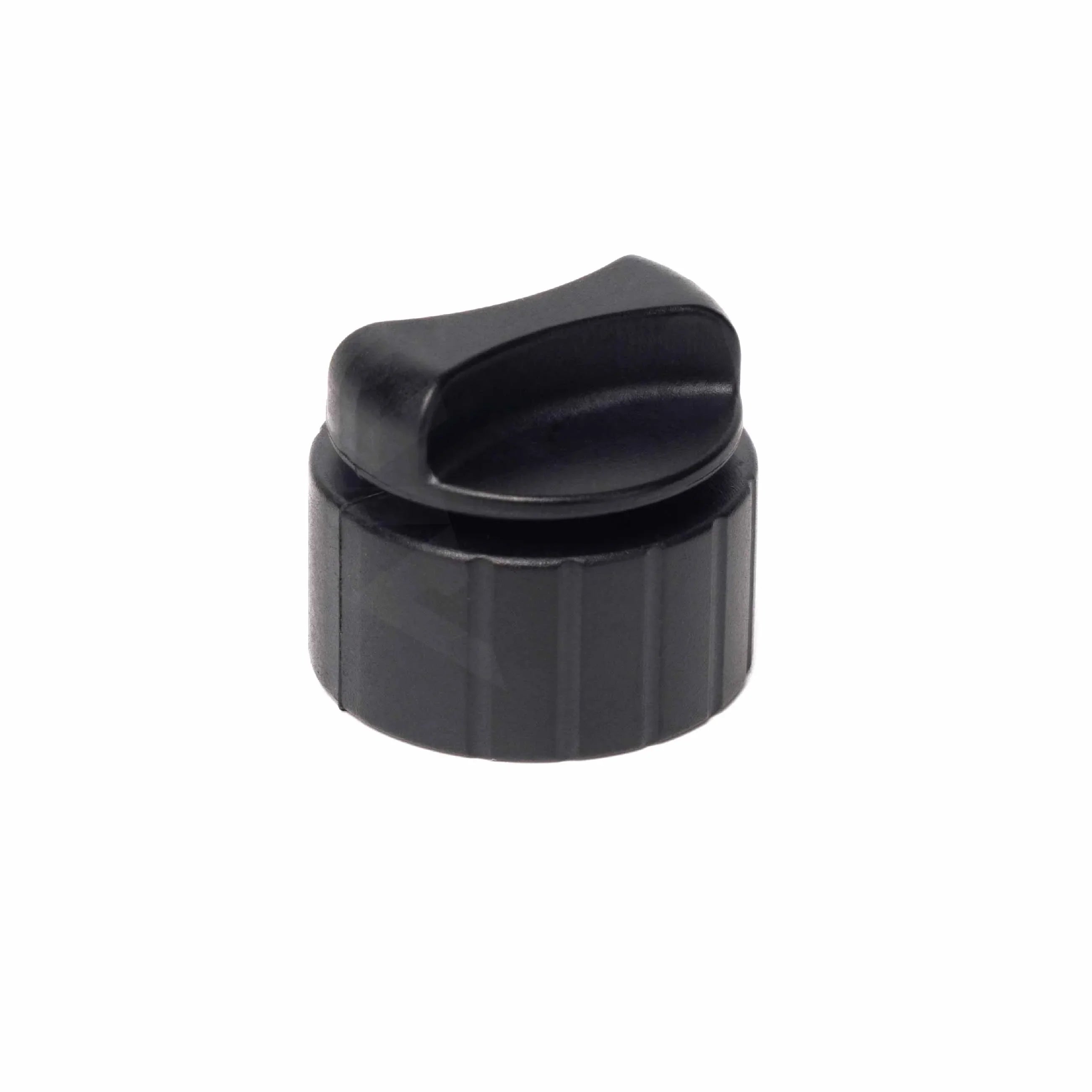
The single battery cap assembly takes more abuse than any other part on this housing, because it is opened every time the cell is changed. A hairline crack in the cap, a spring that has taken a set, or a contact with a film of corrosion all produce the classic forum symptom: one tube buzzes for roughly three seconds and then goes quiet. That buzz is the power supply beginning to charge and then losing its contact under load.
Look for green or white powder on the contact face, a spring that no longer stands proud of its seat, and any play in the threads. The BNVD-1431 MK2 single battery cap assembly is an inexpensive part and takes about a minute to swap, which makes it the cheapest test you can run on a no-power unit.
7. If you run an external pack, test on the internal cell first
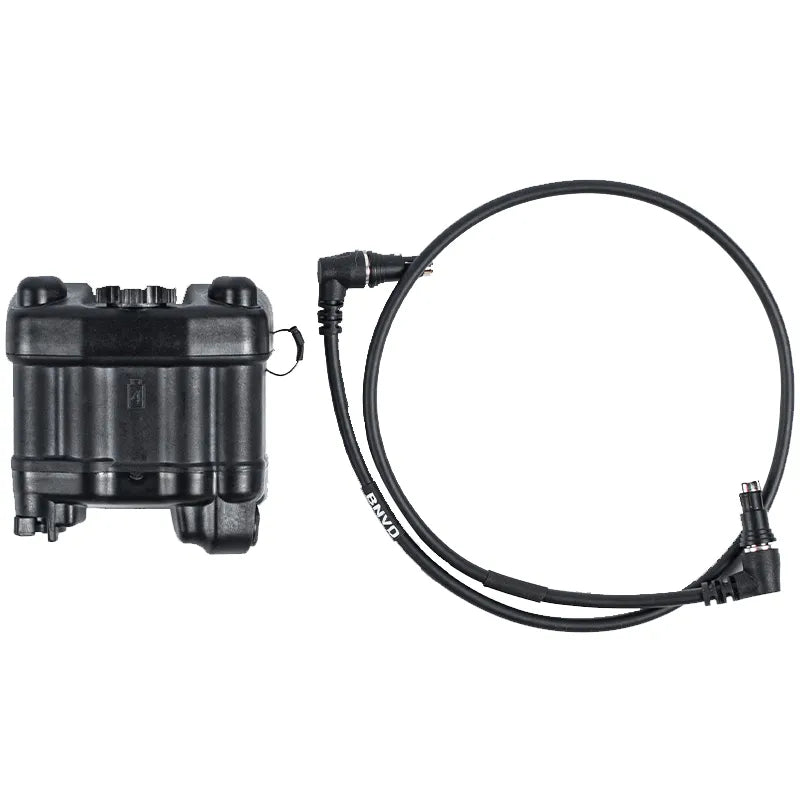
The MK2 runs beyond 50 hours from an external battery pack over a Fischer connector, against more than 15 hours from a single internal AA. Cables get pinched under helmet edges, and the strain relief at the right-angle plug is the first thing to fail on any cable that has been pulled out by the wire rather than the connector body.
Disconnect the pack, fit a fresh cell in the housing, and retry. If the goggle comes up on internal power, your fault is in the right-angle Fischer power supply cable or the pack, not in the goggle. Check the pack's own cells for the same load-collapse problem described in check 4, and confirm the plug seats fully with its alignment mark lined up.
8. Look at the hinge and the plug cover
Each pod flips 140 degrees sideways, and over thousands of cycles the hinge wears. A loose hinge does not by itself prevent power-up, but it can let a pod rest at an angle that the gravity sensor reads as flipped up, which produces an intermittent no-power fault that seems to depend on how the goggle is set down. The BNVD1431 MK2 hinge is a user-replaceable part.
The plug cover on the bridge keeps grit out of the power port. A port full of range dust is a poor connection waiting to happen. Both parts, along with light pipes, lock rings and eye cups, sit in our night vision spare parts range.
When a BNVD-1431 MK2 won't turn on after all eight checks
If a fresh lithium cell, a level housing, a five-press reset and a new battery cap still leave you with one dark pod, the fault is inside that pod: either the tube's power supply or the tube itself.
Do not open the pod. The pods hold dry nitrogen, and opening one lets humid air in; the goggle will fog at the first sharp temperature change afterwards, and you will have converted a single-component fault into two problems. Resealing correctly requires drying, refilling and leak-checking, not just a squirt of gas.
Before you contact anyone, write down four things: the serial number, which pod is affected, whether the three-second buzz is present, and what the pod LED does at power-up. Those four data points usually separate a power supply replacement from a tube replacement before the goggle is even on a bench, which shortens both the quote and the turnaround. Our assembly, testing and repair capabilities page describes the bench equipment used for that diagnosis, including the collimation and gain measurements that decide whether a tube is genuinely out of specification or simply mismatched to its partner.
Preventing the repeat visit
Three habits keep this housing out of the shop. Store it with the cell removed, because a leaked AA inside the compartment destroys the contact assembly and is the single most common avoidable failure. Keep the goggle flipped up in its case so that flip-up shutoff is actually cutting power rather than relying on you to remember. And replace the battery cap at the first sign of thread wear rather than at the first no-power call, since it costs less than the shipping on a repair.
If you are working on the mount side of the system rather than the goggle, note that the housing uses the standard Wilcox pattern dovetail, and mount-side continuity problems present very similarly to goggle faults; Wilcox Industries publishes the interface documentation for that pattern.
Frequently Asked Questions
Why does my BNVD-1431 MK2 turn off when I tilt it, even though it works when level?
That is the gravity sensor working as designed. The housing cuts power past a preset flip angle so the eyepieces do not expose the tubes to light when the goggle is stowed above the helmet. Raising your head is not enough to trip it, but holding the unit at a steep upward tilt on the bench is. Press the power button five times to suspend the behaviour for bench work.
My goggle powers up, then dies after about a minute on the table. Is it faulty?
No. After more than 100 seconds without movement the housing puts the tubes to sleep to save power and to protect the phosphor screens from a static burn. Any movement wakes it. Use the five-press code to suspend the sleep timer if you need the unit to stay awake for testing.
One pod buzzes for a few seconds and then nothing happens. What does that mean?
The buzz is a tube power supply starting to charge and then losing contact under load. In most cases the cause is the battery cap assembly: a cracked cap, a spring that has taken a set, or a corroded contact. Fit a fresh lithium AA and a new cap assembly before assuming a tube fault.
Can I open the pod to look inside?
You should not. The pods are sealed and filled with dry nitrogen. Opening one admits humid air and the goggle will fog at the next sharp temperature change. Resealing requires drying, nitrogen refill and a leak check, so pod-internal work belongs on a bench with purge equipment.
What information should I have ready before requesting service?
Four things: the serial number, which pod is affected, whether the three-second buzz is present, and what the pod LED does at power-up. Those four points usually distinguish a power supply replacement from a tube replacement before the goggle reaches the bench.