
Cart
0

Introduction
Night vision makes low-light environments easier to observe, but it also changes the way users should think about light.
A light source that appears weak—or completely invisible—to the unaided eye may look dramatically different through an image intensifier tube.
This is particularly important with infrared equipment.
IR illuminators, identification strobes and other infrared emitters can add useful information to a night vision system, but they also introduce energy into the environment.
That energy can:
-
Illuminate nearby objects
-
Reflect from surfaces
-
Scatter through moisture or dust
-
Produce blooming or halo
-
Become visible to other compatible night vision equipment
-
Affect how easily users interpret the surrounding scene
This is where the concept of light discipline becomes important.
Light discipline does not simply mean turning every light off.
It means understanding when illumination is useful, how emitted light interacts with the environment and when unnecessary brightness can reduce rather than improve night vision performance.
Two concepts are especially useful to understand:
-
Off-axis IR illumination
-
IR strobe flashes
This guide explains both from an equipment and image-quality perspective, including reflections, autogating, identification, search and rescue, battery use and common misconceptions.
It does not provide instructions for using illumination to evade detection or conduct offensive operations.
For a broader introduction to emitted IR versus passive NVG use, read Passive Aiming vs. Active IR Illumination.
What Is Light Discipline Under NVGs?
In night vision use, light discipline means deliberately managing visible and infrared light rather than assuming more illumination always creates a better image.
The goal is to avoid unnecessary light that may:
-
Wash out useful detail
-
Create reflections
-
Produce glare
-
Reduce contrast
-
Distract the user
-
Consume battery power
-
Interfere with other night vision users
-
Reveal the presence of an active emitter to compatible sensors
Light discipline applies to more than handheld illuminators.
It may include:
-
IR illuminators
-
IR strobes
-
Visible flashlights
-
Helmet lights
-
Vehicle lighting
-
Electronic displays
-
Searchlights
-
Identification beacons
-
Reflective surfaces
Under NVGs, users must consider not only the light they can see directly but also the light that reaches the image intensifier after reflecting or scattering through the environment.
Why Infrared Is Not the Same as Invisible
Infrared illumination is often described as invisible because the unaided human eye cannot normally see many near-infrared wavelengths used by night vision equipment.
But that does not make the light universally invisible.
Compatible image intensifier tubes and other sensors may detect it.
An IR source can therefore appear through NVGs as:
-
A bright source
-
A large illuminated area
-
Reflected light
-
A flashing signal
-
A hotspot on nearby surfaces
The important distinction is:
Invisible to the unaided eye does not mean invisible to night vision equipment.
Any active IR system should be treated as an emitter.
What Does “Off-Axis IR” Mean?
Off-axis illumination simply describes a situation where the light source is not aligned directly with the observer’s viewing direction.
For example, an IR source may illuminate an area from the side rather than from directly behind the NVG’s optical axis.
This changes how the light interacts with:
-
Surfaces
-
Shadows
-
Reflections
-
Dust
-
Water droplets
-
Glass
-
Vegetation
Off-axis lighting is a general optical concept and is not unique to night vision.
Photographers, security cameras and industrial imaging systems also use changes in illumination angle to affect how surfaces appear.
Under NVGs, the same principle applies.
The direction of illumination can change the appearance of the scene even when the total amount of emitted IR remains similar.
Direct Illumination vs. Off-Axis Illumination
Direct Illumination
When the illumination direction is close to the viewing direction, light reaches surfaces from approximately the same direction from which the user observes them.
This may produce:
-
Strong frontal illumination
-
Limited side-shadow information
-
Bright reflections from surfaces facing the observer
-
More obvious retroreflective objects
Off-Axis Illumination
When the source is positioned away from the viewing axis, light reaches surfaces from another direction.
This may produce:
-
More visible shadows
-
Different surface texture
-
Reduced or increased reflection depending on material
-
Greater contrast on some three-dimensional objects
-
Uneven illumination across the scene
Neither geometry is automatically better.
The effect depends heavily on the environment.
Off-Axis IR Does Not Make an Emitter Undetectable
A common misunderstanding is that directing infrared light away from the viewing axis automatically makes the source hidden.
That is not a safe assumption.
IR energy can still:
-
Scatter in the atmosphere
-
Reflect from terrain
-
Reflect from walls
-
Reflect from glass or metal
-
Illuminate dust or moisture
-
Become visible from another viewing position
-
Be detected directly by a compatible sensor
Light direction changes how energy is distributed.
It does not turn an active emitter into a passive system.
If minimizing active emissions is important under an authorized procedure, the correct approach is to follow that procedure rather than assuming an off-axis position guarantees concealment.
Why Reflections Matter
Different materials reflect IR differently.
Common reflective environments include:
-
Painted walls
-
Glass
-
Road signs
-
Vehicles
-
Wet pavement
-
Calm water
-
Snow
-
Light-colored equipment
-
Metal surfaces
A surface may appear relatively dark under ambient night vision and suddenly become very bright when illuminated with IR.
This can create:
-
Blooming
-
Halo
-
Loss of nearby detail
-
Visual distraction
-
Uneven exposure
The effect can be particularly strong at close distances.
This is one reason unnecessary illumination may actually produce a worse NVG image.
Water, Moisture and Off-Axis IR
Water creates a particularly complex environment for infrared illumination.
Light may reflect from:
-
Wet decks
-
Waves
-
Calm water
-
Rain
-
Sea spray
-
Wet glass
-
Equipment surfaces
Depending on viewing and illumination geometry, the reflection may appear weak, strong or highly directional.
Rain and spray can also scatter IR back toward the observer.
This may create a hazy or washed-out appearance.
For a deeper discussion of reflective environments, read Night Vision for Maritime & Coastal Patrols: Overcoming Water Reflection and Glare.
Dust, Fog and Smoke
Airborne particles can scatter both visible and infrared light.
Examples include:
-
Dust
-
Fog
-
Rain
-
Snow
-
Smoke
-
Sea spray
When illumination strikes these particles, part of the energy may return toward the observer.
The NVG may then amplify the scattered light.
The result can appear as:
-
Haze
-
Bright particles
-
Reduced contrast
-
A glowing foreground
-
Loss of distant detail
Adding more illumination may make this worse.
The correct response in poor atmospheric conditions is not automatically to increase output.
Sometimes less added light provides a more useful image.
What Is an IR Strobe?
An IR strobe is an infrared emitter that produces repeated flashes rather than constant illumination.
Through compatible night vision equipment, it may appear as a clearly recognizable flashing signal.
IR strobes can be used for authorized applications such as:
-
Identification
-
Search and rescue
-
Location marking
-
Equipment identification
-
Aviation or team coordination where approved
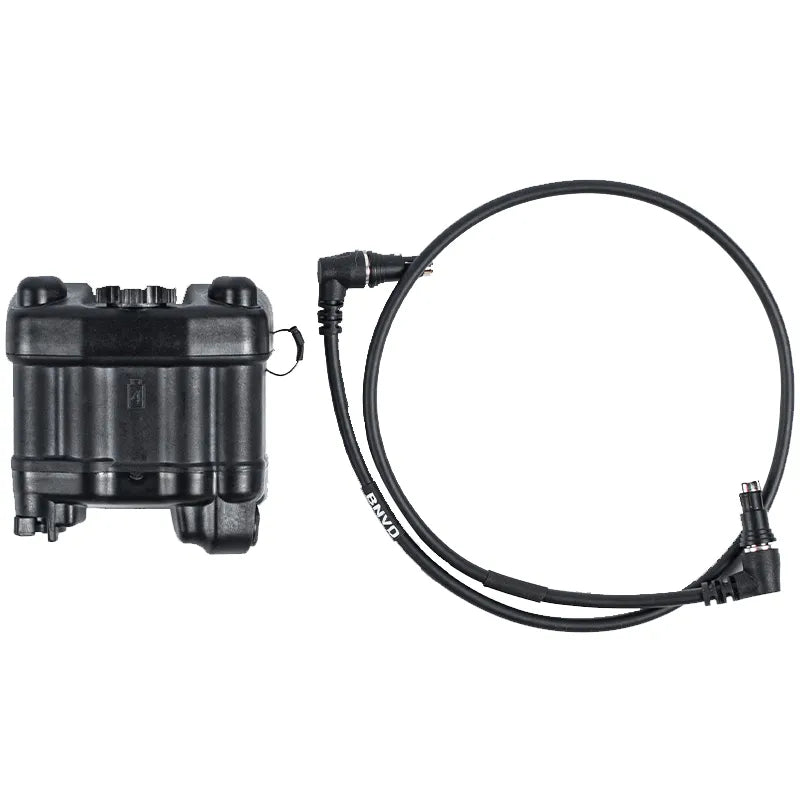
The ARGUS Universal Strobe Battery Pack includes two IR strobes in addition to its external NVG power and helmet-counterbalance functions.
ARGUS lists those strobes for nighttime identification and search-and-rescue support.
Why a Flashing Signal Is Easy to Notice
The human visual system is highly sensitive to changes in brightness.
A steady point of light may become part of the visual background.
A flashing source repeatedly changes brightness, making it easier to notice.
Under night vision, this can make a strobe useful as an identification or location signal.
A flashing source may be easier to distinguish from:
-
Static lights
-
Buildings
-
Stars
-
Distant reflections
-
Constant illumination
This is one reason strobes are widely associated with marking and rescue functions.
However, the same characteristic means an active strobe should never be treated as an inherently hidden signal.
IR Strobe vs. Constant IR Illumination
| Feature | IR Strobe | Constant IR Illuminator |
|---|---|---|
| Emission pattern | Repeated flashes | Continuous |
| Primary role | Identification or marking | Scene illumination |
| Provides continuous terrain detail | No | Yes |
| Easy to notice through compatible NVG | Often | Depends on scene |
| Battery consumption | Depends on design and duty cycle | Depends on output and runtime |
| Can create reflections | Yes | Yes |
| Can cause blooming | Yes | Yes |
| Useful as location signal | Yes | Not its primary role |
An IR strobe and an IR illuminator solve different problems.
A strobe says, in effect:
“Notice this location or object.”
An illuminator says:
“Add light to this area.”
Why Strobes Can Temporarily Overwhelm the Image
A strong flashing source may become extremely bright through an image intensifier.
Possible effects include:
-
Blooming
-
Halo
-
Temporary loss of surrounding detail
-
Visual distraction
-
Repeated brightness changes
If the signal is close to the user or reflected from a nearby surface, these effects may become more noticeable.
Autogated tubes can manage changing light more effectively, but autogating does not make a bright strobe disappear.
The full image still depends on:
-
Source intensity
-
Distance
-
Reflection
-
Tube halo
-
Ambient light
-
Viewing geometry
Why Autogating Matters Around Flashing IR
Autogated image intensifier tubes rapidly regulate their operation when incoming light changes.
This makes autogating useful around environments containing:
-
Flashing identification lights
-
Vehicle lighting
-
Searchlights
-
IR illumination
-
Reflected light
-
Mixed urban lighting
A non-gated tube may show stronger blooming or washout when exposed to sudden brightness.
Autogating generally produces a more controlled transition.
It does not eliminate:
-
Halo
-
Reflection
-
Light scatter
-
Sensor detectability
For a complete explanation, read Gated vs. Non-Gated Image Intensifiers.
Halo Is Important Around Strobes
Halo describes the glow that appears around a concentrated bright source.
A strong strobe may produce a visible halo through the tube.
A larger halo can temporarily hide nearby details.
This matters when a marker is positioned close to:
-
Equipment
-
People
-
Vehicles
-
Terrain features
A user comparing image intensifier tubes should therefore consider halo along with:
-
SNR
-
FOM
-
Resolution
-
EBI
-
Autogating
-
Gain
Available tube specifications can be compared through the Image Intensifier Tube collection.
Manual Gain and Bright Identification Signals
Manual gain allows the user to adjust the apparent brightness of the intensified image.
In an environment containing bright strobes or other strong lights, reducing gain may make the image more comfortable.
However, gain reduction also makes darker parts of the scene less prominent.
Manual gain therefore changes image presentation rather than eliminating the actual source.
It should not be confused with:
-
Autogating
-
Turning off illumination
-
Reducing emitted IR
-
Making a strobe undetectable
For more information, read The Truth About Flying Wires vs 3-Pin Tubes: Managing Manual Gain Control.
IR Strobes for Search and Rescue
Search and rescue is one of the clearest non-offensive applications for an IR strobe.
When rescue teams use compatible night vision equipment, a flashing signal can help mark:
-
A rescuer
-
A survivor location
-
A staging point
-
Authorized equipment
-
A known reference location
Strobes are most useful when all participating teams understand the identification procedure.
An uncoordinated flashing signal may create confusion rather than clarity.
The ARGUS Universal Strobe Battery Pack specifically lists nighttime SAR among the uses for its two IR strobes.
For broader rescue equipment planning, read Night Vision in Search & Rescue.
Identification Requires Procedures, Not Just Equipment
A flashing IR source is only a signal.
It does not automatically tell the observer who or what is producing it.
Reliable identification may require:
-
Agreed signaling procedures
-
Known equipment
-
Communication
-
Location information
-
Other visual or electronic confirmation
This is particularly important in professional environments.
A strobe should support identification rather than replace it.
Do not assume that any flashing IR source represents a known friendly or authorized person.
Strobe Location and Helmet Ergonomics
A rear helmet strobe battery pack adds more than an identification signal.
It also changes:
-
Weight distribution
-
Helmet balance
-
Cable routing
-
Access to batteries
The ARGUS USBP is designed to mount on the rear of a helmet and can act as functional counterbalance for front-mounted NVGs.
This may be useful with:
-
Binocular NVGs
-
PVS-31-style systems
-
BNVD platforms
-
Panoramic NVGs
A rear battery pack adds total weight but can reduce forward helmet pull.
For more detail, read Managing NVG Weight: Why You Need a Strobe Battery Pack for Helmet Balance.
Power Planning for IR Strobes
An active strobe consumes power.
When the strobe is integrated into a battery pack, the same system may also be responsible for powering the NVG.
Power planning should therefore consider:
-
Battery condition
-
Battery chemistry
-
Cold-weather performance
-
NVG runtime
-
Strobe use
-
Cable condition
-
Spare batteries
The ARGUS USBP uses four AA batteries and supplies compatible night vision systems through the appropriate cable or adapter.
For a complete battery comparison, read Powering Your Night Vision: AA vs. CR123A vs. External Battery Packs.
Visible Strobes vs. IR Strobes
Visible and infrared strobes serve similar signaling concepts but interact with different observers.
Visible Strobe
Can generally be seen by unaided human vision.
Useful when:
-
NVGs are not universal
-
Rescue aircraft or personnel need a visible reference
-
Public safety signaling is required
IR Strobe
Designed to be observed using compatible night vision or IR-sensitive equipment.
Useful when:
-
Authorized teams are using NVGs
-
Visible-light disruption should be limited
-
The signaling system is designed around night vision
Neither signal type is universally better.
The correct choice depends on:
-
Rescue procedures
-
Equipment availability
-
Regulations
-
Team coordination
-
Environmental conditions
Light Discipline in Vehicles and Structures
Enclosed environments create strong reflection problems.
IR light can reflect from:
-
Windshields
-
Windows
-
White walls
-
Metal
-
Polished surfaces
-
Electronic screens
The reflected light may be brighter than the outside scene.
In these environments, users should first understand whether ambient light is already adequate before introducing additional illumination.
Unnecessary active IR may reduce rather than improve visibility.
Light Discipline Around Water
Water is another environment where illumination geometry matters strongly.
A bright source may:
-
Reflect as a long streak
-
Appear duplicated
-
Scatter from spray
-
Produce moving highlights
-
Hide darker objects nearby
An off-axis source may change the reflection pattern, but it does not remove reflection physics.
The scene should be interpreted using multiple visual references and complementary sensors where appropriate.
Read Night Vision for Maritime & Coastal Patrols for more detail.
Light Discipline Does Not Mean Avoiding All Illumination
Active illumination has legitimate uses.
It may support:
-
Search and rescue
-
Inspection
-
Navigation in enclosed darkness
-
Training
-
Equipment identification
-
Authorized signaling
The goal is not to eliminate light.
The goal is to use the minimum illumination needed for the task while understanding its effects on both the image and other compatible sensors.
This reduces:
-
Unnecessary glare
-
Reflection
-
Battery use
-
Image clutter
-
Confusion
Good light discipline is therefore partly an image-quality skill.
A Safe Light-Management Framework
For lawful observation, SAR and training, use this general decision process.
1. Check Ambient Light First
Determine whether the NVG already provides enough information without active illumination.
2. Check the Optical Setup
Confirm:
-
Focus
-
Diopter
-
Lens cleanliness
-
Gain
-
Helmet position
3. Identify Reflective Surfaces
Look for:
-
Glass
-
Water
-
Wet surfaces
-
Signs
-
Metal
-
Light-colored walls
4. Add Illumination Only When Necessary
More output does not always create more usable information.
5. Watch for Blooming and Halo
If additional light hides nearby detail, the image may be over-illuminated.
6. Treat Every IR Emitter as Detectable
Do not assume off-axis geometry or invisible wavelengths provide guaranteed concealment.
7. Use Strobes Only Under an Appropriate Identification Procedure
A flash is useful when everyone knows what it means.
Common Misconceptions
“Off-Axis IR Cannot Be Seen”
False. Reflected, scattered or direct IR may still be visible to compatible sensors.
“A Strobe Is Only Visible to the Intended Observer”
False. Compatible night vision equipment in a suitable position may detect the signal.
“Autogating Makes Bright IR Harmless”
Autogating improves tube response but does not eliminate glare, halo or intense illumination.
“More IR Always Improves Night Vision”
Excessive illumination may reduce contrast through blooming, reflection and scatter.
“IR Strobes Automatically Identify Friendly Personnel”
A strobe is a marker. Reliable identification requires procedures and context.
“Light Discipline Means Never Using Active IR”
No. It means understanding when illumination adds useful information and when it creates unnecessary problems.
Frequently Asked Questions
What Is Off-Axis IR Illumination?
It describes infrared illumination coming from a direction that is not directly aligned with the observer’s viewing axis. The different illumination geometry changes shadows, texture and reflections.
Does Off-Axis IR Reduce Glare?
It can change the reflection pattern, but the result depends on the surface, angle, distance and environment. It should not be treated as a guaranteed glare-reduction technique.
Can NVGs See IR Strobes?
Compatible image intensifier systems may detect IR strobe emissions.
What Is an IR Strobe Used For?
Common authorized uses include identification, marking, equipment location and search-and-rescue signaling.
Does an IR Strobe Work as an Illuminator?
Its primary function is signaling rather than continuous scene illumination.
Can a Bright Strobe Affect the NVG Image?
Yes. Strong flashing sources may produce halo, blooming and temporary loss of nearby image detail.
Does Autogating Help?
Autogating can improve image stability when incoming light changes rapidly, but it does not remove the light source or its reflections.
Is Passive Night Vision Always Preferable?
No. Very dark environments may require additional illumination. The correct approach depends on available light, tube performance and the authorized task.
Final Thoughts
Night vision changes the meaning of light.
Infrared energy that appears invisible to the unaided eye may become extremely obvious through an image intensifier.
Understanding light discipline therefore requires users to think about:
-
Where the light comes from
-
What surfaces it reaches
-
How it reflects
-
How it scatters
-
How the tube responds
-
What other compatible sensors may detect
Off-axis IR changes illumination geometry.
It can change shadows, surface texture and reflection patterns, but it does not make an active emitter invisible.
IR strobes provide a different function.
They create a repeated signal that can be useful for authorized identification, marking and search-and-rescue applications.
Their visibility is a feature, not a flaw.
A well-configured night vision system should therefore treat active IR as a tool rather than a default setting.
First maximize the performance of:
-
Image intensifier tubes
-
Optics
-
Focus
-
Autogating
-
Gain control
-
Helmet fit
Then add illumination when the task genuinely requires it.
The central principle is simple:
Every emitted light source changes the scene.
Good light discipline means understanding that change before deciding whether the additional light provides more useful information than it takes away.