
Cart
0
Ask how much do night vision goggles cost and you usually get a range so wide it tells you nothing. The honest answer has a shape: a ladder with six rungs, where the housing stays roughly constant and the tube does almost all of the work on price. This article walks each rung, explains exactly what changes between them, and gives you a way to judge whether any quote you receive is reasonable. Figures here are taken from our own storefront in September 2026 and will move over time; the structure will not.
Why the tube, not the goggle, sets the price
Before the ladder, one idea makes everything else make sense. A night vision device is a housing, a pair of lenses and an image intensifier tube. The housing is manufactured to a repeatable cost. The lenses vary, but within a narrow band. The tube is a hand-graded component whose performance is measured individually, and its grade can swing the finished price by a factor of two on an otherwise identical goggle.
That is why two goggles with the same model name can be thousands of dollars apart, and why a seller who quotes you a model without naming the tube has not actually quoted you anything.
Rung 1: a complete Gen 2+ monocular
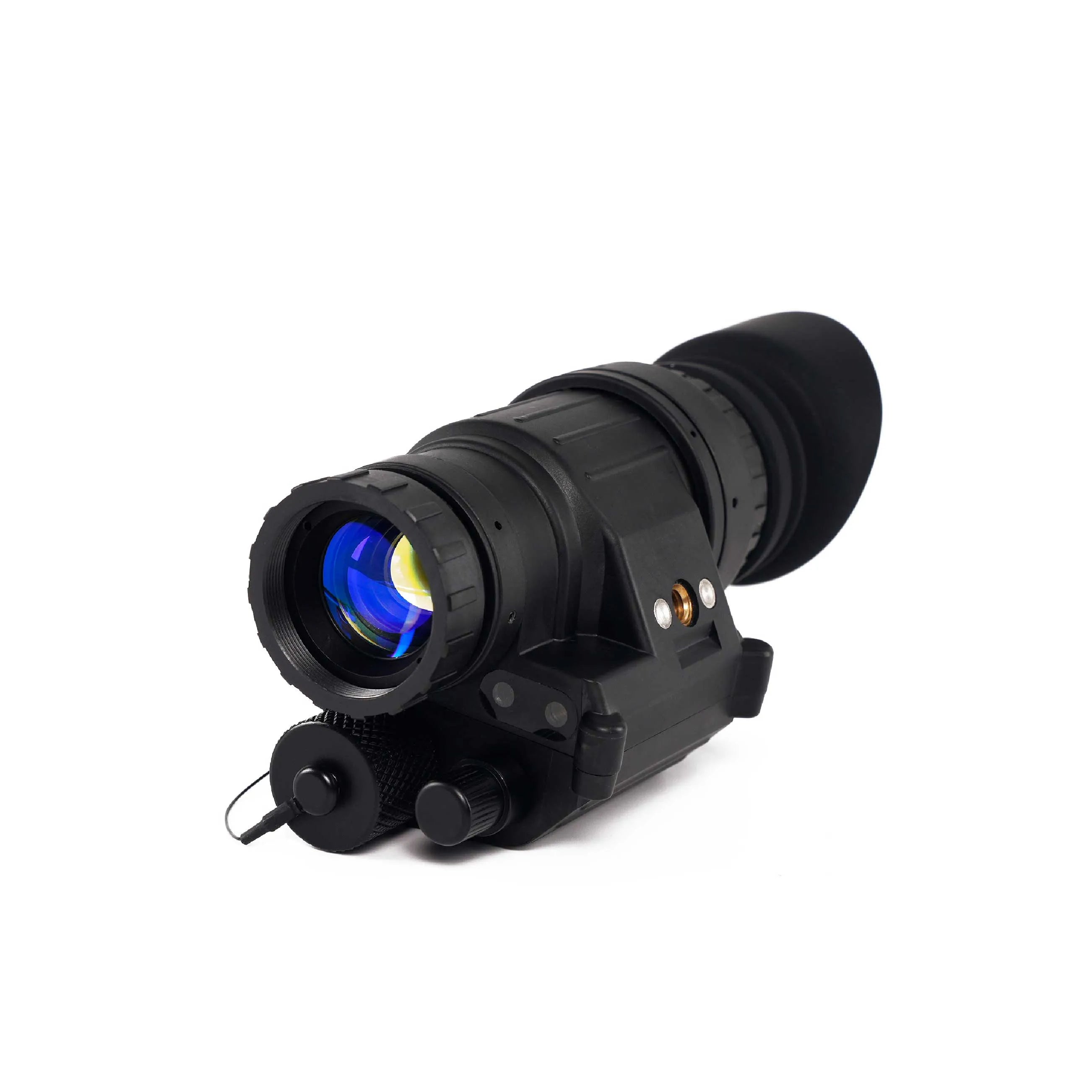
The cheapest complete device is a PVS-14 pattern monocular with a Gen 2+ tube at figure of merit 1400, non-gated. In green phosphor with a raised screen it sits at the bottom of our range; moving to a white phosphor screen at the same figure of merit adds a few hundred dollars and nothing else changes. That difference is the phosphor alone.
At this rung you get a genuine, usable night vision device. What you do not get is autogating, which matters the moment artificial light enters the scene.
PVS-14 with Gen 2+ FOM 1400 white phosphor tube
Rung 2: autogating and manual gain
The next step adds an autogated tube, typically NVT5 class, at figure of merit 1400 to 1600, with either a two-pin or a three-pin manual gain interface. Between rung 1 and rung 2 you are paying roughly three hundred dollars for gating and a further hundred and fifty or so for the figure of merit step. The interface itself, two-pin against three-pin manual gain, is a small premium.
If you are going to spend money once above the entry rung, spend it here. Autogating is what stops a passing vehicle's headlights from blanking your image, and manual gain is what lets you tune the picture rather than accept whatever the tube decides.
PVS-14 with NVT5-class FOM 1600 autogated tube and manual gain
Rung 3: top Gen 2+ or entry Gen 3
Here the ladder becomes interesting. NVT7-class Gen 2+ tubes at figure of merit 1800 to 2000 land at roughly the same price as Gen 3 tubes at figure of merit 1800. The generation label and the measured performance are pulling in different directions, and the measured number is the one that describes what you will see.
A Gen 2+ tube measuring 2000 and a Gen 3 tube measuring 1800 sit within a couple of hundred dollars of each other. Buy on the measured figure of merit and the phosphor you prefer, not on the generation badge. The full spread of individually measured tubes is visible in our image intensifier tube listings, where each tube carries its own serial number and measured value rather than a marketing bracket.
Rung 4: articulating binoculars
Two tubes, two lens sets, a housing with a gravity sensor and a programmable bridge. A BNVD-1431 MK2 starts with a pair of figure of merit 1400 green phosphor tubes and tops out with Gen 3 figure of merit 2000 white phosphor autogated tubes, and the spread inside that single model is over three thousand dollars. Almost all of it is tube grade.
This is the rung where most serious buyers land, and it is where the tube-grade lesson pays for itself. Compare configurations across the binocular night vision range and you will see the housing price is effectively fixed while the tube pair moves everything.
Rung 5: lightweight fixed-form binocular
The PVS-31 sits above the 1431 because of what the housing itself delivers rather than because of the tubes: a system resolution up to 72 line pairs per millimetre, 450 grams or less with tubes and without a battery, and lenses designed to be stripped in the field for maintenance. You are paying for weight and serviceability.
The bare housing with lenses and no tubes is a useful reference point here. Subtract it from the complete unit price and you have the market's answer to what a matched pair of tubes is worth.
Rung 6: four-tube panoramic
The PNVG-18 uses four tubes to widen the field of view from around 40 degrees to around 100. Four tubes is why the price roughly doubles from the binocular rung. The bare housing and the housing with lenses are a small fraction of the complete unit; the rest is the four tubes. Browse the panoramic night vision range and the same arithmetic holds at every configuration.
What the ladder tells you
- Tube grade is the price. From rung 1 to rung 3 the housing is identical. The entire spread is the tube.
- A second tube costs more than a second housing. Going from a monocular to a binocular with the same tube grade roughly doubles the tube spend, and the housing difference is comparatively small.
- Housing kits are the cheap way in. If you already own tubes, buying the BNVD-1431 MK2 housing kit and fitting them is far cheaper than a complete unit. This is how a large share of units actually leave our building.
- Individual tubes are priced by measured performance. A tube advertised as "1600 plus" might measure 1601 or 1848. The gap is worth real money.
Where the money actually goes inside one goggle
It helps to see the split rather than the total. On a mid-range binocular, roughly two thirds of what you pay is the pair of tubes. The housing, hinges, bridge electronics and dovetail together account for most of the remainder, and the lens sets are a smaller slice than buyers expect.
That ratio explains several things at once. It explains why a housing-only purchase is dramatically cheaper than a complete unit. It explains why upgrading tubes in a housing you already own is the most cost-effective performance improvement available to you. And it explains why two sellers quoting the same model can be far apart without either of them being dishonest: they are quoting different tubes.
It also explains what does not save you money. Choosing a cheaper lens set saves a modest amount and costs you image quality at the edges. Skipping the mount saves nothing, because you will buy one within a week. The only lever with real travel on it is the tube.
Used, refurbished and grey market
A fair question at every rung is whether to buy new at all. Three cautions apply.
First, a used goggle is only as good as its tube hours, and tubes age. A tube with unknown history and no data sheet should be priced as an unknown, not as its badge suggests.
Second, refurbished units vary enormously depending on whether the refurbisher measured anything. A unit that has been cleaned and reassembled without being collimated or gain-matched will look fine for ten minutes and tire your eyes over an hour.
Third, the export rules discussed below apply to used equipment exactly as they apply to new. A bargain that cannot legally reach you is not a bargain.
What else changes how much night vision goggles cost
Three factors sit outside the ladder and catch people out.
Export status. Night vision devices are controlled items in the United States, and the applicable rules sit in the International Traffic in Arms Regulations; the United States Munitions List in 22 CFR Part 121 is the authoritative text. Whether a given device can ship to a given destination changes both what is available to you and what it costs to get it there.
Accessories you will buy anyway. A mount, a battery pack, sacrificial lenses and a case are not optional in practice. Budget for them at purchase rather than discovering them afterwards; our night vision accessories range covers what a first-time buyer actually needs.
Tube documentation. A tube supplied without a data sheet is worth less than one with. The military specifications that define these tube formats are published; the Defense Logistics Agency's ASSIST specification database is where the underlying documents live. Insist on resolution, signal-to-noise ratio and the measured figure of merit before you agree a price.
So how much do night vision goggles cost, in one paragraph
A usable Gen 2+ monocular starts at the low four figures. Adding autogating and manual gain moves it up by a few hundred. A high-grade monocular, whether top Gen 2+ or entry Gen 3, roughly doubles the entry figure. An articulating binocular starts at around three times a comparable monocular and can reach seven times it with the best tubes. A four-tube panoramic starts at roughly double the top binocular. Every one of those steps is a tube decision wearing a housing.
How to judge a quote in two minutes
Ask three questions. What is the tube's measured figure of merit and serial number? Is it autogated? Is the price for a complete unit, a housing with lenses, or a bare housing? A seller who answers all three clearly is quoting you something you can compare. A seller who cannot answer the first is quoting you a bracket, and you should pay bracket-minimum for it.
Frequently Asked Questions
How much do night vision goggles cost at the entry level?
The cheapest complete device is a Gen 2+ monocular with a non-gated tube at figure of merit 1400. It is a genuine night vision device, but it lacks autogating, so bright artificial light will wash out the image. Stepping up to an autogated tube is the single most worthwhile increment above the entry rung.
Why do two goggles with the same model name have very different prices?
Because the tube is graded individually and the housing is not. On an identical housing, the tube grade can change the finished price by a factor of two. A quote that names a model without naming the tube's measured figure of merit and gating has not really quoted anything.
Is a Gen 3 tube always better than a Gen 2+ tube?
No. Generation describes the manufacturing technology, not the delivered performance. A Gen 2+ tube measuring 2000 and a Gen 3 tube measuring 1800 sit close in price and the Gen 2+ tube has the higher measured figure of merit. Buy on the measured number and the phosphor you prefer.
Is it cheaper to buy a housing kit and fit my own tubes?
Only if you already own suitable tubes or can source them below the bundled price. If you are buying both at retail the saving is small, and it disappears if you have to pay someone to purge and collimate the finished build. What the housing route buys is control over tube grade, phosphor, gating and lenses.
What should I budget beyond the goggle itself?
A mount, a battery pack, sacrificial or protective lenses and a case. These are not optional in real use, and buyers who leave them out of the initial budget routinely spend several hundred dollars more than they planned within the first month.