
Cart
0
Introduction
Night vision devices are expensive precision optical systems.
Whether you use a PVS-14 monocular, PVS-31 style binocular NVG, BNVD-1431 MK2, DTNVG, RNVG, MOD-3, or another helmet-mounted night vision platform, one part of the setup is always exposed:
Your lenses.
The objective lens and eyepiece lens are easy to overlook because they are not as exciting as image intensifier tubes, FOM numbers, SNR, white phosphor, or panoramic field of view.
But once a lens gets scratched, cracked, contaminated, or damaged, the entire viewing experience can suffer.
That is why NVG lens protectors should not be treated as optional accessories.
Two of the most common protection options are:
-
Sacrificial lenses
-
Rubber lens protection caps
Both are useful, but they solve different problems.
In this guide, we explain why lens protection matters, how sacrificial lenses compare with PVS-31/PVS-14 rubber caps, and how to choose the right protection setup for your night vision device.
If you already know you need simple cap-style protection, start with the Universal Lens Protection Cover for PVS31 and PVS14 optics.
Why Night Vision Lens Protection Matters
A night vision device is only as useful as the image it can produce.
The image intensifier tube may be the core component, but the lens system determines how cleanly light enters and exits the device.
Scratches, dust, moisture, and impact damage can reduce:
-
Image clarity
-
Contrast
-
Sharpness
-
Light transmission
-
Edge performance
-
Focus precision
-
Long-term resale value
A scratched lens can make a good tube look worse than it really is.
A dirty or damaged eyepiece can make the image uncomfortable to view.
A cracked objective lens can turn a working NVG into an expensive repair project.
This is why small lens protection accessories can protect a much larger investment.
What Usually Damages NVG Lenses?
Night vision lenses can be damaged in more ways than many users expect.
Common causes include:
-
Sand
-
Dust
-
Mud
-
Rain
-
Fingerprints
-
Rough cleaning cloths
-
Branches and brush
-
Impact during transport
-
Helmet storage
-
Gear bag contact
-
Dropping the device
-
Scraping against equipment
-
Training environments
-
Vehicle movement
Many lens scratches happen when the device is not even being used.
They happen during storage, transport, packing, unpacking, or helmet handling.
That is exactly why rubber caps and universal protection covers are so useful.
What Is a Sacrificial Lens?
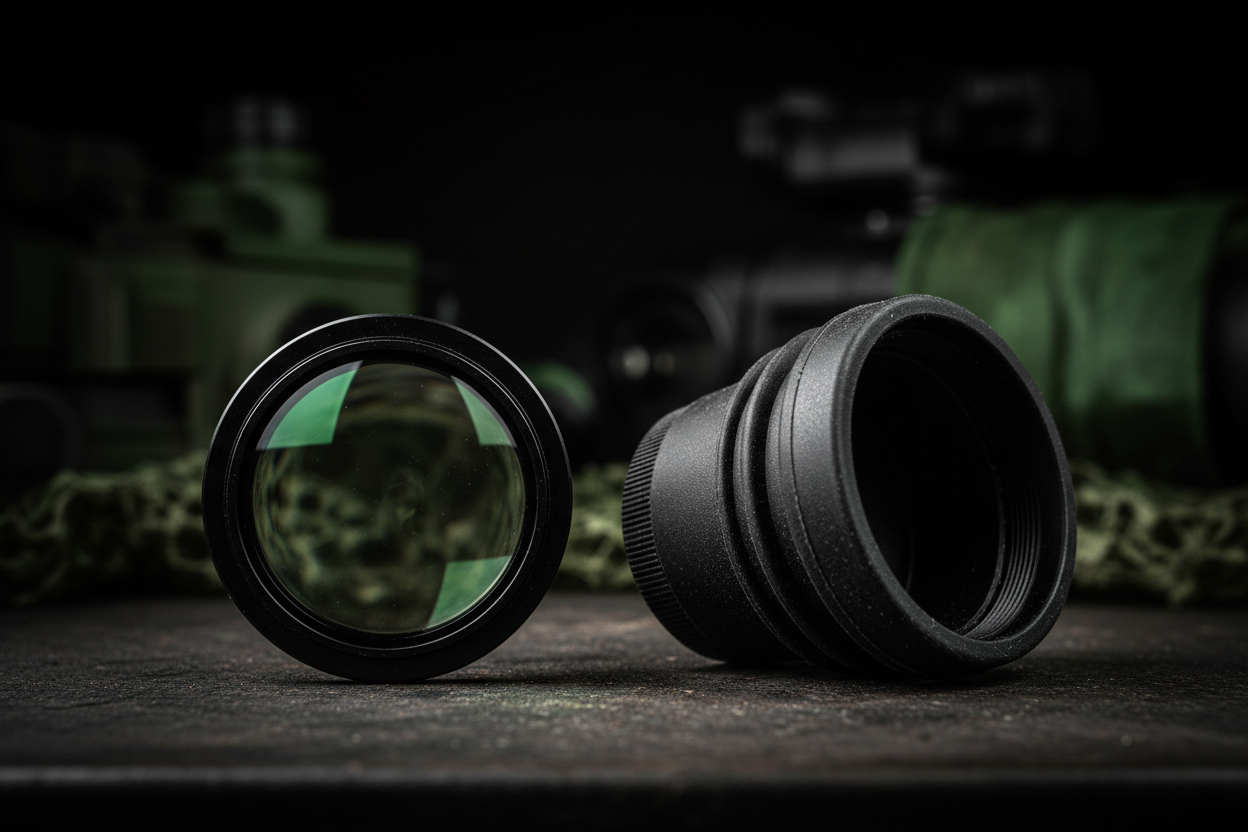
A sacrificial lens is a transparent protective lens installed over the main optical lens.
Its job is simple:
It takes the damage so the main optic does not have to.
If the sacrificial lens gets scratched, worn, or damaged, you replace the sacrificial lens instead of replacing the more expensive main lens.
Sacrificial lenses are commonly used during active operation because they allow the user to keep looking through the device while protecting the optical surface.
They are useful for:
-
Dusty environments
-
Sandy terrain
-
Brush movement
-
Outdoor training
-
Range use
-
Search operations
-
Field use
-
Active helmet-mounted NVG use
For PVS-31 style systems, the PVS31 Objective sacrificial lens is a relevant protection option.
What Is a Rubber Lens Protection Cap?
A rubber lens protection cap is a flexible cap-style protector that covers the lens when the device is not actively being used.
Unlike a sacrificial lens, a rubber cap is usually removed before viewing.
Its main purpose is to protect lenses during:
-
Storage
-
Transport
-
Helmet setup
-
Gear bag movement
-
Vehicle movement
-
Equipment staging
-
Long-term storage
-
Everyday handling
The Universal Lens Protection Cover for PVS31 and PVS14 optics uses soft rubber material, has a two-point attachment design, and is listed as compatible with multiple night vision platforms including PVS-14, PVS-31, BNVD-1431, BNVD-31, DTNVG/DTNVS, MOD3, RNVG/RPNVG, KATANA, and more.
This makes rubber caps a practical everyday protection option for many NVG users.
Sacrificial Lenses vs Rubber Caps: Quick Comparison
| Feature | Sacrificial Lens | Rubber Protection Cap |
|---|---|---|
| Main purpose | Protects lens during active use | Protects lens during storage and transport |
| Transparent | Yes | Usually no |
| Used while viewing | Yes | Usually removed before viewing |
| Best for | Dust, sand, brush, active field use | Gear bags, helmet transport, storage |
| Replacement role | Replaceable optical protection layer | Reusable cap-style protection |
| Image impact | Possible if dirty or low quality | No viewing impact when removed |
| Best user | Active field users | Almost every NVG user |
| Example use | Objective lens protection during operation | PVS-14 / PVS-31 rubber cap during storage |
The best option depends on when and how you need protection.
For serious users, the answer is usually not one or the other.
It is both.
Why Sacrificial Lenses Are Useful During Active Use
Sacrificial lenses are most valuable when your NVGs are exposed while you are using them.
For example, if you are moving through brush, sand, dust, or debris, the objective lens is vulnerable.
A sacrificial lens adds a replaceable barrier in front of the main optic.
This can help protect against:
-
Scratches from branches
-
Dust and sand contact
-
Light debris
-
Training wear
-
Environmental exposure
-
Minor surface damage
Because sacrificial lenses are transparent, they allow the device to remain usable while protected.
That makes them different from caps.
Caps are for storage and transport.
Sacrificial lenses are for active protection.
Limitations of Sacrificial Lenses
Sacrificial lenses are useful, but they are not perfect.
They can introduce problems if they are dirty, scratched, or poorly made.
Possible issues include:
-
Reduced image clarity
-
Added glare
-
Lower contrast
-
Light reflection
-
Distortion
-
Dust buildup
-
Water spots
-
More surfaces to clean
A scratched sacrificial lens is still better than a scratched main optic, but users should replace damaged sacrificial lenses when needed.
Do not let a worn protection layer ruin the image quality of a good NVG setup.
Why Rubber Caps Are Useful for Everyday Protection
Rubber caps are simple, affordable, and practical.
They protect lenses when the device is not being viewed through.
This matters because many NVG users damage lenses during normal handling rather than during active field use.
A rubber cap can help prevent damage from:
-
Gear bag contact
-
Helmet shifting
-
Storage pressure
-
Dust buildup
-
Finger contact
-
Scraping against other equipment
-
Vehicle transport
-
Accidental bumps
For users who own PVS-14, PVS-31, BNVD-1431, or similar systems, a rubber cap is one of the easiest accessories to justify.
The Universal Lens Protection Cover for PVS31 and PVS14 optics is a direct option for this role.
Limitations of Rubber Caps
Rubber caps are mainly designed for storage and transport protection.
They are not usually used while actively viewing through the device.
This means they do not protect the lens during:
-
Active scanning
-
Movement through brush
-
Dust exposure while operating
-
Rain exposure while viewing
-
Range use
-
Field observation
If your device is exposed during active use, you may still want a sacrificial lens.
Rubber caps protect when the device is not in use.
Sacrificial lenses protect while the device is in use.
PVS-31 Lens Protection
PVS-31 style binocular night vision systems have multiple optical surfaces that need protection.
A typical binocular system includes:
-
Two objective lenses
-
Two eyepieces
-
Multiple optical coatings
-
Helmet-mounted exposure
-
Storage and transport risk
Because PVS-31 style devices are often helmet-mounted, they may be exposed to bumps, scratches, and gear contact even before the user turns them on.
PVS-31 users should consider:
-
Objective sacrificial lenses
-
Eyepiece protection
-
Rubber lens caps
-
Protective pouches or cases
-
Lens-safe cleaning tools
Useful protection pages include:
PVS-14 Lens Protection
The PVS-14 is one of the most widely used night vision monocular platforms.
It can be used handheld, helmet-mounted, bridge-mounted, or as a general-purpose observation device.
Because of that versatility, it is often handled frequently.
That increases the risk of lens damage.
PVS-14 users should protect:
-
Objective lens
-
Eyepiece lens
-
Threaded lens areas
-
Storage surfaces
-
Lens caps
-
Optical coatings
The Universal Lens Protection Cover for PVS31 and PVS14 optics is listed as compatible with PVS-14 optics, making it a practical everyday protection accessory for PVS-14 users.
If you are comparing PVS platforms, read PVS-14 vs PVS-31: Which Night Vision Device Is Right for You?.
BNVD-1431 Lens Protection
The BNVD-1431 MK2 is a popular binocular night vision platform.
Its product page states that it is compatible with US military standard PVS-14 lenses and can also work with commercial 40-degree lenses, 51-degree lenses, and ultra-light resin lenses depending on user requirements.
Because BNVD-1431 systems are commonly helmet-mounted, lens protection is especially important during:
-
Training
-
Transport
-
Storage
-
Pod articulation
-
Helmet setup
-
Field movement
Users running BNVD-1431 style setups can use compatible rubber caps for storage and may also consider sacrificial lenses or protective optical accessories depending on the lens setup.
For platform details, see the BNVD-1431MK2 Binocular Night Vision Device 1431 housing kit with lenses.
Why Lens Protectors Matter for Image Quality
Lens protectors are not only about avoiding visible scratches.
They also help preserve the optical path.
A clean and undamaged lens system helps maintain:
-
Light transmission
-
Sharpness
-
Contrast
-
Edge clarity
-
Focus accuracy
-
User comfort
A poor optical path can make a good image intensifier tube look worse.
This is why lens protection is directly connected to tube performance.
For more on tube performance, read What Is FOM in Night Vision? Understanding Image Intensifier Tube Specs.
For more on optical distortion and lens design, read What Causes Distortion in NVGs? The Difference Between Aspherical and Spherical Lenses.
When Should You Use Sacrificial Lenses?
Use sacrificial lenses when you expect the lens to be exposed during operation.
They are useful for:
-
Outdoor movement
-
Range training
-
Dusty conditions
-
Sandy environments
-
Brush or woodland movement
-
Active helmet-mounted use
-
Search and rescue
-
Field observation
-
Rough handling environments
Sacrificial lenses make sense when you need protection while still viewing through the device.
For PVS-31 style systems, start with the PVS31 Objective sacrificial lens.
When Should You Use Rubber Caps?
Use rubber caps when the device is not actively being viewed through.
They are useful for:
-
Storage
-
Transport
-
Helmet setup
-
Gear bags
-
Vehicle movement
-
Equipment staging
-
Long-term protection
-
Preventing dust buildup
-
Preventing scratches during handling
Rubber caps are one of the most practical accessories for everyday NVG ownership.
For PVS-14 and PVS-31 style optics, the Universal Lens Protection Cover for PVS31 and PVS14 optics is the most relevant option.
Best Setup: Use Both
For the strongest protection, use both sacrificial lenses and rubber caps.
A practical setup may look like this:
-
Sacrificial lens during active use
-
Rubber cap during storage and transport
-
Diopter protective lens for eyepiece protection where compatible
-
Protective case or pouch
-
Lens-safe cleaning tools
-
Regular inspection
This gives your NVG lenses protection in more situations.
Sacrificial lenses protect the lens while you are using the device.
Rubber caps protect the lens when you are not using it.
Together, they reduce the risk of avoidable damage.
How to Clean Protected NVG Lenses
Lens protectors reduce risk, but they still need proper care.
Follow these basic practices:
1. Remove Loose Dust First
Use an air blower or lens-safe brush before wiping.
Dust and sand can scratch optical surfaces.
2. Use Lens-Safe Materials
Use microfiber cloths or approved optical cleaning tools.
Avoid clothing, paper towels, dirty rags, or aggressive chemicals.
3. Replace Damaged Sacrificial Lenses
If the sacrificial lens is scratched or cloudy, replace it.
Do not let a damaged protector ruin your image.
4. Inspect Rubber Caps
If rubber caps become loose, cracked, deformed, or dirty, replace them.
5. Store Devices Dry
Do not store wet NVGs in a sealed bag for long periods.
Moisture can create fogging and long-term maintenance issues.
For moisture prevention, read The Importance of NVG Nitrogen Purging: Why You Need a Purge Valve Fitting.
Common Mistakes NVG Users Make
Mistake 1: Thinking Lens Protectors Are Optional
Lens protectors are inexpensive compared with optical repairs.
Skipping them can cost more later.
Mistake 2: Only Protecting During Storage
Storage protection is important, but active-use protection may also be needed.
Mistake 3: Using Dirty Sacrificial Lenses
A dirty sacrificial lens can reduce image quality.
Clean or replace it as needed.
Mistake 4: Cleaning with the Wrong Cloth
Improper cleaning can scratch lenses faster than field use.
Mistake 5: Forgetting Eyepiece Protection
Objective lenses are not the only optical surfaces that matter.
Eyepieces also need protection.
Mistake 6: Assuming All Caps Fit All Devices
Check compatibility before buying.
Universal caps can fit many platforms, but you should still verify your setup.
Are Lens Protectors Worth It?
Yes.
Lens protectors are one of the simplest and most cost-effective ways to protect a night vision device.
They are especially worth it if you:
-
Use helmet-mounted NVGs
-
Transport devices in gear bags
-
Train outdoors
-
Move through brush or dust
-
Own PVS-14 or PVS-31 style optics
-
Use binocular night vision
-
Want to protect resale value
-
Want to avoid unnecessary repairs
-
Care about long-term optical clarity
A high-performance tube deserves a protected optical path.
Skipping lens protection is not a good way to save money.
Where to Find NVG Lens Protection Parts
Useful pages include:
Related guides:
-
How to Protect Your NVG Lenses: Sacrificial Lenses vs. Universal Protection Covers
-
What Causes Distortion in NVGs? The Difference Between Aspherical and Spherical Lenses
-
The Importance of NVG Nitrogen Purging: Why You Need a Purge Valve Fitting
-
What Is FOM in Night Vision? Understanding Image Intensifier Tube Specs
-
PVS-14 vs PVS-31: Which Night Vision Device Is Right for You?
Final Thoughts
Lens protectors are small accessories, but they play an important role in night vision ownership.
Sacrificial lenses help protect your optics during active use.
PVS-31/PVS-14 rubber caps help protect your lenses during storage, transport, and everyday handling.
One protects while you are looking through the device.
The other protects while the device is packed, staged, mounted, or stored.
For the best protection, use both.
If you own PVS-14, PVS-31, BNVD-1431, or other compatible night vision optics, start with the Universal Lens Protection Cover for PVS31 and PVS14 optics and add sacrificial lenses where active-use protection is needed.
A better night vision setup is not only about better tubes.
It is also about protecting the lenses that allow those tubes to perform.