
Cart
0
Introduction
Thermal imaging is no longer limited to static observation or long-range detection.
Modern compact thermal monoculars are increasingly used for:
-
Night navigation
-
Search and rescue
-
Tactical movement
-
Hunting and wildlife observation
-
Vehicle support
-
Perimeter security
-
Helmet-mounted thermal use
-
Clip-on thermal applications
In difficult environments, visible light is not always reliable.
Darkness, smoke, fog, light rain, dense vegetation, cold terrain, and uneven surfaces can make movement more challenging.
This is where a compact thermal monocular such as the PFalcon V2 becomes valuable.
Unlike image intensifier night vision, which relies on available light, thermal imaging detects heat signatures. This allows users to identify people, animals, vehicles, and warm objects even when visual contrast is low.
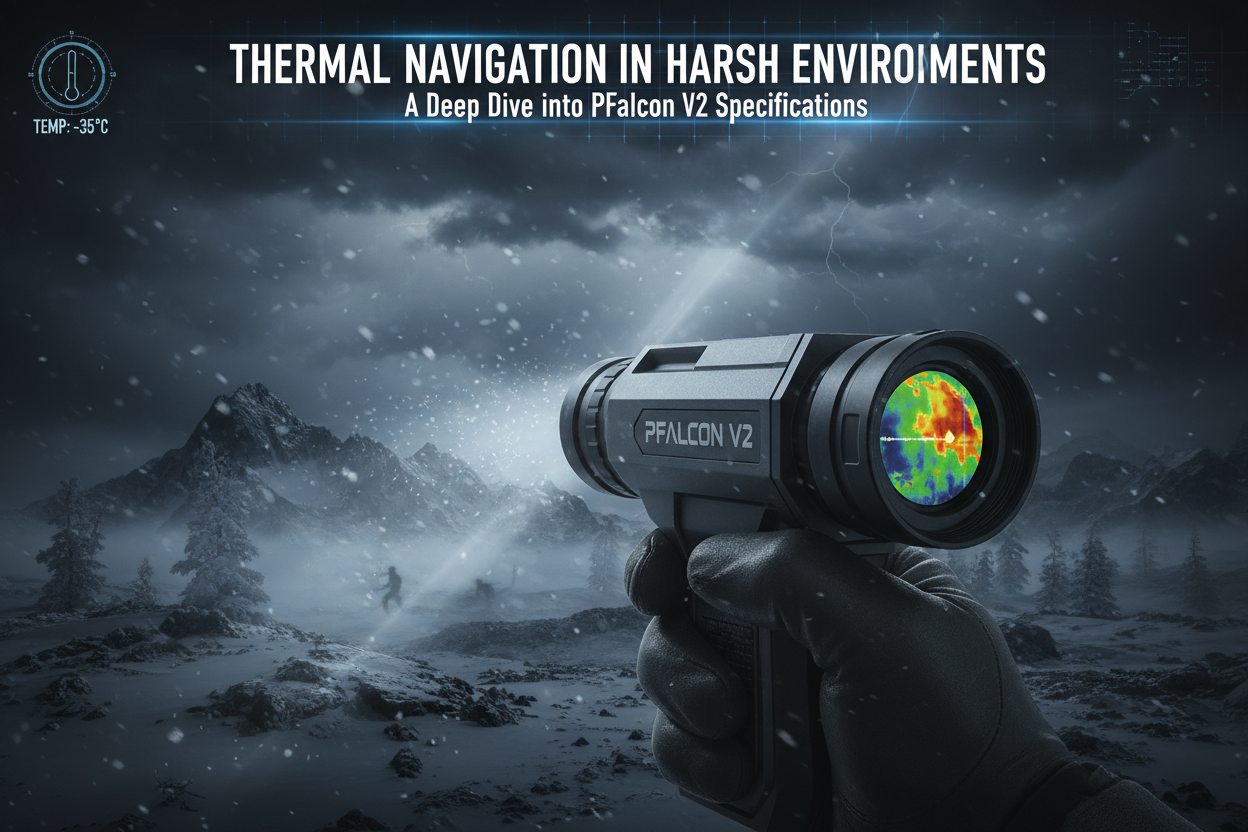
In this guide, we take a deep dive into PFalcon V2 specifications, explain what each spec means, and show why these features matter for thermal navigation in harsh environments.
For users comparing thermal overlay systems and standard NVGs, you may also find this guide useful: Clip-On Thermal Imagers Explained.
What Is the PFalcon V2?
The PFalcon V2 is a compact multi-purpose thermal monocular designed for users who need thermal detection in a lightweight and flexible platform.
Depending on setup and accessories, it may be used in multiple roles, including:
-
Handheld thermal monocular
-
Helmet-mounted thermal device
-
Clip-on thermal imager
-
Dedicated thermal optic
-
Thermal navigation tool
This multi-role design is one of the reasons the PFalcon V2 is popular among advanced thermal users.
Instead of being limited to one use case, it can support different setups depending on mission needs, local regulations, and compatible accessories.
Why Thermal Navigation Matters
Traditional night vision and thermal imaging are different technologies.
Night vision image intensifier tubes amplify available light.
Thermal sensors detect infrared radiation from heat.
For navigation, each technology has strengths.
Night Vision Strengths
Night vision is excellent for:
-
Terrain recognition
-
Depth perception
-
Moving naturally
-
Seeing roads, paths, and structures
-
Reading the environment in a familiar way
For more on image intensifier technology, read What Is an Image Intensifier Tube?.
Thermal Strengths
Thermal imaging is excellent for:
-
Detecting people
-
Detecting animals
-
Finding warm vehicles
-
Seeing heat contrast
-
Identifying targets in darkness
-
Locating heat sources through visual clutter
Thermal navigation is not always about replacing night vision.
It is about adding a different layer of information.
In harsh environments, thermal can reveal what standard optics may miss.
PFalcon V2 Specifications: Quick Overview
Common PFalcon V2 specifications include:
| Specification | PFalcon V2 Common Spec |
|---|---|
| Sensor | 640-class thermal detector |
| Pixel pitch | 12μm |
| NETD | ≤15mK |
| Refresh rate | 60Hz |
| Display | High-resolution AMOLED |
| Field of view | Around 17.5° × 13.1° |
| Optical magnification | Around 1x to 1.36x depending on listing |
| Digital zoom | 1x / 2x / 4x |
| Battery | 1 × 18650 / 18700 rechargeable battery |
| Battery life | Around 6+ hours |
| Storage | 64GB internal storage |
| Weight | Around 320–325g |
| IP rating | IP67 |
| Operating temperature | Around -40°C to +55°C / +60°C |
| Use modes | Handheld, helmet-mounted, clip-on, dedicated thermal optic |
Exact specifications can vary by market, configuration, and listing, so always confirm the actual product specification sheet before purchase.
640-Class Thermal Sensor
One of the most important PFalcon V2 specifications is its 640-class thermal sensor.
A 640 thermal sensor provides higher thermal image detail than many 384-class thermal devices.
This matters because higher sensor resolution can improve:
-
Heat signature recognition
-
Environmental awareness
-
Object separation
-
Detection confidence
-
Usability in complex terrain
-
Identification of smaller heat sources
For harsh environments, a higher-resolution thermal sensor can make it easier to distinguish between background heat and meaningful heat signatures.
This is especially useful in:
-
Forested areas
-
Rocky terrain
-
Urban environments
-
Open fields
-
Cold weather
-
Search and rescue scenarios
A 640-class thermal monocular gives the user more thermal information to work with.
12μm Pixel Pitch
Pixel pitch describes the distance between pixels on the thermal sensor.
The PFalcon V2 is commonly listed with a 12μm detector.
A smaller pixel pitch can help support compact optics and maintain strong image detail in a smaller device.
For users, this contributes to:
-
More compact device design
-
Useful image detail
-
Efficient sensor performance
-
Better balance for helmet-mounted use
-
Better overall portability
In practical terms, the 12μm sensor helps make the PFalcon V2 compact enough for handheld, helmet-mounted, and multi-role use.
NETD ≤15mK: Why Thermal Sensitivity Matters
NETD stands for Noise Equivalent Temperature Difference.
It measures how well a thermal sensor can detect very small temperature differences.
Lower NETD is better.
A device with ≤15mK NETD can detect subtle thermal differences more effectively than a device with a higher NETD value.
This matters in harsh environments because temperature contrast is not always obvious.
For example:
-
A person may be partially cooled by wind or rain
-
Animals may be hidden in vegetation
-
Warm objects may blend into sun-heated terrain
-
Fog or humidity may reduce contrast
-
Cold environments may create subtle thermal gradients
Better thermal sensitivity helps reveal details that lower-sensitivity sensors may miss.
For thermal navigation, this can improve detection and confidence.
60Hz Refresh Rate
The PFalcon V2 is commonly listed with a 60Hz refresh rate.
Refresh rate affects how smooth the image appears when objects or the user are moving.
A higher refresh rate is especially useful for:
-
Walking
-
Scanning
-
Helmet-mounted use
-
Tracking moving animals
-
Observing moving vehicles
-
Navigating uneven terrain
-
Reducing visual lag
For harsh environments, smooth image motion matters.
If the image feels delayed or choppy, it can make movement less comfortable and reduce user confidence.
A 60Hz thermal image is better suited for active navigation than lower-refresh systems.
High-Resolution AMOLED Display
The PFalcon V2 is commonly listed with a high-resolution AMOLED display, such as 1440×1080 or 1920×1080 depending on configuration and listing.
Display quality matters because the thermal sensor is only one part of the viewing experience.
A better display can improve:
-
Image sharpness
-
Contrast perception
-
Comfort during long viewing
-
Menu readability
-
Detail interpretation
-
Overall viewing experience
For thermal navigation, the display needs to present useful details clearly.
A strong thermal sensor paired with a poor display would limit what the user can actually see.
Field of View: Around 17.5° × 13.1°
Field of view determines how much area the user can see at once.
The PFalcon V2 is commonly listed with a field of view around 17.5° × 13.1°.
This is important for navigation because field of view affects scanning speed and situational awareness.
A wider field of view helps users:
-
Scan terrain more efficiently
-
Track movement
-
Understand the surrounding area
-
Reduce excessive head movement
-
Navigate at closer distances
-
Maintain better awareness
For helmet-mounted or handheld thermal navigation, field of view can be just as important as detection range.
A thermal device with too narrow a view may be better for long-range observation but less comfortable for movement.
The PFalcon V2’s field of view gives it practical versatility for both scanning and navigation.
Detection and Recognition Range
PFalcon V2 listings often mention human recognition around 600m and vehicle recognition around 1070m, while some related Falcon 640+ V2 listings mention longer detection distances depending on target type, environment, and measurement method.
Range numbers should always be understood carefully.
Detection, recognition, and identification are not the same.
Detection
You can notice that something is there.
Recognition
You can determine the general type of object, such as human, animal, or vehicle.
Identification
You can confirm specific details with higher confidence.
In real environments, range depends on:
-
Target size
-
Temperature contrast
-
Weather
-
Humidity
-
Terrain
-
Vegetation
-
Lens setup
-
User experience
-
Display settings
-
Movement
For harsh environments, thermal range is useful, but practical navigation also depends on image clarity, field of view, and refresh rate.
Digital Zoom: 1x / 2x / 4x
Digital zoom allows users to enlarge the thermal image.
PFalcon V2 listings commonly show 1x / 2x / 4x electronic zoom.
Digital zoom is useful for:
-
Checking distant heat signatures
-
Confirming movement
-
Inspecting areas of interest
-
Scanning open terrain
-
Improving observation flexibility
However, digital zoom does not create new sensor detail.
As zoom increases, image quality may appear less sharp.
For navigation, 1x is often more useful because it preserves field of view.
For observation, 2x or 4x can help examine a distant heat source more closely.
Battery Life and 18650 / 18700 Power
The PFalcon V2 commonly uses one rechargeable 18650 or 18700 battery.
Battery life is often listed around 6 hours or more, depending on usage conditions.
Battery performance matters because thermal devices are power-dependent.
In harsh environments, users should consider:
-
Cold weather battery performance
-
Spare battery storage
-
Battery change speed
-
Runtime with recording or Wi-Fi enabled
-
External power options
-
Mission duration
For long operations, always carry spare batteries.
Cold temperatures can reduce battery performance, so winter users should plan power more carefully.
64GB Internal Storage
Many PFalcon V2 listings include 64GB internal storage.
This allows users to save:
-
Thermal images
-
Video footage
-
Training records
-
Search documentation
-
Observation clips
-
Field review material
For professional or training use, storage can be valuable.
It allows users to review what they saw, document events, and analyze thermal performance under different conditions.
Weight: Around 320–325g
Weight is one of the most important specs for helmet-mounted thermal use.
The PFalcon V2 is commonly listed around 320–325g.
This makes it compact enough for:
-
Handheld scanning
-
Helmet-mounted thermal use
-
Clip-on thermal applications
-
Multi-role field setups
However, even a compact thermal device adds front-end weight to a helmet system.
If you plan to run the PFalcon V2 helmet-mounted, helmet balance becomes important.
You may need:
-
A stable mount
-
Rear counterweight
-
Battery pack
-
Proper cable routing
-
Secure helmet fit
For more on this topic, read Managing NVG Weight for Helmet Balance.
IP67 Waterproof and Dustproof Protection
The PFalcon V2 is commonly listed with an IP67 rating.
IP67 generally means the device is protected against dust ingress and temporary water immersion under defined test conditions.
For harsh environments, this matters because thermal devices may be used in:
-
Rain
-
Snow
-
Dust
-
Mud
-
Humidity
-
Wet vegetation
-
Vehicle movement
-
Field training
IP67 does not mean a device is indestructible.
It does mean the device is designed with meaningful environmental resistance.
For users working outdoors, this is a critical specification.
Operating Temperature: Around -40°C to +55°C / +60°C
The PFalcon V2 is commonly listed with a wide operating temperature range, often around -40°C to +55°C or +60°C depending on listing.
This matters because harsh environments are not only dark.
They may also be extremely cold or hot.
A wide operating temperature range supports use in:
-
Winter environments
-
Desert conditions
-
Mountain areas
-
Hot vehicle zones
-
Cold nighttime fields
-
Long outdoor deployments
Temperature affects both electronics and battery performance.
Even if the device can operate in extreme temperatures, users should still manage batteries carefully.
Recoil Resistance
Some PFalcon V2 listings mention recoil resistance, including ratings around 1200g shock.
This matters if the device is used as a dedicated thermal optic or clip-on system on compatible platforms.
However, users should always follow:
-
Local laws
-
Device mounting instructions
-
Manufacturer guidance
-
Firearm and recoil compatibility limits
-
Proper zeroing and safety procedures
For many users, the PFalcon V2 may be more valuable as a handheld or helmet-mounted thermal navigation tool.
But recoil resistance adds versatility for users who require it.
Four Use Modes: Why Multi-Role Design Matters
One of the strongest selling points of the PFalcon V2 is its multi-role design.
Common use modes include:
-
Handheld
-
Helmet-mounted
-
Clip-on
-
Dedicated thermal optic
This flexibility matters because different environments require different setups.
Handheld Use
Best for scanning, observation, and quick detection.
Helmet-Mounted Use
Best for hands-free movement and thermal navigation.
Clip-On Use
Best for adding thermal capability to an existing optic setup where legal and compatible.
Dedicated Thermal Use
Best for users who need a standalone thermal aiming or observation configuration.
A multi-role device gives users more value from one thermal platform.
PFalcon V2 for Harsh Weather
Thermal imaging can be useful in harsh weather, but performance depends on conditions.
Fog and Humidity
Thermal can still work in fog or humidity, but heavy moisture can reduce contrast and range.
Rain
Light rain may still allow useful thermal detection, but heavy rain can reduce image clarity.
Snow
Thermal can be excellent in snow because warm objects stand out strongly against cold backgrounds.
Heat Saturation
In hot environments, rocks, roads, walls, and terrain can absorb heat and reduce contrast.
A low NETD sensor can help, but users still need to understand thermal limitations.
The PFalcon V2’s combination of sensitivity, refresh rate, and IP67 protection makes it well-suited for demanding outdoor use.
PFalcon V2 for Helmet-Mounted Thermal Navigation
Helmet-mounted thermal is different from handheld scanning.
When a thermal monocular is helmet-mounted, the user relies on it while moving.
This makes several specs especially important:
-
Weight
-
Refresh rate
-
Field of view
-
Display quality
-
Image lag
-
Battery life
-
Mount stability
-
Balance
The PFalcon V2’s lightweight design and 60Hz refresh rate make it a practical candidate for helmet-mounted thermal use.
However, users should remember that thermal navigation is not identical to night vision navigation.
Thermal can reveal heat, but it may not show terrain depth in the same natural way as image intensifier night vision.
For best results, many users combine thermal with night vision depending on the setup.
PFalcon V2 vs Standard Night Vision
The PFalcon V2 is not a direct replacement for standard NVGs.
It solves a different problem.
Standard NVGs Are Better For:
-
Natural movement
-
Depth perception
-
Terrain detail
-
Helmet-mounted navigation
-
Reading the environment visually
PFalcon V2 Thermal Is Better For:
-
Heat detection
-
Finding people or animals
-
Seeing in complete darkness
-
Detecting warm vehicles
-
Searching through visual clutter
-
Observation in low-contrast conditions
The strongest setups often use both technologies.
For example, a user may navigate with night vision and scan with thermal.
Or they may use thermal fusion / COTI-style systems to combine both.
For related reading, see Thermal Fusion Night Vision.
Who Should Consider the PFalcon V2?
The PFalcon V2 is best suited for users who need compact thermal capability in a flexible platform.
It may be a strong choice for:
-
Search and rescue users
-
Security teams
-
Advanced night vision users
-
Hunters where legal
-
Wildlife observers
-
Tactical trainers
-
Helmet-mounted thermal users
-
Users needing handheld and helmet-mounted flexibility
-
Users comparing 640 thermal monoculars
It may be less necessary for users who only need casual short-range observation or who already own a dedicated thermal device that fits their needs.
Key Questions Before Buying a PFalcon V2
Before purchasing, ask:
-
Do I need handheld, helmet-mounted, clip-on, or dedicated thermal use?
-
Is 640-class thermal resolution important for my use case?
-
Do I need 60Hz refresh for movement?
-
Is the field of view suitable for navigation?
-
How important is low NETD thermal sensitivity?
-
Will battery life support my intended sessions?
-
Do I need IP67 protection for outdoor use?
-
Is the device compatible with my helmet or optic setup?
-
Do I need recording or internal storage?
-
Am I following all local laws and regulations for thermal use?
These questions help match the device to real-world needs.
Common Mistakes When Choosing a Thermal Monocular
Mistake 1: Only Looking at Detection Range
Detection range is useful, but it does not tell the full story.
Field of view, sensitivity, refresh rate, display quality, and weight also matter.
Mistake 2: Ignoring Helmet Balance
A thermal monocular may be lightweight by itself, but helmet-mounted setups must be balanced properly.
Mistake 3: Confusing Thermal with Night Vision
Thermal detects heat.
Night vision amplifies light.
They are not the same.
Mistake 4: Forgetting Battery Planning
Thermal devices consume power.
Carry spare batteries, especially in cold conditions.
Mistake 5: Expecting Perfect Performance in All Weather
Thermal imaging is powerful, but heavy rain, humidity, fog, and heat saturation can still affect performance.
Where to Learn More
If you are comparing thermal and night vision systems, these guides may help:
Final Thoughts
The PFalcon V2 is a compact thermal monocular designed for users who need more than basic observation.
Its 640-class thermal sensor, low NETD sensitivity, 60Hz refresh rate, compact weight, IP67 protection, wide operating temperature range, and multi-role design make it a strong option for thermal navigation in harsh environments.
It is especially valuable when users need to detect heat signatures in darkness, bad weather, visual clutter, or low-contrast terrain.
However, the PFalcon V2 should be understood as part of a complete low-light system.
Thermal imaging is excellent for detection.
Night vision is excellent for natural navigation.
Fusion systems combine the strengths of both.
If your goal is to improve detection, move with more confidence, and operate in more demanding environments, the PFalcon V2 is worth considering as a serious thermal navigation tool.