
Cart
0

Introduction
Search and rescue operations rarely happen under ideal conditions.
A missing hiker may disappear shortly before sunset. A vehicle may leave a mountain road during heavy rain. A maritime emergency may continue through the night. A rescue team may need to cross forests, damaged buildings, steep terrain or flood zones with very little usable light.
In these situations, darkness creates more than an inconvenience.
It can slow the search, conceal hazards, increase rescuer fatigue and reduce the time available to locate a survivor.
Night vision goggles help trained search and rescue teams continue working when unaided vision becomes ineffective. By amplifying available light, NVGs can improve terrain awareness, navigation, team coordination and visual searching during critical nighttime missions.
However, NVGs are not a universal solution. They cannot see through every weather condition, replace thermal imaging or remove the need for professional training.
Their value comes from using the right night vision system for the environment, integrating it with thermal equipment where appropriate and building a complete helmet-mounted setup that remains reliable for long-duration operations.
This guide explains how night vision supports search and rescue missions, which NVG features matter most for SAR teams and how to build a more capable low-light rescue system.
Why Darkness Makes Search and Rescue More Difficult
Search and rescue teams must often make decisions quickly while operating in unfamiliar environments.
At night, rescuers may struggle to see:
-
Trails and terrain changes
-
Holes, rocks and fallen branches
-
Cliffs and steep slopes
-
Damaged structures
-
Water boundaries
-
Vehicles and equipment
-
Other rescue personnel
-
Signals from missing persons
-
Safe landing or staging areas
Artificial lighting can help, but it also has limitations.
A flashlight illuminates only a limited area. It can create glare, reduce peripheral awareness and make distant objects harder to detect. Powerful white lights may also reflect from rain, fog, snow, dust or nearby surfaces.
NVGs allow rescuers to use available ambient light across a wider scene without constantly directing a visible beam at the environment.
This can support more natural movement and continuous observation.
How Night Vision Goggles Work
Analog night vision goggles use image intensifier tubes.
The objective lens collects small amounts of available light from sources such as:
-
Moonlight
-
Starlight
-
Sky glow
-
Distant artificial lighting
-
Reflected near-infrared light
-
Compatible IR illuminators
The image intensifier tube converts the collected light into electrons, amplifies the signal and converts it back into a visible image.
This allows the user to see environmental structure that would otherwise be hidden in darkness.
Important parts of an NVG system include:
-
Image intensifier tube
-
Objective lens
-
Eyepiece
-
Housing
-
Power system
-
Helmet mount
-
Lens protection
-
Optional external battery pack
Users comparing complete systems can begin with the night vision goggles, binoculars and monoculars collection.
How NVGs Support Lifesaving SAR Missions
NVGs do not rescue a missing person by themselves.
Their value comes from helping trained personnel move, search and coordinate more effectively when darkness would otherwise restrict the operation.
Extending the Search Window
Without night vision, some ground searches may need to slow down or pause after sunset.
NVGs can help qualified teams continue searching during low-light periods, potentially reducing the delay before a missing person is located.
This can be especially important when the subject is exposed to:
-
Cold
-
Heat
-
Injury
-
Water
-
Severe weather
-
Dangerous terrain
-
Medical complications
Night vision does not guarantee a successful rescue, but extending effective search time can be extremely valuable in time-sensitive missions.
Improving Terrain Navigation
Ground SAR teams often operate in forests, mountains, fields, disaster zones and damaged urban areas.
NVGs can help reveal:
-
Trail edges
-
Tree lines
-
Rocks
-
Ditches
-
Fences
-
Buildings
-
Vehicles
-
Elevation changes
-
Nearby team members
This environmental detail is one of the biggest advantages of image-intensified night vision compared with thermal-only viewing.
Thermal imagers are excellent for detecting heat, but they may not show natural terrain depth as clearly as analog night vision.
For movement, NVGs often provide the more intuitive visual foundation.
Supporting Aerial Search Operations
Night vision is widely associated with helicopter search and rescue because aerial crews must maintain awareness of terrain, obstacles, landing areas and surface references.
NVGs may help trained aviation teams identify:
-
Terrain contours
-
Coastlines
-
Roads
-
Towers and obstacles
-
Landing zones
-
Vehicles
-
Search personnel
-
Visual signals
-
Surface features
Aviation NVG use requires much more than simply giving a pilot goggles.
The aircraft lighting, cockpit displays, crew training, maintenance procedures and operating limitations must all be compatible with night vision operations.
Ground-use NVGs should never be treated as a substitute for an approved aviation night vision imaging system.
Helping Maritime Rescue Teams
Maritime SAR missions can be especially challenging at night.
Water surfaces offer few visual reference points, while survivors, rafts and small vessels may be difficult to distinguish from the surrounding darkness.
NVGs may help trained crews observe:
-
Vessel outlines
-
Shorelines
-
Waves and surface features
-
Reflective materials
-
Rescue swimmers
-
Signal lights
-
People or objects on the water
However, water, rain, spray, cloud cover and reflections can also reduce performance.
Maritime teams may combine NVGs with radar, thermal cameras, searchlights, strobes and other detection systems rather than relying on one sensor alone.
Monocular vs Binocular NVGs for SAR
Search and rescue teams may use monocular or binocular night vision depending on the mission.
Monocular Night Vision
A monocular such as a PVS-14 provides night vision to one eye.
Potential advantages include:
-
Lower weight
-
Lower cost
-
Compact size
-
Easy handheld use
-
Unaided vision retained in the other eye
-
Simple backup-device role
Possible disadvantages include:
-
Reduced depth perception
-
Greater visual imbalance
-
More adaptation time
-
Less natural movement for some users
A monocular may be practical for observation, backup use or teams that need a lightweight system.
Binocular Night Vision
A binocular system provides intensified imagery to both eyes.
Potential benefits include:
-
More natural movement
-
Better depth perception
-
Improved obstacle awareness
-
Greater comfort during extended use
-
Easier terrain interpretation
For SAR teams moving through difficult terrain over several hours, binocular NVGs may offer a more comfortable experience.
The BNVD-1431 MK2 housing kit with lenses is an example of a modular binocular platform using standard 18 mm tube formats and articulating optical pods.
The BNVD-931 housing kit is another binocular platform designed for extended operation and compatibility with external power and thermal-overlay accessories.
Why Autogating Matters for Rescue Teams
Search and rescue environments are rarely consistently dark.
A team may encounter:
-
Vehicle headlights
-
Emergency lighting
-
Flashlights
-
Building lights
-
Road lighting
-
Aircraft lighting
-
IR illuminators
-
Reflective signs
-
Rescue strobes
A non-gated tube may become heavily bloomed or temporarily washed out when exposed to sudden bright light.
An autogated image intensifier rapidly regulates its operation to help maintain a more usable image when lighting changes.
For SAR personnel moving between dark terrain, roads, vehicles and buildings, autogating can improve visual stability.
It does not make the tube immune to damage, and users should still avoid direct exposure to intense lights and lasers.
For a detailed comparison, read Auto-Gated vs Non-Gated Night Vision.
Tube Specifications That Matter in SAR
The generation label alone does not tell rescuers how well an NVG will perform.
Important image intensifier specifications include:
Signal-to-Noise Ratio
SNR affects how clean the image appears in low light.
Higher SNR usually means less visible noise and better detail when ambient light is limited.
FOM
Figure of Merit combines resolution and SNR into a general comparison number.
FOM is useful, but it should not be evaluated alone.
EBI
Equivalent Background Illumination becomes important in extremely dark and warmer environments.
Lower EBI can support better shadow detail under very low light.
Halo
Halo describes the glow around bright light sources.
Lower halo can be helpful around vehicles, emergency lights and illuminated structures.
Autogating
Autogating improves performance when lighting changes rapidly.
Tube Cosmetics
Large central spots, shading or other visible defects can interfere with detailed searching.
SAR buyers should review the complete tube specification and not select equipment only by “Gen 2+” or “Gen 3.”
Available tube formats and performance tiers can be compared through the image intensifier tube collection.
White Phosphor vs Green Phosphor for Long Searches
SAR missions can continue for hours.
During extended viewing, phosphor preference may affect comfort.
P43 Green Phosphor
Green phosphor provides the traditional night vision image.
Some users value:
-
Familiarity
-
Strong perceived brightness
-
Traditional NVG appearance
-
Potentially lower cost in some configurations
P45 White Phosphor
White phosphor produces a grayscale-style image.
Many users prefer it for:
-
Natural scene interpretation
-
Perceived contrast
-
Long-duration comfort
-
Easier recognition of terrain and shapes
Phosphor color is still a personal preference.
Tube matching, diopter adjustment, SNR, optical alignment and helmet position may affect eye strain more than phosphor color alone.
For more detail, read P43 Green Phosphor vs P45 White Phosphor.
Why Thermal Imaging Complements NVGs
Night vision and thermal imaging should not be treated as competing technologies.
They solve different problems.
NVGs Are Stronger For:
-
Terrain navigation
-
Depth perception
-
Identifying roads and trails
-
Reading environmental structure
-
Natural movement
-
Helmet-mounted continuous viewing
Thermal Imaging Is Stronger For:
-
Detecting people
-
Detecting animals
-
Finding warm vehicles or equipment
-
Searching in complete darkness
-
Locating heat signatures in visual clutter
In a search operation, a missing person may be difficult to see through NVGs if their clothing blends into the terrain or if they are partially hidden by vegetation.
A thermal imager may help the heat signature stand out.
However, thermal performance can be reduced by heavy rain, dense fog, humidity, warm backgrounds and physical barriers.
The most capable SAR teams may use both technologies.
Standalone Thermal for SAR
A handheld or helmet-compatible thermal monocular can help rescuers scan an area for heat signatures.
The PFalcon V2 Thermal Monocular is a multi-role thermal platform that can be configured for handheld, helmet-mounted or other compatible applications.
Standalone thermal may be useful for:
-
Deliberate scanning
-
Checking vegetation
-
Locating warm vehicles
-
Searching cold terrain
-
Confirming suspicious heat signatures
-
Allowing multiple team members to share one thermal device
For a deeper explanation, read Thermal Navigation in Harsh Environments.
COTI Thermal Overlay for SAR
A Clip-On Thermal Imager attaches to a compatible NVG and places thermal cues into the intensified view.
This allows the user to continue navigating with analog night vision while receiving heat-based detection information.
Potential SAR benefits include:
-
Faster detection of warm objects
-
Less switching between devices
-
Hands-free thermal awareness
-
Better scanning in vegetation
-
Additional information in complete darkness
COTI is generally a detection enhancement rather than a full replacement for a high-resolution standalone thermal imager.
For more information, read Clip-On Thermal Imagers: Transforming Standard NVGs into Fusion Systems.
Helmet Mount Stability
A rescue team may climb, run, crawl, enter vehicles or move through unstable terrain.
The NVG mount must hold the optic securely while still allowing practical adjustment.
A reliable mount should provide:
-
Secure dovetail lockup
-
Fore-and-aft adjustment
-
Vertical adjustment
-
Tilt adjustment
-
Repeatable return to eye position
-
One-handed operation where appropriate
-
Compatibility with the helmet and shroud
-
A suitable safety-release design
The ARGUS A4 Lightweight Night Vision Mount supports standard dovetail-equipped monocular and binocular platforms and includes positioning adjustments intended for helmet-mounted operation.
A poor mount can make even a good NVG difficult to use.
Movement, wobble or loss of eye position can reduce confidence during critical terrain navigation.
Battery Life and Helmet Balance
SAR missions may continue far longer than expected.
Power planning should account for:
-
NVG runtime
-
Thermal device runtime
-
Cold-weather battery loss
-
Backup batteries
-
External battery cables
-
Battery replacement in darkness
-
Device compatibility
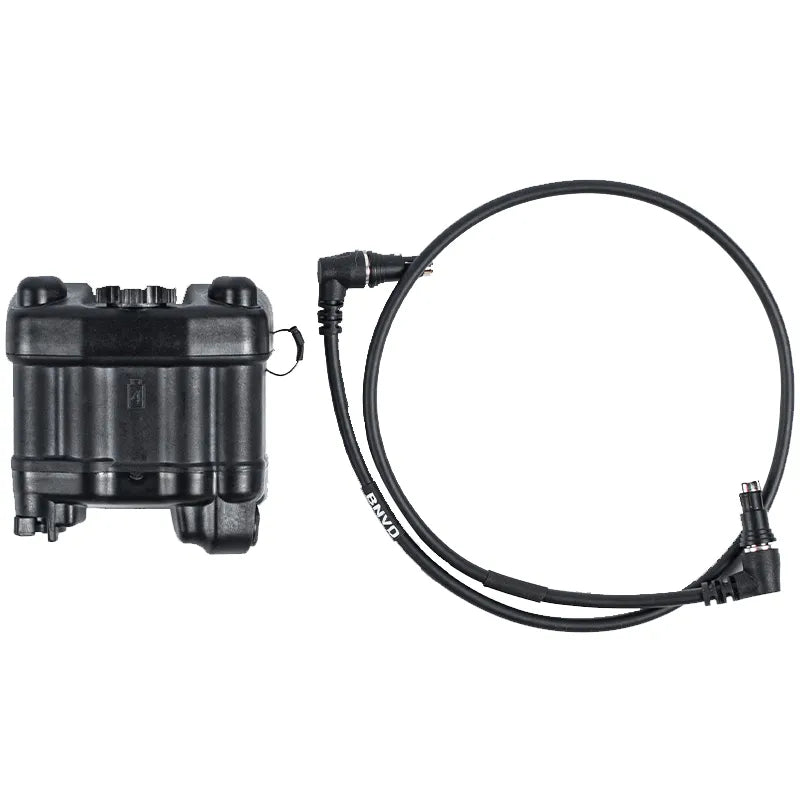
An external battery pack can extend runtime and move useful weight to the rear of the helmet.
The ARGUS Universal Strobe Battery Pack supplies compatible night vision systems through the appropriate cable and can act as a rear counterweight. It also includes IR strobe functionality intended to assist nighttime identification and search-and-rescue coordination.
Helmet balance matters because front-mounted NVGs create leverage.
A poorly balanced system can increase:
-
Neck fatigue
-
Helmet movement
-
Pressure points
-
Headaches
-
Reduced concentration
-
Discomfort during long searches
The objective is not simply to add rear weight.
It is to balance the complete operational setup.
Lens Protection in Harsh SAR Environments
Search teams may work in:
-
Rain
-
Snow
-
Dust
-
Sand
-
Mud
-
Thick vegetation
-
Damaged structures
-
Vehicle interiors
Objective and eyepiece lenses are exposed to scratches, impact and contamination.
A practical protection setup may include:
-
Sacrificial lenses during active use
-
Rubber protection caps during transport
-
A protective case
-
Lens-safe cleaning tools
-
Regular inspections
The Universal Lens Protection Cover for PVS-31 and PVS-14 optics is compatible with multiple common NVG platforms.
For a full comparison, read Why You Shouldn’t Skip Lens Protectors.
Environmental Limitations of NVGs
NVGs are powerful, but they have limitations that SAR teams must understand.
Very Low Ambient Light
Image intensifier tubes need some usable light.
Under heavy cloud cover, dense forest canopy or enclosed spaces, an IR illuminator may be required.
Fog, Rain and Snow
Moisture and airborne particles can scatter light and reduce clarity.
Strong illumination may reflect back toward the user.
Smoke and Dust
NVGs cannot reliably see through dense smoke or heavy dust.
Thermal equipment may sometimes provide additional information, but it also has environmental limitations.
Narrow Field of View
Many standard NVGs provide approximately 40 degrees of field of view.
Users must scan actively and remain aware of tunnel vision.
Depth and Distance Errors
NVGs improve visibility, but they do not produce normal daylight vision.
Users may misjudge distance, terrain slope or object size without training.
Bright Light Sources
Headlights, emergency lights and reflective surfaces can reduce image quality, especially with non-gated tubes.
Understanding these limitations is part of safe NVG use.
NVGs Do Not Replace Training
Equipment alone does not create an effective SAR capability.
Teams need training in:
-
Low-light movement
-
Scanning techniques
-
Focus and diopter adjustment
-
Bright-light transitions
-
Communication
-
Battery management
-
Helmet setup
-
Thermal-image interpretation
-
Device limitations
-
Emergency procedures
A new user may initially move more slowly under NVGs because depth, field of view and image appearance feel unfamiliar.
Training helps the brain interpret the image correctly and reduces the temptation to move faster than conditions allow.
Aviation teams require specialized NVG and aircraft-system training beyond general ground use.
Building a Complete SAR Night Vision Kit
A practical SAR night vision kit may include:
-
Monocular or binocular NVG
-
Autogated image intensifier tubes
-
Stable helmet and mount
-
Rear battery pack or counterweight
-
Spare batteries
-
Lens protection
-
IR illuminator
-
IR or visible identification strobe
-
Handheld thermal monocular
-
COTI where appropriate
-
Protective storage case
-
Lens-safe cleaning kit
-
Retention lanyard
-
Compatible communication equipment
The best configuration depends on the mission.
A ground wilderness team may prioritize low weight and thermal scanning.
A maritime crew may prioritize environmental sealing and identification signals.
An aviation unit requires approved NVIS integration, formal training and aircraft compatibility.
There is no single universal SAR NVG setup.
Ground SAR Configuration Example
A ground search team might use:
-
Autogated binocular NVGs
-
Lightweight dovetail mount
-
Rear battery pack
-
Lens protection
-
Handheld thermal monocular
-
IR illuminator
-
Visible and IR marking devices
This configuration supports navigation and continuous observation while preserving the option to perform targeted thermal scans.
For teams covering long distances, total system weight should be controlled carefully.
Maritime SAR Configuration Example
A maritime team might prioritize:
-
Sealed binocular NVGs
-
Secure helmet retention
-
Water-resistant battery system
-
IR strobe capability
-
Lens covers
-
Thermal scanning equipment
-
Backup lighting
-
Device retention lanyards
Saltwater spray, wind and reflections create additional challenges.
Equipment should be inspected, cleaned and dried after exposure.
Aviation SAR Configuration Example
An aviation SAR system may include:
-
Approved aviation NVGs
-
NVG-compatible cockpit lighting
-
Crew-specific training
-
Approved helmet and mount
-
Regular inspection and maintenance
-
Thermal or electro-optical search sensors
-
Searchlights
-
Radar and navigation systems
Aviation teams should never assume that a high-quality ground NVG is automatically suitable for flight operations.
The entire aircraft lighting and operating system must be evaluated as an NVIS environment.
Common SAR Night Vision Mistakes
Mistake 1: Treating NVGs as Daylight Vision
NVGs improve visibility but still provide a limited, artificial image.
Mistake 2: Relying on NVGs Alone
Thermal, radar, lighting, maps, communications and other sensors may all be needed.
Mistake 3: Ignoring Autogating
Mixed emergency lighting can challenge non-gated tubes.
Mistake 4: Using an Unstable Mount
Wobble and poor eye positioning can make terrain movement more difficult.
Mistake 5: Underestimating Battery Needs
Cold conditions and extended missions can reduce expected runtime.
Mistake 6: Ignoring Helmet Balance
Fatigue can reduce concentration during long searches.
Mistake 7: Skipping Lens Protection
Branches, spray, sand and debris can damage exposed optics.
Mistake 8: Using Untrained Personnel
Improper use can increase rather than reduce risk.
How to Select NVGs for a SAR Team
Before purchasing, evaluate:
-
Will the device be used on the ground, at sea or in aviation?
-
Is a monocular or binocular platform more appropriate?
-
Are the image intensifier tubes autogated?
-
What are the SNR, FOM, EBI and halo values?
-
Is white or green phosphor preferred?
-
How long must the system operate?
-
Is external battery support required?
-
Is the mount secure and adjustable?
-
Is the housing sealed and serviceable?
-
Are spare parts available?
-
Will thermal imaging also be used?
-
Can personnel receive proper training?
-
Is the total helmet weight sustainable?
-
Is the equipment appropriate for the specific regulatory environment?
The best SAR device is not simply the model with the highest specification.
It is the system that trained rescuers can use safely, reliably and comfortably throughout the mission.
Final Thoughts
Night vision goggles can play a critical role in search and rescue by helping trained teams continue operating after darkness reduces unaided visibility.
They can support:
-
Longer search windows
-
Safer terrain navigation
-
Improved team awareness
-
Better aerial and maritime observation
-
Faster movement through low-light environments
-
More effective use of thermal and IR equipment
However, NVGs do not eliminate risk.
They cannot see through every form of weather, replace approved aviation procedures or guarantee that a missing person will be detected.
Their greatest value appears when they are part of a complete rescue system that includes:
-
Properly selected image intensifier tubes
-
Reliable housings
-
Stable mounts
-
Long-duration power planning
-
Lens protection
-
Thermal support
-
Training
-
Maintenance
-
Clear operating procedures
In critical missions, time and information matter.
A well-configured NVG system gives rescuers more usable visual information during the hours when darkness would otherwise limit the search.
That additional capability can help teams move more safely, search more efficiently and reach people in need sooner.