
Cart
0

Introduction
Maritime night operations create a visual environment unlike forests, roads, buildings or open land.
Over water, the user may face two opposite problems at the same time:
-
Too little usable visual detail across the open sea
-
Too much concentrated brightness from reflected lights
A dark water surface may provide few recognizable features for judging distance, speed or direction. Moments later, a navigation light, harbor spotlight, vessel headlight or coastal building may reflect across the water and dominate the night vision image.
Rain, sea spray, fog, wet decks and windows can add another layer of glare and backscatter.
For maritime and coastal patrol teams, selecting night vision equipment is therefore not only about buying the highest-FOM image intensifier tube.
The complete system must handle:
-
Reflections from water
-
Mixed coastal lighting
-
Low-contrast horizons
-
Sea spray and moisture
-
Unlit vessels
-
Long-duration observation
-
Helmet movement on small boats
-
Sudden transitions between darkness and artificial light
This guide explains why water creates unique challenges for night vision, which image intensifier specifications matter most, and how autogating, manual gain, optics, thermal imaging, lens protection and proper equipment setup can improve maritime NVG performance.
To compare available monocular, binocular and panoramic systems, begin with the Night Vision collection.
Why Night Vision Over Water Is So Difficult
Night vision goggles amplify available light.
They perform best when the scene contains enough contrast and visual structure for the user to interpret.
On land, that structure may include:
-
Roads
-
Trees
-
Rocks
-
Buildings
-
Fences
-
Terrain elevation
-
Vehicle outlines
Open water often contains fewer stable reference points.
A calm surface may look dark and visually flat. A rough surface may show constantly changing highlights and shadows. The horizon may become difficult to separate from the sky, especially under overcast conditions or when the coastline is poorly illuminated.
This can make it harder to judge:
-
Distance to another vessel
-
Wave height
-
Closing speed
-
Shoreline position
-
Small floating objects
-
The exact waterline of a low-profile craft
-
Whether a light is fixed, moving or reflected
NVGs improve visibility, but they do not create normal daylight depth perception.
Maritime operators still need training, active scanning and support from other navigation and detection systems.
How Water Creates Reflection and Glare
Water does not reflect light in one consistent way.
Its appearance changes with:
-
Surface smoothness
-
Wave direction
-
Viewing angle
-
Light position
-
Wind
-
Rain
-
Vessel movement
-
Distance
Smooth Water
Calm water can produce mirror-like reflections.
A single bright light may appear both at its actual position and as a reflected streak or duplicate below it.
This can make it difficult to determine the true position or distance of the source.
Rough Water
Waves break a reflection into many moving highlights.
Through NVGs, these highlights may look like flickering points or bright bands that change as the vessel moves.
Wet Decks and Windows
Water on a deck, windshield, visor or protective lens can reflect nearby lights back toward the user.
A light that is not directly in the field of view may still create glare through a wet surface.
Rain and Sea Spray
Small droplets can scatter visible and near-infrared illumination.
This may create backscatter, haze and a bright veil across the image, particularly when a strong illuminator or searchlight is aimed through the droplets.
The central challenge is that maritime scenes can shift quickly between visual darkness and intense localized brightness.
Common Maritime Light Sources That Challenge NVGs
Coastal patrol teams may encounter many different light sources:
-
Navigation lights
-
Harbor lights
-
Dock lighting
-
Searchlights
-
Vessel headlights
-
Bridge or deck lighting
-
Emergency strobes
-
Coastal roads
-
Lighthouses
-
Electronic displays
-
IR illuminators
-
Reflections from wet equipment
These lights do not affect the entire image equally.
A small bright source may cause:
-
Blooming
-
Halo
-
Temporary loss of nearby detail
-
Reduced contrast
-
Reflected glare
-
Difficulty seeing a darker object beside the light
For example, a small vessel may be difficult to distinguish when it passes close to a brighter harbor background.
A person in the water may also be much harder to detect when reflections and whitecaps create competing visual signals.
Why Autogating Matters at Sea
Autogating is one of the most important image intensifier features for maritime and coastal use.
An autogated tube rapidly regulates its operation when the incoming light level changes.
This helps the image remain more controlled when the user encounters:
-
Searchlights
-
Navigation lights
-
Bright shore facilities
-
Emergency strobes
-
Reflections from waves
-
Vessel-to-vessel lighting
-
Sudden movement toward a harbor
A non-gated tube can still work well in stable darkness, but it may show more blooming and washout around bright maritime lights.
Autogating does not remove reflections.
It also does not make the tube immune to damage from intense lights, lasers or daylight exposure.
Its main benefit is better image stability when the scene changes quickly.
For a complete explanation, read Auto-Gated vs Non-Gated Night Vision: What’s the Real Difference?.
An autogated binocular example is the PVS-31 NNVT NVT5 Gen2+ FOM1600+ Autogate P45.
Autogating Does Not Eliminate Halo
Autogating and halo are related to bright-light performance, but they are not the same specification.
Halo describes the visible glow surrounding a bright point.
In maritime environments, halo may form around:
-
Buoy lights
-
Vessel navigation lights
-
Dock lights
-
Searchlights
-
Coastal buildings
-
Emergency beacons
A large halo can hide a small object positioned near the light source.
When selecting tubes for coastal use, compare:
-
Autogating
-
Halo
-
SNR
-
Resolution
-
EBI
-
Gain
-
Tube cosmetics
A tube that is autogated but has poor halo performance may still be uncomfortable around dense harbor lighting.
The full tube specification matters more than any single label.
Available configurations can be compared through the Image Intensifier Tube collection.
Manual Gain Can Help Manage Reflections
Manual gain allows the user to reduce or increase the apparent brightness of the intensified image.
It is not the same as autogating.
Autogating responds automatically and rapidly to changing light at the tube level.
Manual gain gives the operator direct control over the displayed image brightness.
Reducing gain may help when:
-
Operating near a brightly lit coastline
-
Entering a harbor
-
Looking across reflected navigation lights
-
Working around illuminated vessels
-
Experiencing eye fatigue
-
Using NVGs for extended periods
Lower gain can make bright reflections feel less dominant and may help the user interpret contrast more comfortably.
However, lowering gain too far can hide weak details in darker parts of the scene.
The correct setting is therefore a balance between glare control and shadow visibility.
For more detail, read The Truth About Flying Wires vs 3-Pin Tubes: Managing Manual Gain Control.
Maritime Lighting Problem and Recommended Response
| Maritime condition | Possible NVG effect | Practical response |
|---|---|---|
| Calm water reflecting a bright light | Duplicate image or long reflection | Change viewing angle and confirm with other sensors |
| Rough water and whitecaps | Flickering highlights and visual clutter | Slow scanning and reduce excessive gain |
| Harbor or dock lighting | Blooming and reduced nearby detail | Use autogated tubes and evaluate halo |
| Rain or sea spray | Backscatter and hazy image | Reduce unnecessary illumination and keep optics clean |
| Very dark open water | Limited visual texture | Use active scanning and complementary sensors |
| Wet lens protector | Smearing, glare and loss of contrast | Clean or replace the exposed protector |
| Bright onboard displays | Reflections and reduced dark adaptation | Apply lighting discipline and lower display intensity |
| Low-profile unlit vessel | Weak visual contrast | Combine NVGs with thermal, radar and trained lookout procedures |
No single setting solves every maritime lighting problem.
The operator must adjust the system as the environment changes.
Why Lens Quality Matters Over Water
Water reflections are already difficult to interpret.
Poor night vision optics can make the problem worse.
Lens quality affects:
-
Light transmission
-
Contrast
-
Edge sharpness
-
Internal reflection
-
Distortion
-
Focus
-
Viewing comfort
A low-quality optical system may introduce additional flare around bright lights.
Dirty lenses, fingerprints, salt residue and water spots can scatter light and reduce contrast even further.
A high-performance image intensifier tube cannot deliver its full potential through contaminated or weak optics.
The ARGUS Ultra-Light Night Vision Lenses for PVS-14-style housings are an option for compatible systems where weight and optical performance are part of the build plan.
For more information, read Glass Matters: How Ultra-Light Lenses Optimize Image Intensifier Tube Performance.
White Phosphor vs Green Phosphor for Coastal Patrols
Both green and white phosphor tubes can be used in maritime environments.
P43 Green Phosphor
Green phosphor provides the traditional NVG image.
Potential advantages include:
-
Familiar appearance
-
Strong perceived brightness
-
Established user preference
-
Availability across multiple tube grades
P45 White Phosphor
White phosphor produces a grayscale-style image.
Many users prefer it for:
-
Perceived contrast
-
Natural scene interpretation
-
Long-duration viewing
-
Differentiating shapes and edges
For coastal patrols, perceived contrast may matter more than phosphor color alone.
A strong P43 tube can outperform a weaker P45 tube.
The operator should compare the complete specification, especially SNR, halo, EBI and autogating.
White phosphor may be attractive for long night shifts, but properly matched tubes, correct focus and comfortable helmet adjustment are also important for reducing fatigue.
Monocular vs Binocular NVGs on Boats
Monocular NVGs
A PVS-14-style monocular provides intensified imagery to one eye while leaving the other eye unaided.
Possible benefits include:
-
Lower weight
-
Compact size
-
Easy handheld use
-
Unaided eye available for displays or visible-light observation
-
Lower system cost
Possible disadvantages include:
-
Reduced depth perception
-
Greater visual imbalance
-
More adaptation between the aided and unaided eye
-
Less natural movement for some users
A monocular can be practical for observation or as a portable backup.
A current example is the PVS-14 NNVT Gen3 FOM1800+ P45 MX10160.
Binocular NVGs
Binocular systems provide intensified images to both eyes.
Potential benefits include:
-
More natural visual processing
-
Better depth perception
-
Improved long-duration comfort
-
Easier scanning during movement
-
Better obstacle awareness on deck
Possible disadvantages include:
-
Greater cost
-
Additional helmet weight
-
Less immediate unaided vision
-
Need for proper tube matching and collimation
On a moving vessel, stable binocular alignment and a secure helmet mount are especially important.
Use Thermal Imaging as a Complementary Sensor
Image-intensified night vision and thermal imaging solve different problems.
NVGs are strong at showing:
-
Horizon structure
-
Shorelines
-
Deck equipment
-
Boats and buildings
-
Terrain
-
Natural movement cues
Thermal imaging is strong at detecting:
-
People
-
Animals
-
Warm engines
-
Recently operated equipment
-
Heat contrast in darkness
A low-profile vessel may be visually difficult to separate from dark water, while its engine or occupants may produce detectable thermal contrast.
A person in the water may also be easier to locate thermally under favorable environmental conditions.
Thermal imaging still has limitations.
Rain, fog, humidity, distance, warm backgrounds and waves can reduce useful contrast. Thermal also does not provide the same natural depth and terrain information as analog night vision.
A practical coastal system may therefore combine NVGs with a handheld thermal device such as the PFalcon V2 Thermal Monocular.
For more information, read Thermal Navigation in Harsh Environments: A Deep Dive into PFalcon V2 Specifications.
COTI Thermal Overlay for Maritime Observation
A Clip-On Thermal Imager can add thermal cues to a compatible NVG image.
This may help the operator notice heat signatures while retaining the intensified view of the vessel, shoreline and surrounding environment.
Potential advantages include:
-
Hands-free thermal alerts
-
Less switching between devices
-
Retention of analog navigation detail
-
Faster detection of warm objects
-
Modular installation
The JERRY-CE5 is the current COTI-related product listed by ARGUS.
COTI is mainly a detection enhancement.
It does not necessarily replace a higher-resolution standalone thermal monocular for deliberate scanning.
For an introduction to the technology, read Clip-On Thermal Imagers: Transforming Standard NVGs into Fusion Systems.
Helmet Mount Stability on Moving Vessels
A night vision mount must remain stable as the vessel moves, turns or strikes waves.
Poor mount stability may cause:
-
Loss of eye position
-
Image movement
-
Reduced viewing comfort
-
Difficulty returning the device to the same position
-
Greater fatigue
-
Increased risk of equipment contact with nearby structures
A suitable mount should provide secure dovetail engagement and practical adjustment for:
-
Height
-
Fore-and-aft position
-
Tilt
-
Eye relief
The ARGUS A4 Lightweight Night Vision Mount is compatible with multiple standard-dovetail monocular, binocular and panoramic platforms.
A retention lanyard should also be considered around open water.
A secure mount reduces movement, but a secondary retention method helps protect the device if it becomes detached.
Battery Planning for Long Coastal Patrols
Coastal patrols may continue for many hours, and cold or wet conditions can affect battery performance.
A complete power plan should include:
-
Primary NVG batteries
-
Backup batteries
-
Thermal-device batteries
-
External power cables
-
Protected battery storage
-
A low-light replacement procedure
-
Compatibility checks
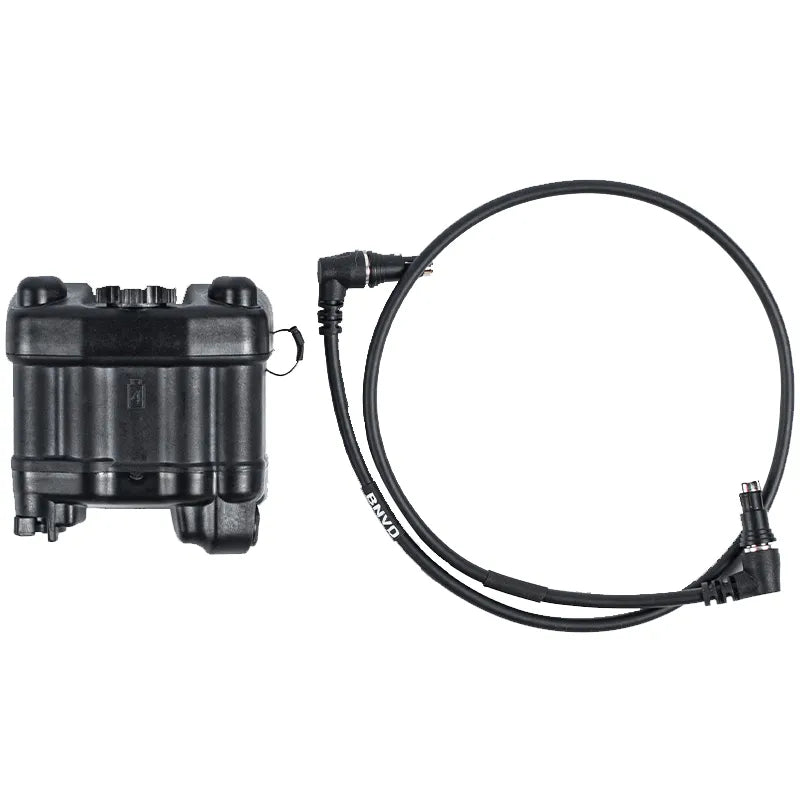
The ARGUS Universal Strobe Battery Pack provides external power to compatible devices through the appropriate cable and can function as rear helmet counterbalance.
Its integrated IR strobe capability may also support compatible nighttime identification or SAR coordination procedures.
Exact cable and connector compatibility must be confirmed for the selected NVG.
For helmet setup guidance, read Managing NVG Weight: Why You Need a Strobe Battery Pack for Helmet Balance.
Salt Spray and Lens Protection
Saltwater environments are demanding on optical equipment.
Salt residue can:
-
Reduce lens clarity
-
Scatter light
-
Increase glare
-
Damage coatings if cleaned incorrectly
-
Collect abrasive particles
-
Affect moving components and connectors
A lens-protection plan should include:
-
Sacrificial lenses during exposed use
-
Rubber caps during storage and transport
-
Lens-safe cleaning materials
-
Fresh-water cleaning procedures appropriate to the device
-
Regular seal and connector inspection
-
Dry storage after use
The Universal Lens Protection Cover for PVS-31 and PVS-14 Optics supports multiple common NVG platforms.
For a complete comparison, read Why You Shouldn’t Skip Lens Protectors: Sacrificial Lenses vs PVS-31/PVS-14 Rubber Caps.
Do not wipe dried salt directly across an optical surface.
Loose contamination should be removed carefully before the surface is wiped.
Moisture, Sealing and Nitrogen Purging
A waterproof-looking housing is not automatically protected against internal fogging.
Changes in temperature and humidity may cause internal moisture to condense on optical surfaces if the device is not sealed and serviced correctly.
A professionally maintained NVG may require:
-
O-ring inspection
-
Seal replacement
-
Leak testing
-
Dry-gas purging
-
Controlled reassembly
Nitrogen purging helps replace moisture-containing internal air with dry gas.
It is not a substitute for proper sealing, and it does not make a damaged housing waterproof.
For more information, read The Importance of NVG Nitrogen Purging: Why You Need a Purge Valve Fitting.
NVGs Do Not Replace Maritime Navigation Systems
NVGs are visual aids.
They should not replace:
-
Radar
-
AIS
-
Electronic charts
-
Compass and navigation instruments
-
Navigation lights
-
Trained lookouts
-
Thermal or electro-optical sensors
-
Established watchkeeping procedures
A reflected light can be misinterpreted.
An object may be hidden by waves.
A dark vessel may remain difficult to see.
Fog, heavy rain and spray may reduce the image severely.
Using several complementary sensors reduces dependence on one imperfect image.
This is especially important in collision avoidance, search and rescue and operations close to shore.
Practical Maritime NVG Setup
A balanced coastal-patrol configuration may include:
-
Autogated monocular or binocular NVG
-
Tubes with suitable SNR and halo performance
-
Stable dovetail helmet mount
-
Retention lanyard
-
External battery pack or counterweight
-
Spare protected batteries
-
Sacrificial lenses
-
Rubber storage caps
-
Lens-safe cleaning materials
-
Handheld thermal monocular
-
COTI where appropriate
-
Compatible IR illumination
-
Radar, AIS and standard navigation equipment
The final equipment selection should depend on:
-
Vessel size
-
Patrol duration
-
Shoreline lighting
-
Sea state
-
Weather
-
Crew training
-
Regulatory requirements
-
Whether the system is handheld, helmet-mounted or used from a fixed observation point
Maritime NVG Operating Checklist
Before departure:
-
Inspect lenses for salt, moisture and scratches.
-
Confirm tube operation and image stability.
-
Test the mount and secondary retention.
-
Check battery condition and spare power.
-
Confirm thermal-device operation where applicable.
-
Reduce unnecessary onboard glare and reflections.
-
Verify that displays can be dimmed appropriately.
-
Review expected weather, moonlight and coastal lighting.
-
Confirm that all users understand NVG limitations.
-
Ensure radar, AIS and other navigation systems remain operational.
During use:
-
Scan actively instead of staring at one point.
-
Recheck dark areas beside bright lights.
-
Adjust gain when reflected light becomes distracting.
-
Change viewing angle if a reflection hides the target.
-
Compare the NVG image with radar, thermal and unaided observation.
-
Clean water droplets only when it is safe to do so.
-
Stop relying on the NVG image if weather removes usable visual cues.
After use:
-
Install protective caps.
-
Remove salt and moisture using an appropriate procedure.
-
Dry the device and accessories.
-
Inspect connectors and seals.
-
Record any fogging, flicker or image abnormality.
-
Store the device in a clean, dry protective case.
Common Mistakes in Maritime Night Vision Use
Assuming Autogating Removes All Glare
Autogating improves light management but cannot eliminate reflections or halo.
Increasing Gain Too Much
Excessive gain can make water reflections, image noise and backscatter more distracting.
Using Strong Illumination in Spray or Fog
The light may reflect back and create a bright veil.
Focusing Only on Bright Navigation Lights
A dark vessel or person may be located close to the bright source.
Ignoring Lens Contamination
Salt and water spots can reduce contrast and increase flare.
Relying on NVGs Instead of Radar or AIS
NVGs provide visual information, not complete collision avoidance.
Using Loose Helmet Equipment
Boat movement can magnify mount instability.
Skipping Training
Restricted field of view, altered depth perception and reflected lights require experience to interpret correctly.
Final Thoughts
Maritime night vision is difficult because open water can provide too little visual structure while reflected lights create too much localized brightness.
The best coastal NVG system must therefore manage both darkness and glare.
Important features include:
-
Autogated image intensifier tubes
-
Suitable halo performance
-
Manual gain where required
-
High-quality, clean optics
-
Stable helmet mounting
-
Reliable power
-
Moisture and salt protection
-
Thermal support
-
Professional training
Night vision can help patrol teams observe shorelines, vessels, floating objects and activity that would be difficult to see unaided.
However, it does not turn night into daylight.
Reflections may be misleading. Fog and rain may remove visual cues. Open water may remain visually flat. Small targets may disappear among waves and coastal lighting.
The strongest approach is sensor integration.
Use NVGs for environmental detail and natural movement. Use thermal imaging for heat detection. Use radar, AIS and standard navigation equipment for broader maritime awareness.
When these tools are combined with proper lighting discipline, lens care and trained scanning techniques, night vision becomes far more effective for maritime and coastal patrols.